Cantitate/Preț
Produs

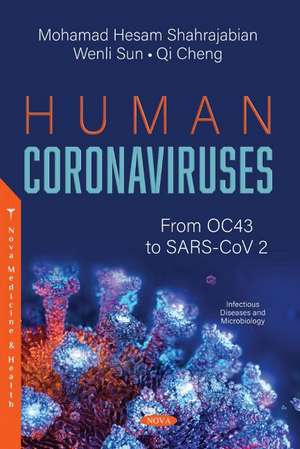
Human Coronaviruses: From OC43 to SARS-CoV 2

Autor Mohamad Hesam
en Limba Engleză Paperback – 28 iul 2020
The coronaviruses are ssRNA viruses that infect a wide range of mammalian and avian species; they are important causes of respiratory and enteric disease, encephalomyelitis, hepatitis, serositis and vasculitis domestic animals. In humans coronaviruses are one of several groups of viruses that cause the common cold. The genus Coronavirus together with the genus Torovirus from the family Coronaviridae; members of these two genera are similar morphologically. The Coronaviridae, Arteriviridae, and Roniviridae are within the order Nidovirales. Seven coronaviruses are known to infect humans, three of them are serious, namely, SARS (severe acute respiratory syndrome, China, 2002), MERS (Middle East respiratory syndrome, Saudi Arabia, 2012), and SARS-CoV-2 (2019-2020). SARS is caused by a coronavirus (SARS-CoV) which exists in bats and palm civets in Southern China. Its family is Coronaviridae, and its genus is Coronavirus. The most important groups who are at risk are family members in close contact with cases, health-care workers in close contact with cases, elderly and immune compromised individuals appear at increased risk. MERS-CoV is a zoonotic virus which can lead to secondary human infections. It is the sixth coronavirus that influences human. MERS-CoV is most likely derived from an ancestral reservoir bats. MERS outbreak was found in the Republic of Korea since 2015. Coronavirus entry is initiated by the binding of the spike protein (S) to cell receptors, specifically, dipeptidyl peptidase 4 (DDP4) and angiotensin converting enzyme 2 (ACE2) for MERS-CoV and SARS-CoV, respectively. The genome sequence analysis has shown that SARS-CoV-2 belongs to betacoronavirus genus, which includes Bat SARS-like coronavirus, SARS-CoV and MERS-CoV. On the basis of nucleic acid sequence similarity, the newly identified 2019-nCoV is a betacoronavirus. The RBD portion of the SARS-CoV-2 pike proteins has evolved to effectively target a molecular feature on the outside of human cells called ACE2, a receptor involved in regulating blood pressure. The SARS-CoV-2 spike protein was found so effective at binding the human cells. In SARS-CoV-2, M protein is responsible for the transmembrane transport of nutrient, the bud release and the formation of envelope, S protein, attaching to hose receptor ACE2, including two subunits S1 and S2. These diseases can be considered important models for emerging infectious diseases as it emerged from natural animal reservoirs. Early recognition, prompt isolation and appropriate supportive therapy are the main parameters in combating with these deadly infections.
Citește tot Restrânge

Preț: 57470 lei

Preț vechi: 70211 lei
-18%

Puncte Express: 862

Preț estimativ în valută:
10163 11927$ 8815£

Carte disponibilă

Livrare economică 16 februarie-02 martie


Specificații

ISBN-13: 9781536182590
ISBN-10: 1536182591
Pagini: 161
Greutate: 0.25 kg
Editura: Nova Science Publishers Inc
Colecția Nova Science Publishers Inc
Locul publicării:United States

Cuprins

Preface; Coronaviruses; Human Coronavirus OC43 (HCoV-OC43); Human Coronavirus HKU1 (HCoV-HKU1); Human Coronavirus 229E (HCoV-229E); Human Coronavirus NL63 (HCoV-NL63) (New Haven Coronavirus); From SARS to COVID-19 (SARS, MERS and SARS-CoV-2); Severe Acute Respiratory Syndrome (SARS); The Middle East Respiratory Syndrome Coronavirus (MERS-CoV); COVID-19 Coronavirus; References.