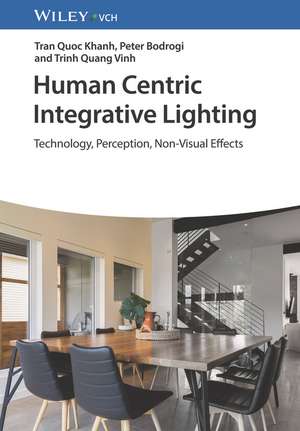
Human Centric Integrative Lighting – Technology, Perception, Non–Visual Effects
Autor TQ Khanhen Limba Engleză Hardback – 29 aug 2023
Considerăm că Human Centric Integrative Lighting – Technology, Perception, Non–Visual Effects reprezintă o sinteză necesară între ingineria optică, fiziologie și psihologie, abordând iluminatul nu doar ca utilitate, ci ca factor determinant al stării de bine. Interdisciplinaritatea este nucleul acestei lucrări, unde fizica fotonicii se întâlnește cu cronobiologia pentru a explica modul în care lumina artificială reglează ritmul circadian și performanța cognitivă în mediile construite.
Lucrarea se distinge prin rigoarea cu care TQ Khanh și echipa sa traduc datele brute din jurnale medicale și specificații de brevete în modele matematice și recomandări tehnice concrete. Apreciem în mod deosebit structura logică a celor aproape 500 de pagini, care pornește de la fundamentele percepției vizuale și avansează spre calitatea culorii și impactul emoțional al luminii. Spre deosebire de manualele clasice de fizică, volumul de față prioritizează „iluminatul integrativ”, oferind soluții pentru dezvoltatorii care doresc să implementeze tehnologii ce respectă biologia umană.
Acoperă aceeași arie tematică precum Interior Lighting de Wout van Bommel, dar cu o abordare mult mai orientată spre modelarea practică și implementarea industrială a conceptelor de Human Centric Lighting (HCL). În timp ce alte titluri similare, precum Visual and Non-Visual Effects of Light, se concentrează pe ergonomia locului de muncă, volumul publicat de Wiley Vch oferă un cadru tehnic mai vast, fiind esențial pentru înțelegerea noilor standarde de eficiență care transcend simplul consum energetic, vizând eficiența biologică a sistemelor de iluminat moderne.
Preț: 893.23 lei
Preț vechi: 1038.64 lei
-14%
Carte disponibilă
Livrare economică 26 octombrie-09 noiembrie
Livrare express 10-16 octombrie pentru 59.74 lei
Specificații
ISBN-10: 3527414002
Pagini: 496
Dimensiuni: 177 x 253 x 31 mm
Greutate: 1.07 kg
Ediția:1
Editura: Wiley Vch
Locul publicării:Weinheim, Germany
V-ar putea interesa
-
 -19%Preț: 484.07 lei597.61 lei
 -
 The History of the Soviet Atomic IndustryArkadii Kruglov-18%Preț: 1416.12 lei1726.97 lei
 -
 Optical DetectionOsche-9%Preț: 1204.88 lei1324.05 lei
 -
 It Doesn't Take a Rocket ScientistJohn MalonePreț: 139.87 lei
 -
 Principles of Nonlinear OpticsY R Shen-9%Preț: 827.62 lei909.47 lei
 -
 Fritz LondonKostas Gavroglu-11%Preț: 529.99 lei595.49 lei
 -
 Certain Philosophical QuestionsJe McguirePreț: 375.21 lei
 -
 Consistent Quantum TheoryRobert B. Griffiths-14%Preț: 728.40 lei846.99 lei
 -
 From Physics to MetaphysicsMichael RedheadPreț: 337.95 lei
 -
 Experiments In Physical OpticsM. Francon-18%Preț: 2781.14 lei3391.63 lei
 -
 -18%Preț: 1260.85 lei1537.62 lei
 -
 Destiny MatrixJack SarfattiPreț: 154.07 lei
 -
 Think of a NumberM. E. Lines-15%Preț: 457.38 lei538.09 lei
 -
 Theoretical Physics 2002, Part 1Thomas F. George-26%Preț: 894.11 lei1214.01 lei
 -
 Beleuchtung in Innenräumen - Human Centric Integrative LightingTran Quoc Khanh-8%Preț: 675.27 lei733.99 lei
De ce să citești această carte
Această carte este indispensabilă inginerilor de sistem, designerilor de iluminat și arhitecților care doresc să treacă de la iluminatul funcțional la cel centrat pe om. Cititorul câștigă acces la modele validate de percepție fiziologică și psihologică, transformând conceptele abstracte de „sănătate prin lumină” în parametri tehnici aplicabili în proiectarea spațiilor rezidențiale și de lucru moderne.
Despre autor
TQ Khanh este un cercetător de renume mondial și profesor universitar, recunoscut pentru contribuțiile sale fundamentale în tehnologia iluminatului și știința culorii. Expertiza sa acoperă întregul spectru al sistemelor LED, de la fizica semiconductorilor până la impactul luminii asupra percepției umane. A mai publicat lucrări de referință precum LED Lighting – Technology and Perception, consolidându-și poziția de autoritate în tranziția industriei către soluții inteligente și integrative. Activitatea sa academică este dublată de o colaborare strânsă cu industria, facilitând transferul tehnologic de la cercetare la produse comerciale care respectă standardele de sănătate și confort vizual.