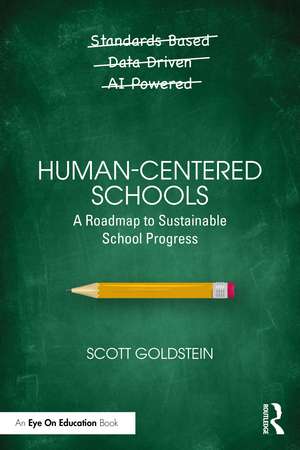
Human-Centered Schools: A Roadmap to Sustainable School Progress
Autor Scott Goldsteinen Limba Engleză Paperback – 16 sep 2026
Drawing on twenty years of classroom teaching and education policy work in Washington, DC and beyond, Scott Goldstein argues that sustainable school improvement has always depended on the quality of human relationships — between students and teachers, educators and leaders, schools and families, and between policymakers and the communities they serve. You’ll learn how to prioritize relationships, promote student and staff wellbeing, create a culture that is responsive to student interest and educator expertise, foster a growth-based approach to data and accountability, focus on productive feedback, and more. Finally, the book provides a playbook to bring these components into actionable strategies for those who work at the school, district, state and national levels.
Human-Centered Schools is a call to action for educators who know something is deeply wrong but need the language and evidence to name it, for school and district leaders ready to build something better, and for policymakers willing to look honestly at what actually helps children thrive.
Preț: 276.57 lei
Nou
Puncte Express: 415
Carte disponibilă
Livrare economică 23 octombrie-06 noiembrie
Livrare express 09-15 octombrie pentru 32.83 lei
Livrare prin curier în România Termenul estimat este afișat lângă disponibilitate.
Transport gratuit de la 400.00 lei Plată online sau ramburs, în funcție de opțiunile comenzii.
Retur gratuit în 14 zile Comandă securizată și suport în română.
Specificații
ISBN-13: 9781041376729
ISBN-10: 1041376723
Pagini: 284
Ilustrații: 4
Dimensiuni: 152 x 229 mm
Greutate: 0.53 kg
Ediția:1
Editura: Taylor & Francis
Colecția Routledge
Locul publicării:Oxford, United Kingdom
ISBN-10: 1041376723
Pagini: 284
Ilustrații: 4
Dimensiuni: 152 x 229 mm
Greutate: 0.53 kg
Ediția:1
Editura: Taylor & Francis
Colecția Routledge
Locul publicării:Oxford, United Kingdom
Public țintă
Professional Practice & DevelopmentNotă biografică
Scott Goldstein is an experienced educator, advocate, and education policy expert who taught social studies and ESL in Washington, DC for ten years (including public, public charter, and private schools) and has taught in international settings. Scott founded and directs a DC-based teacher leadership organization called EmpowerEd that focuses on improving teacher retention, especially among educators of color, and works to elevate diverse educator voices in policy making.
Cuprins
Introduction 1. The Pillars of a Human-Centered Education System 2. Data, Accountability, and the Undermining of Schools 3. Prioritizing People: Relationships and Wellbeing in Human-Centered Schools 4. Retaining Educators, Sustaining Improvement 5. Teaching and Learning in a Human-Centered School 6. Fostering Curiosity, Collaboration, and Culture in the Age of AI 7. What Schools Can’t Solve: A Collective Call to Action 8. Scheduling Solutions for Human-Centered Schools 9. Conclusion: Overcoming Obstacles and Building a Human-Centered Future for Education
Recenzii
"There are no silver bullets in the work of school improvement. But as Scott Goldstein reminds us in this timely book, there is a way forward. By building a system rooted in human dignity, we can transform how our schools operate and give young people the education they deserve."
—Jack Schneider, Distinguished Professor of Education at UMass Amhert, Author of A Wolf at the Schoolhouse Door
“Human-Centered Schools reminds us that great public schools are built on relationships, trust, respect for educators’ professional voice, and strong community schools that provide children and families the supports they need to thrive. Scott Goldstein offers a roadmap for moving beyond test-and-punish accountability toward public schools where educators are supported as professionals, communities are genuine partners, and every child has access to the rich, engaging education they deserve.”
—Randi Weingarten, President, AFT
"A timely and important new book! With artificial intelligence becoming more pervasive, this book offers a profoundly important reminder: humans need humans. This is especially true for children who need caring adults who can provide stimulating instruction and emotional support to grow and develop. Goldstein's advice and recommendations are grounded in solid research and common sense. Educators should read this book and follow the sage advice offered before adopting the latest technology and AI fads."
—Pedro A. Noguera, Distinguished Professor of Education, Emery Stoops and Joyce King Stoops Dean, University of Southern California
—Jack Schneider, Distinguished Professor of Education at UMass Amhert, Author of A Wolf at the Schoolhouse Door
“Human-Centered Schools reminds us that great public schools are built on relationships, trust, respect for educators’ professional voice, and strong community schools that provide children and families the supports they need to thrive. Scott Goldstein offers a roadmap for moving beyond test-and-punish accountability toward public schools where educators are supported as professionals, communities are genuine partners, and every child has access to the rich, engaging education they deserve.”
—Randi Weingarten, President, AFT
"A timely and important new book! With artificial intelligence becoming more pervasive, this book offers a profoundly important reminder: humans need humans. This is especially true for children who need caring adults who can provide stimulating instruction and emotional support to grow and develop. Goldstein's advice and recommendations are grounded in solid research and common sense. Educators should read this book and follow the sage advice offered before adopting the latest technology and AI fads."
—Pedro A. Noguera, Distinguished Professor of Education, Emery Stoops and Joyce King Stoops Dean, University of Southern California
Descriere
Instead of doubling down on high stakes accountability, what would it look like if we created more human-centered schools that prioritize people, distributed leadership, relational trust, and sustainable practices?