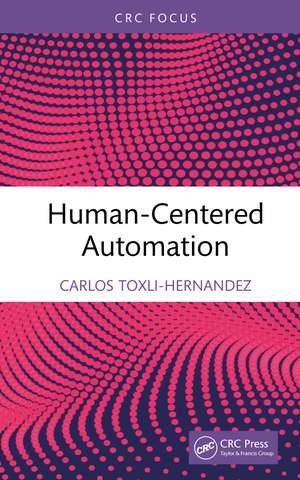
Human-Centered Automation
Autor Carlos Toxli-Hernandezen Limba Engleză Hardback – 7 mai 2026
This book unites insights from cognitive science, software engineering, business strategy, and human factors that view automation as something that works for people and not just systems. This book provides the tools and strategies to ensure efforts with automation succeed with people at the center. It takes readers through the entire HCA lifecycle; from process discovery and planning to system design, testing, and long-term oversight. With easy-to-understand frameworks and real-world examples across sectors, including healthcare, finance, and manufacturing, readers will gain tools to assess risk, define measurable outcomes, involve stakeholders, and build automation that is trustworthy, explainable, and effective. It offers the methodologies needed to drive meaningful, lasting impact through automation.
Human-Centered Automation is essential for ergonomics and human factors professionals, researchers, and organizational leaders involved in designing or managing automation initiatives. Its appeal extends to professionals in AI and machine learning, UX design, process engineering, business operations, and policy development.
Preț: 531.41 lei
Preț vechi: 625.19 lei
-15%
Puncte Express: 797
Carte tipărită la comandă
Livrare economică 30 noiembrie-14 decembrie
Livrare prin curier în România Termenul estimat este afișat lângă disponibilitate.
Transport gratuit pentru acest produs Plată online sau ramburs, în funcție de opțiunile comenzii.
Retur gratuit în 14 zile Comandă securizată și suport în română.
Specificații
ISBN-13: 9781041120247
ISBN-10: 1041120249
Pagini: 238
Ilustrații: 20
Dimensiuni: 138 x 216 mm
Greutate: 0.43 kg
Ediția:1
Editura: CRC Press
Colecția CRC Press
ISBN-10: 1041120249
Pagini: 238
Ilustrații: 20
Dimensiuni: 138 x 216 mm
Greutate: 0.43 kg
Ediția:1
Editura: CRC Press
Colecția CRC Press
Public țintă
Academic and Professional ReferenceCuprins
Part I Foundations and Conceptual Framework 1. Introduction. 2. The Definitional Challenge: Oxymoron or Common Sense?. 3. Historical Perspectives and Theoretical Foundations. 4. Levels and Dimensions of Automation. 5. The Authority-Crisis Matrix. Part II Design and Implementation 6. Cognitive Foundations: Attention, Awareness, and Mental Models. 7. Cognitive Risks in Automated Knowledge Work. 8. Trust: Calibration, Dynamics, and Recovery. 9. Information Design: Display, Advice, and Overload. 10. Error, Variability, and Human Resourcefulness. 11. Task Allocation: Beyond the Fitts List. 12. Process Planning and Requirements. 13. Human-Centered AI: Technical Foundations. 14. Interface Design for HCA. Part III Deployment and Evolution 15. Organizational Readiness and Change Management. 16. Human-Autonomy Teaming. 17. Implementation, Testing, and Monitoring. 18. Case Studies Across Domains. 19. The Future of Human-Centered Automation.
Notă biografică
Carlos Toxli-Hernandez is an accomplished academic and industry professional, currently serving as an assistant professor in the College of Engineering, Computing, and Applied Sciences at Clemson University, USA. He earned his Ph.D. in Computer Science from Northeastern University in Boston, MA, and leads the Human-AI Empowerment Lab, where his research focuses on leveraging Human-Centered Artificial Intelligence to design tools that empower individuals to achieve their goals. His work has garnered recognition at prestigious conferences and has been featured in international media. Throughout his career, Dr. Hernandez has conducted impactful research at leading organizations, including Amazon Twitch, Microsoft Research, and Snap Inc. Before joining Clemson University, he contributed to global initiatives at organizations such as Google and the United Nations, while also founding four automation companies. In addition to his academic and entrepreneurial achievements, Dr. Hernandez is a prolific technical author and tech evangelist, having delivered over 100 talks across the globe.
Descriere
Human-Centered Automation is essential for ergonomics and human factors professionals, researchers, and organizational leaders involved in designing or managing automation initiatives. Its appeal extends to professionals in AI and machine learning, UX design, process engineering, business operations, and policy development.