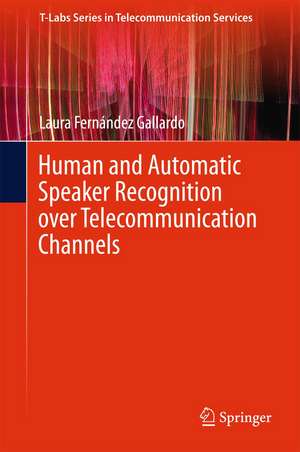
Human and Automatic Speaker Recognition over Telecommunication Channels: T-Labs Series in Telecommunication Services
Autor Laura Fernández Gallardoen Limba Engleză Hardback – 26 aug 2015
Din seria T-Labs Series in Telecommunication Services
- 15%
 Preț: 618.91 lei
 - 15%
 Preț: 617.28 lei
 - 15%
 Preț: 619.92 lei
 - 15%
 Preț: 608.28 lei
 - 24%
 Preț: 685.47 lei
 - 15%
 Preț: 620.13 lei
 - 15%
 Preț: 622.78 lei
 - 15%
 Preț: 619.51 lei
 - 20%
 Preț: 626.95 lei
 - 15%
 Preț: 622.78 lei
 - 15%
 Preț: 616.07 lei
 - 20%
 Preț: 675.39 lei
 - 18%
 Preț: 960.64 lei
 - 15%
 Preț: 612.38 lei
 - 15%
 Preț: 615.44 lei
 - 15%
 Preț: 615.02 lei
 - 18%
 Preț: 695.00 lei
 - 15%
 Preț: 614.60 lei
 - 15%
 Preț: 617.07 lei
 - 15%
 Preț: 620.73 lei
 - 15%
 Preț: 632.77 lei
 - 15%
 Preț: 609.53 lei
 - 15%
 Preț: 620.13 lei
 - 15%
 Preț: 618.09 lei
 -
 Preț: 371.93 lei
 - 15%
 Preț: 620.36 lei
 - 20%
 Preț: 620.38 lei
 - 32%
 Preț: 544.49 lei
 -
 Preț: 366.24 lei
 - 15%
 Preț: 616.27 lei
 - 20%
 Preț: 626.89 lei
 - 18%
 Preț: 906.94 lei
Preț: 619.14 lei
Preț vechi: 728.39 lei
-15%
Puncte Express: 929
Carte tipărită la comandă
Livrare economică 08-22 iunie
Specificații
ISBN-13: 9789812877260
ISBN-10: 9812877266
Pagini: 184
Ilustrații: XII, 169 p.
Dimensiuni: 160 x 241 x 16 mm
Greutate: 0.45 kg
Ediția:1st edition 2016
Editura: Springer
Colecția T-Labs Series in Telecommunication Services
Seria T-Labs Series in Telecommunication Services
Locul publicării:Singapore, Singapore
ISBN-10: 9812877266
Pagini: 184
Ilustrații: XII, 169 p.
Dimensiuni: 160 x 241 x 16 mm
Greutate: 0.45 kg
Ediția:1st edition 2016
Editura: Springer
Colecția T-Labs Series in Telecommunication Services
Seria T-Labs Series in Telecommunication Services
Locul publicării:Singapore, Singapore
V-ar putea interesa
-
 Passive Imaging with Ambient NoiseJosselin Garnier-20%Preț: 852.29 lei1065.37 lei
 -
 Modern MeasurementsAlessandro Ferrero-9%Preț: 841.31 lei924.52 lei
 -
 Combining Pattern ClassifiersLudmila I Kuncheva-9%Preț: 687.89 lei755.92 lei
 -
 An Introduction to 3D PrintingVictoria ZukasPreț: 225.45 lei
 -
 -20%Preț: 1238.08 lei1547.61 lei
 -
 Blind Image DeconvolutionSubhasis Chaudhuri-20%Preț: 321.22 lei401.53 lei
 -
 -15%Preț: 635.62 lei747.78 lei
 -
 Dense Image Correspondences for Computer VisionTal Hassner-15%Preț: 625.42 lei735.79 lei
 -
 Image Processing and Communications Challenges 7Ryszard S. Choraś-20%Preț: 949.94 lei1187.42 lei
 -
 Advances in Face Detection and Facial Image AnalysisMichal KawulokPreț: 391.65 lei
 -
 Emotion, Affect and Personality in SpeechSwati JoharPreț: 362.18 lei
 -
 Signal and Image Processing for BiometricsJacob Scharcanski-15%Preț: 624.01 lei734.13 lei
 -
 -18%Preț: 919.07 lei1120.81 lei
 -
 Telephon- und Signal-AnlagenCarl BeckmannPreț: 405.64 lei
 -
 -20%Preț: 323.63 lei404.54 lei
 -
 Hyperspectral Image ProcessingLiguo Wang-15%Preț: 628.73 lei739.68 lei
 -
 -20%Preț: 624.97 lei781.22 lei
 -
 -20%Preț: 1243.97 lei1554.95 lei
Public țintă
ResearchCuprins
Introduction.- Literature Review.- Human Speaker Identification Performance under Channel Degradations.- Importance of Intelligible Phonemes for Human Speaker Recognition in Different Bandwidths.- Automatic Speaker Verification Performance Under Channel Distortions.- Detecting Speaker-Discriminative Spectral Content in Wideband for Automatic Speaker Recognition.- Relations Among Speech Quality, Human Speaker Identification, and Automatic Speaker Verification. Conclusions and Future Work.
Textul de pe ultima copertă
This work addresses the evaluation of the human and the automatic speaker recognition performances under different channel distortions caused by bandwidth limitation, codecs, and electro-acoustic user interfaces, among other impairments. Its main contribution is the demonstration of the benefits of communication channels of extended bandwidth, together with an insight into how speaker-specific characteristics of speech are preserved through different transmissions. It provides sufficient motivation for considering speaker recognition as a criterion for the migration from narrowband to enhanced bandwidths, such as wideband and super-wideband.