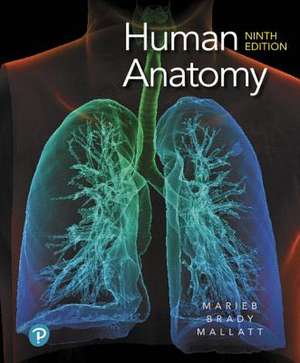
Human Anatomy
Autor Elaine Marieb, Patricia Wilhelm, Jon Mallatten Limba Engleză Hardback – 4 ian 2019
Destinat în principal studenților la medicină și biologie aflați la început de drum, cercetătorilor care au nevoie de o sinteză actualizată și practicienilor din domeniul sănătății, manualul Human Anatomy de Elaine Marieb, Patricia Wilhelm și Jon Mallatt transformă studiul riguros într-o narațiune vizuală coerentă. Ne-a atras atenția modul în care autorii reușesc să echilibreze volumul mare de date tehnice cu o abordare funcțională, explicând nu doar 'ce' este o structură, ci mai ales 'cum' și 'de ce' forma sa îi permite să funcționeze în cadrul organismului.
Observăm că structura cursului este una progresivă și logică. Volumul debutează cu unitățile fundamentale — celulele și țesuturile — și parcurge sistemul integumentar, osos și muscular, culminând cu sistemele de integrare (nervos și endocrin) și cele de întreținere (cardiovascular, respirator, digestiv). Această ediție a 9-a aduce îmbunătățiri semnificative prin includerea unor exerciții de interpretare a imaginilor medicale, pregătind studenții pentru contextul clinic real. Ca alternativă la [Human Anatomy & Physiology [Global Edition]](book) pentru cursurile de anatomie generală, acest titlu are avantajul unei concentrări specifice pe componenta anatomică într-un singur semestru, fără a dilua rigoarea prin extinderea excesivă către fiziologie.
Comparativ cu Fundamentals of Anatomy and Physiology, Global Edition, care este adesea utilizat pentru cursuri de două semestre, Human Anatomy rămâne mai ușor de gestionat pentru modulele intensive. Utilizarea analogiilor transformă terminologia complexă în concepte memorabile, iar tabelele ilustrate, revizuite pentru această ediție, oferă o perspectivă de ansamblu asupra fiecărui sistem, facilitând înțelegerea modului în care întregul corp lucrează ca o unitate biologică.
Preț: 1730.57 lei
Preț vechi: 2247.48 lei
-23%
Carte disponibilă
Livrare economică 13-27 noiembrie
Specificații
ISBN-10: 0135168058
Pagini: 896
Dimensiuni: 231 x 279 x 38 mm
Greutate: 2.13 kg
Ediția:9th edition
Editura: Pearson Education
V-ar putea interesa
-
 Study Guide for Human Anatomy & PhysiologyElaine N. Marieb-5%Preț: 747.53 lei786.87 lei
 -
 -5%Preț: 1330.79 lei1400.83 lei
 -
 -5%Preț: 1376.94 lei1449.42 lei
De ce să citești această carte
Recomandăm această carte studenților care caută o resursă vizuală de top pentru cursul de anatomie. Câștigați claritate în înțelegerea structurilor complexe prin analogii inteligente și vă dezvoltați abilitățile practice de interpretare a imaginilor medicale. Este un instrument esențial pentru a trece de la memorarea brută la înțelegerea funcțională a corpului uman, totul într-un format grafic de excepție oferit de Pearson Education.
Despre autor
Elaine Marieb a fost o figură centrală în educația anatomică, fiind cunoscută pentru capacitatea sa de a prezenta subiecte complexe într-un limbaj accesibil studenților. Cu o vastă experiență academică și clinică, ea a coautorat unele dintre cele mai vândute manuale de profil din lume. Alături de ea, Patricia Wilhelm și Jon Mallatt aduc expertiză în anatomie comparată și biologie evoluționistă, contribuind la rigoarea științifică și la actualizarea constantă a materialelor vizuale. Împreună, echipa de autori a definit standardul modern pentru manualele de anatomie utilizate în universitățile de elită.
Cuprins
- The Human Body: An Orientation
- Cells: The Living Units
- Basic Embryology
- Tissues
- The Integumentary System
- Bones and Skeletal Tissues
- Bones, Part 1: The Axial Skeleton
- Bones, Part 2: The Appendicular Skeleton
- Joints
- Skeletal Muscle Tissue
- Muscles of the Body
- Fundamentals of the Nervous System and Nervous Tissue
- The Central Nervous System
- The Peripheral Nervous System
- The Autonomic Nervous System and Visceral Sensory Neurons
- The Special Senses
- The Endocrine System
- Blood
- The Heart
- Blood Vessels
- The Lymphatic and Immune Systems
- The Respiratory System
- The Digestive System
- The Urinary System
- The Reproductive System
- The Metric System
- Answers to Check Your Understanding, Multiple Choice, and Matching Questions
Notă biografică
Dr.Marieb passed away in 2018 after a lifetime of supporting numerous institutions and programs. Perhaps her favorite cause was helping students, especially nontraditional students, pursue their goals in science. She gave generously to provide opportunities for them to further their education by, to name just one example, funding the E. N. Marieb Science Research Awards at Mount Holyoke College. She also believed strongly in research: she underwrote the renovation of the biology labs in Clapp Laboratory at Mount Holyoke College and provided funding for reconstruction and instrumentation of a cutting-edge cytology research laboratory at the University of Massachusetts at Amherst.
Her legacy of contributing to science education lives on through the Elaine Nicpon Marieb Foundation, which provides support to multiple causes and organizations. In 2021, the Foundation provided a generous donation to University of Massachusetts, Amherst, which is now home to the Elaine Marieb College of Nursing. Dr. Marieb has also provided philanthropic support to Florida Gulf Coast University, which is home to the Elaine Nicpon Marieb College of Health and Human Services.
Patricia M. Brady's interest in human anatomical form was sparked in college when she learned that the human skeleton could reveal an individual's age, sex, nutritional status, and even how many children a female had given birth to. She pursued this interest, earning a PhD from Brown University in biological and medical sciences. Dr. Brady has an extensive career as an undergraduate anatomy educator at Brown University, Rhode Island College, Community College of RI, and Johnson & Wales University. At the graduate level, Dr. Brady coordinates and teaches a clinically focused cadaver-based dissection course for the Johnson & Wales University Center for Physician Assistant Studies.
Dr. Brady's commitment to teaching has been recognized throughout her career. In 1991 she received the Presidential Award for Excellence in Graduate Teaching from Brown University and in 2011 the Teaching Excellence Award from the Community College of Rhode Island. Dr. Brady embraces innovation in the classroom and laboratory, incorporating Project Based Learning, POGIL activities, cooperative team-based dissection and other active learning strategies into her courses. The driving factor behind these innovations is the desire to aid student learning by making course materials accessible and to make the study of anatomy an active and interactive process. Dr. Brady has shared her tools, techniques, experience, and enthusiasm for student success through professional presentations at national and regional meetings, including those of the Human Anatomy and Physiology Society (HAPS), the New England Biology Association of Two Year Colleges (NEBATYC), and Strategies to Success Conferences.
In addition to teaching, Dr. Brady contributes to the development and use of multimedia course tools for human anatomy instruction, is a contributing author and reviewer for a number of anatomy and physiology publications, and is a reviewer for Anatomical Sciences Education. She is a member of Sigma Xi, the Human Anatomy and Physiology Society, the American Association of Anatomists (AAA), National Association of Biology Teachers (NABT), and the PULSE Community (Partnership for Undergraduate Life Science Education).
Most mornings Dr. Brady can be found on the water rowing in an eight-oared shell or a single scull, pursuing another passion she developed in college.
Jon Mallatt earned his Ph.D. in Anatomy from the University of Chicago. Dr. Mallatt is currently a Clinical Faculty of the University of Washington's WWAMI Medical Education Program at the University of Idaho. Previously Dr. Mallatt served as Associate Professor of Biological Sciences at Washington State University, where he taught human anatomy to undergraduates of all backgrounds for 37 years. WWAMI honored him with their "Excellence in Teaching Award" in 1992, 1993, 1995, and 2000, and 2017. Additionally Dr. Mallatt is an adjunct Associate Professor in the department of Biological Structure at the University of Washington. His particular areas of expertise are histology, human and comparative anatomy, and anatomical drawing, although his research now focuses on the origin and evolution of consciousness among animals. Dr. Mallatt is an accomplished researcher with 58 publications in a variety of fields ranging from vertebrate evolution to molecular phylogeny to neurobiology and consciousness studies.