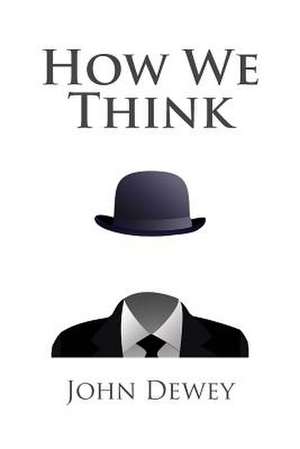
How We Think
Autor John Deweyen Limba Engleză Paperback
Preț: 67.00 lei
Puncte Express: 101
Carte indisponibilă temporar
Doresc să fiu notificat când acest titlu va fi disponibil:
Se trimite...
Specificații
ISBN-13: 9781495911873
ISBN-10: 149591187X
Pagini: 168
Dimensiuni: 152 x 229 x 9 mm
Greutate: 0.23 kg
Editura: CREATESPACE
ISBN-10: 149591187X
Pagini: 168
Dimensiuni: 152 x 229 x 9 mm
Greutate: 0.23 kg
Editura: CREATESPACE
V-ar putea interesa
-
 The Official CIA Manual of Trickery and DeceptionRobert WallacePreț: 109.75 lei
 -
 Native RealmCzeslaw Milosz-18%Preț: 65.52 lei79.43 lei
 -
 Oxford Guide to Effective Argument and Critical ThinkingColin Swatridge-19%Preț: 92.93 lei114.43 lei
 -
 Critical ThinkingJonathan Haber-16%Preț: 97.15 lei115.70 lei
 -
 The Book of General IgnoranceJohn MitchinsonPreț: 148.01 lei
 -
 Creative EvolutionHenri BergsonPreț: 108.62 lei
 -
 Preț: 134.50 leiNou
 -
 Administrative Behavior, 4th EditionHerbert A. Simon-18%Preț: 89.65 lei109.04 lei
 -
 -27%Preț: 78.80 lei107.43 lei
 -
 Human Nature and ConductJohn DeweyPreț: 64.81 lei
 -
 Cambridge International AS & A Level Thinking SkillsAngus Grogono-17%Preț: 355.10 lei428.34 lei
 -
 The Baron in the TreesItalo Calvino-18%Preț: 59.45 lei72.48 lei
 -
 Preț: 117.15 lei
 -
 Critical Thinking TestsHow2becomePreț: 106.93 lei
 -
 Critical ThinkingRichard L EpsteinPreț: 398.45 lei
Descriere
Descriere de la o altă ediție sau format:
John Dewey's How We Think advises us to step back from the noisy clutter of the information age. The acquisition of information, no matter how voluminous, by itself, is neither knowledge nor critical thinking. In How We Think, Dewey provides a clear but profound philosophical analysis of how we transform ideas into instruments to solve our personal, social, and political problems.
Notă biografică
"We are apt to look at the school from an individualistic standpoint, as something between teacher and pupil, or between teacher and parent. That which interests us most is naturally the progress made by the individual child of our acquaintance, his normal physical development, his advance in ability to read, write, and figure, his growth in the knowledge of geography and history, improvement in manners, habits of promptness, order, and industry-it is from such standards as these that we judge the work of the school." John Dewey (1859-1952) was a philosopher, educational reformer, and a psychologist. The School and Society was Dewey's first published book of length on education, and it paved the foundation for his later works on this same topic. Dewey's works are a valuable source of information and anyone interested in learning more about education and child development.