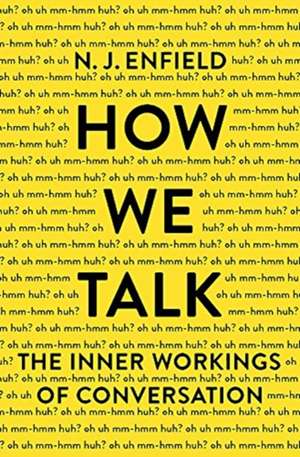
How We Talk: The Inner Workings of Conversation
Autor N. J. Enfielden Limba Engleză Paperback – 13 noi 2017
An
expert
guide
to
how
conversation
works,
from
how
we
know
when
to
speak
to
whyhuhis
a
universal
word
We
all
had
teachers
who
scolded
us
over
the
use
ofum,uh-huh,oh,like,
andmm-hmm.
But
as
linguist
N.
J.
Enfield
reveals
inHow
We
Talk,
these
"bad
words"
are
fundamental
to
language.
Whether
we
are
speaking
with
the
clerk
at
the
store,
our
boss,
or
our
spouse,
language
is
dependent
on
things
as
commonplace
as
a
rising
tone
of
voice,
an
apparently
meaningless
word,
or
a
glance--signals
so
small
that
we
hardly
pay
them
any
conscious
attention.
Nevertheless,
they
are
the
essence
of
how
we
speak.
From
the
traffic
signals
of
speech
to
the
importance
of
um,How
We
Talkrevolutionizes
our
understanding
of
conversation.
In
the
process,
Enfield
reveals
what
makes
language
universally--and
uniquely--human.
Preț: 108.10 lei
Puncte Express: 162
Carte indisponibilă temporar
Doresc să fiu notificat când acest titlu va fi disponibil:
Se trimite...
Specificații
Notă biografică
N.
J.
Enfieldis
a
professor
and
the
chair
of
linguistics
at
the
University
of
Sydney,
and
a
research
associate
in
the
Language
and
Cognition
Group
at
the
Max
Planck
Institute.
He
lives
in
Sydney,
Australia.
Recenzii
"[Enfield's]
sparkling
book,How
We
Talk,
sets
out
to
show
that
the
power
of
the
'conversation
machine'
is
as
astonishing
as
any
of
our
grammatical
achievements,
and
that
how
we
direct
our
fast-paced
exchanges
challenges
how
we
think
about
human
nature."—New
Scientist
"Has anyone--a parent, teacher, or boss--told you to purge the words 'um' and 'uh' from your conversation?...InHow We Talk...Nick Enfield rescues those words (and everyone who uses them) from censure...expos[ing] the fascinating and intricate workings of what he calls the human conversation machine."—NPR/13.7: Cosmos & Culture
"Enfield opens a window on linguistic dimensions far beyond grammar."—Nature
"In Enfield's analysis, human conversation across cultures is defined by a social unease that begins to develop after a break of 600 milliseconds or so. One of the primary purposes of ums and ahhs is a kindness to those around us, a fulfilling of a neighborly duty that keeps others from growing worried or disengaged from the social encounter... Persuasive."—Washington Free Beacon
"What really stays with the reader is the sense of deep compassion with which Enfield approaches and discusses the inner workings of conversations and the underlying reasons for the evolution of language...It is this empathy that leads Enfield to envision the simple norms of conversations (like the expectation of a response) as following a 'moral architecture' that guides our behavior."—Down to Earth
"Only when people understand the structure of conversations can they understand the grammar of language...Highly recommended."—Choice
"Enfield's
overall
understanding
of
conversation
is
unexpectedly
moving."
—New
York
Times
Book
Review"Has anyone--a parent, teacher, or boss--told you to purge the words 'um' and 'uh' from your conversation?...InHow We Talk...Nick Enfield rescues those words (and everyone who uses them) from censure...expos[ing] the fascinating and intricate workings of what he calls the human conversation machine."—NPR/13.7: Cosmos & Culture
"Enfield opens a window on linguistic dimensions far beyond grammar."—Nature
"Conversation,
it
turns
out,
is
a
finely
tuned
machine,
as
Nick
Enfield...suggests
inHow
We
Talk...From
a
certain
point
of
view,
what
is
fascinating
about
human
conversation
is
not
how
hard
it
is,
but
how
we
subconsciously
co-operate
to
make
it
seem
easy."
—Economist"In Enfield's analysis, human conversation across cultures is defined by a social unease that begins to develop after a break of 600 milliseconds or so. One of the primary purposes of ums and ahhs is a kindness to those around us, a fulfilling of a neighborly duty that keeps others from growing worried or disengaged from the social encounter... Persuasive."—Washington Free Beacon
"Enfield
calls
for
more
focus
on
conversation
as
a
key
to
understanding
'what
makes
language
possible
in
our
species,'
and
he
does
it
in
clear
prose,
and
with
the
use
of
30-odd
graphs
and
charts."
—Winnipeg
Free
Press"What really stays with the reader is the sense of deep compassion with which Enfield approaches and discusses the inner workings of conversations and the underlying reasons for the evolution of language...It is this empathy that leads Enfield to envision the simple norms of conversations (like the expectation of a response) as following a 'moral architecture' that guides our behavior."—Down to Earth
"An
insightful
look
into
the
unique
nature
of
human
conversation...Make[s]
a
strong
and
convincing
case
as
to
why
conversation
is
the
fundamental
and
essential
place
in
which
the
uniquely
human
aspects
of
language
are
to
be
found...Recommended."
—Library
Journal"Only when people understand the structure of conversations can they understand the grammar of language...Highly recommended."—Choice
"Enfield
makes
a
solid
case
for
more
focus---and
fieldwork---on
conversation
as
a
key
to
understanding
'what
makes
language
possible
in
our
species.'
He
does
all
this
in
clear
and
casually
authoritative
prose...This
survey
performs
the
neat
trick
of
offering
enormous
amounts
of
complex
material
in
a
format
that
remains
utterly
accessible."
—Publishers
Weekly"If
you
think
grammar
is
all
about
nouns,
verbs,
gender
and
the
subjunctive,
N.J.
Enfield's
new
book
will
transform
what
you
think
of
language
as
being
all
about.
At
heart
language
is
about
communicating
with
others
in
rapid-fire
conversation,
and
linguists
have
found
that
conversation
has
rules
just
as
sentence-making
does.
You
may
have
heard
that
'mama'
and
'papa'
are
universal
words---but
Enfield
will
teach
you
that
'huh?'
is
a
third
one.
If
you
want
to
feel
sophisticated
just
in
being
able
to
have
a
two
minute
conversation
on
the
phone,How
We
Talkis
the
book
for
you."
—John
McWhorter,
professor
of
linguistics,
Columbia
University,
and
author
ofThe
Language
Hoax,Words
on
the
Move,
andTalking
Back,
Talking
Black"N.
J.
Enfield
is
one
of
the
most
brilliant,
innovative,
and
insightful
researchers
to
ever
work
on
language
as
a
cultural
construct.How
We
Talkis
a
superbly
readable
summary
of
his
and
others'
work.
It
is
a
book
that
anyone
interested
in
our
species,
communication,
and
the
delight
of
learning
should
read.
I
loved
every
page
of
it."
—Daniel
L.
Everett,
author
ofDon't
Sleep,
There
Are
Snakes"N.
J.
Enfield's
new
book
explains
how
everyday
conversation---language
we
just
take
for
granted---is
all
at
once
both
ordinary
and
extraordinary,
and
how
that
paradox
defines
our
very
humanity.
Full
of
examples
that
feel
familiar,
it's
nonetheless
a
book
full
of
surprises,
written
in
a
straightforward,
friendly
style
distilled
from
long
experience
of
making
complicated
things
clear."
—Michael
Adams,provost
professor
of
English,
Indiana
University
at
Bloomington,
and
author
ofIn
Praise
of
ProfanityandSlang:
The
People's
Poetry"N.J.
Enfield'sHow
We
Talkis
a
delight.
The
book
is
not
about
the
grammar,
vocabulary,
or
usage
of
language,
but
rather
about
how
we
collaborate
with
each
other
in
everyday
conversation.
Enfield's
topics
range
from
taking
turns,
forestalling
delays,
and
assuring
mutual
understanding,
to
features
of
talk
that
are
universal
and
play
a
role
in
the
evolution
of
language.
Enfield
and
his
colleagues
have
investigated
everyday
talk
in
languages,
both
major
and
minor,
from
every
corner
of
the
world,
so
he
is
a
true
authority
on
these
issues.
Best
of
all,
he
makes
these
issues
come
alive
for
us
readers."
—Herbert
H.
Clark,Albert
Ray
Lang
Professor
of
Psychology
Emeritus,
Stanford
University