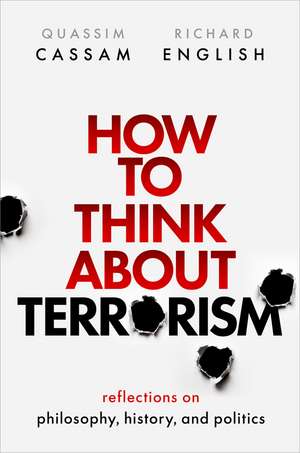
How to Think About Terrorism: Reflections on Philosophy, History, and Politics
Autor Quassim Cassam, Richard Englishen Limba Engleză Hardback – 8 oct 2026
Preț: 188.54 lei
Preț vechi: 221.00 lei
-15% Nou
Puncte Express: 283
Carte disponibilă
Livrare economică 30 octombrie-04 noiembrie
Livrare express 16-22 octombrie pentru 67.28 lei
Livrare prin curier în România Termenul estimat este afișat lângă disponibilitate.
Transport gratuit de la 400.00 lei Plată online sau ramburs, în funcție de opțiunile comenzii.
Retur gratuit în 14 zile Comandă securizată și suport în română.
Specificații
ISBN-13: 9780198911074
ISBN-10: 0198911076
Pagini: 272
Dimensiuni: 166 x 243 x 20 mm
Greutate: 0.57 kg
Editura: OUP OXFORD
Colecția OUP Oxford
Locul publicării:Oxford, United Kingdom
ISBN-10: 0198911076
Pagini: 272
Dimensiuni: 166 x 243 x 20 mm
Greutate: 0.57 kg
Editura: OUP OXFORD
Colecția OUP Oxford
Locul publicării:Oxford, United Kingdom
Recenzii
How to Think About Terrorism blows open the doors of perception. The rigorous philosophical approach taken by Cassam and English, rooted in real world examples not abstract thought experiments, shows what terrorism studies have been lacking. It is now clear that questions of justification, motive, ties to religion, and radicalisation are not inherently problematic - it is just that we didn't know how to think about them. This book supplies the tools.
This radically interdisciplinary work combines the best of two worlds: the conceptual clarity and argumentative rigor of analytic philosophy and the empirical richness and historical depth of political history. The result is an innovative book, which goes beyond the classical philosophical questions about terrorism that focus on issues of definition and morality. It provides the first full-blown philosophy of terrorism and adopts a highly context-sensitive approach to numerous real-life cases.
This fascinating and important book by two renowned scholars tackles the crucial questions of terrorism and counterterrorism in all their complexity. By fusing philosophical insight with rigorous political and historical analysis it presents a compelling innovative approach to a crowded field. This book should be an invaluable resource for both scholars of terrorism and practitioners of counterterrorism.
This radically interdisciplinary work combines the best of two worlds: the conceptual clarity and argumentative rigor of analytic philosophy and the empirical richness and historical depth of political history. The result is an innovative book, which goes beyond the classical philosophical questions about terrorism that focus on issues of definition and morality. It provides the first full-blown philosophy of terrorism and adopts a highly context-sensitive approach to numerous real-life cases.
This fascinating and important book by two renowned scholars tackles the crucial questions of terrorism and counterterrorism in all their complexity. By fusing philosophical insight with rigorous political and historical analysis it presents a compelling innovative approach to a crowded field. This book should be an invaluable resource for both scholars of terrorism and practitioners of counterterrorism.
Notă biografică
Quassim Cassam is Professor of Philosophy at the University of Warwick, an Honorary Fellow of Keble College, Oxford, and a Fellow of the British Academy. He was previously Knightbridge Professor of Philosophy at Cambridge, Professor of Philosophy at UCL, and Reader in Philosophy at Oxford University. He has been a Mind Senior Research Fellow, President of the Aristotelian Society, and President of the Mind Association. His books include Extremism: A Philosophical Analysis (Routledge 2021), Vices of the Mind: From the Intellectual to the Political (Oxford 2019), and Conspiracy Theories (Polity 2019). Richard English is Professor of Politics at Queen's University Belfast. His books include: Armed Struggle: The History of the IRA; Irish Freedom: The History of Nationalism in Ireland; Does Terrorism Work? A History; Does Counter-Terrorism Work? He has been elected to the British Academy, the Royal Irish Academy, the Royal Society of Edinburgh, the Academia Europaea, the Royal Historical Society, and an Honorary Fellowship at Keble College Oxford. In 2018 he was awarded a CBE for services to the understanding of modern-day terrorism and political history. In 2019 he received the Royal Irish Academy's Gold Medal in the Social Sciences.