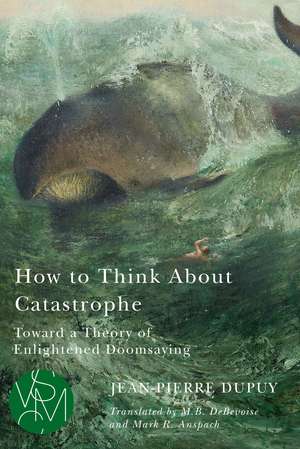
How to Think About Catastrophe: Toward a Theory of Enlightened Doomsaying: Studies in Violence, Mimesis & Culture
Autor Jean-Pierre Dupuyen Limba Engleză Paperback – noi 2022
Din seria Studies in Violence, Mimesis & Culture
-
 Preț: 128.45 lei
 -
 Preț: 171.02 lei
 -
 Preț: 267.12 lei
 -
 Preț: 523.64 lei
 -
 Preț: 191.93 lei
 -
 Preț: 195.09 lei
 -
 Preț: 140.69 lei
 -
 Preț: 466.17 lei
 -
 Preț: 355.95 lei
 -
 Preț: 273.53 lei
 -
 Preț: 102.74 lei
 -
 Preț: 134.72 lei
 -
 Preț: 163.88 lei
 -
 Preț: 160.32 lei
 -
 Preț: 128.75 lei
 -
 Preț: 191.56 lei
 -
 Preț: 131.72 lei
 -
 Preț: 129.33 lei
 -
 Preț: 129.91 lei
 -
 Preț: 158.50 lei
 -
 Preț: 195.69 lei
 -
 Preț: 162.15 lei
 -
 Preț: 162.71 lei
 -
 Preț: 131.72 lei
 -
 Preț: 196.95 lei
 -
 Preț: 131.72 lei
 -
 Preț: 160.89 lei
 -
 Preț: 246.41 lei
 -
 Preț: 244.30 lei
 -
 Preț: 299.15 lei
 -
 Preț: 468.59 lei
 -
 Preț: 292.97 lei
 -
 Preț: 392.25 lei
 -
 Preț: 391.35 lei
Preț: 340.08 lei
Puncte Express: 510
Carte disponibilă
Livrare economică 29 octombrie-12 noiembrie
Livrare express 14-20 octombrie pentru 26.46 lei
Livrare prin curier în România Termenul estimat este afișat lângă disponibilitate.
Transport gratuit de la 400.00 lei Plată online sau ramburs, în funcție de opțiunile comenzii.
Retur gratuit în 14 zile Comandă securizată și suport în română.
Specificații
ISBN-13: 9781611864366
ISBN-10: 1611864364
Pagini: 194
Dimensiuni: 152 x 229 x 3 mm
Greutate: 0.25 kg
Ediția:First Edition
Editura: Michigan State University Press
Colecția Michigan State University Press
Seria Studies in Violence, Mimesis & Culture
ISBN-10: 1611864364
Pagini: 194
Dimensiuni: 152 x 229 x 3 mm
Greutate: 0.25 kg
Ediția:First Edition
Editura: Michigan State University Press
Colecția Michigan State University Press
Seria Studies in Violence, Mimesis & Culture
Notă biografică
JEAN-PIERRE DUPUY is professor emeritus of social and political philosophy at the École Polytechnique in Paris and professor in the Program in Science, Technology, and Society at Stanford University.
Cuprins
Contents
Prologue. A Time of Catastrophes
Part One | Risk and Fatality
Chapter 1. A Singular Point of View
Chapter 2. Sacrifice, Counterproductivity, and Ethics, or the Logic of the Detour
Chapter 3. Fate, Risk, and Responsibility
Chapter 4. The Autonomy of Technology
Chapter 5. Doomsaying on Trial
Part Two | The Limits of Economic Rationality
Chapter 6. Precaution, Between Risk and Uncertainty
Chapter 7. The Veil of Ignorance and Moral Luck
Chapter 8. Knowing Is Not Believing
Part Three | The Limits of Moral Philosophy and the Necessity of Metaphysics
Chapter 9. Memory of the Future
Chapter 10. Predicting the Future in Order to Change It (Jonah vs. Jonas)
Chapter 11. Projected Time and Occurring Time
Chapter 12. The Rationality of Doomsaying
Notes
Index
Recenzii
“In this timely meditation on humanity’s frightful inclination to violence, Jean-Pierre Dupuy weaves together the philosophical implications of today’s nuclear and climate horror. In the face of a ‘murderous free-for-all,’ Dupuy sketches the way forward: utter clarity about the doom that awaits us, thereby forestalling its realization.”
—JERRY BROWN, governor of California (1975–1983, 2011–2019)
—JERRY BROWN, governor of California (1975–1983, 2011–2019)
Descriere
During the last century humanity acquired the ability to destroy itself. The direct approach to destruction can be seen in such facts as the ever-present threat of nuclear war, but we have also developed the capacity to do indirect harm by altering conditions necessary for survival, including the looming cloud of climate change. How can we look forward and work past the dire position we now find ourselves in to achieve a sustainable future? This book aims to build a general theory of catastrophes—a new form of apocalyptic thinking that is grounded in science and philosophy. An ethics for the sake of the future is what is required, which in turn necessitates a new metaphysics of temporality. If a way out of the imminent danger in which we find ourselves is to be found, we must first look to radically alter our ethics.