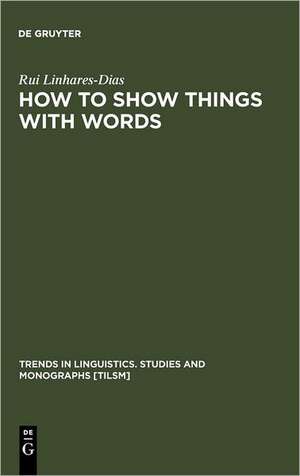
How to Show Things with Words
Autor Rui Linhares-Diasen Limba Engleză Hardback – 21 apr 2006
Preț: 1371.57 lei
Preț vechi: 1781.26 lei
-23%
Puncte Express: 2057
Carte tipărită la comandă
Livrare economică 21 noiembrie-05 decembrie
Livrare prin curier în România Termenul estimat este afișat lângă disponibilitate.
Transport gratuit pentru acest produs Plată online sau ramburs, în funcție de opțiunile comenzii.
Retur gratuit în 14 zile Comandă securizată și suport în română.
Specificații
ISBN-13: 9783110179958
ISBN-10: 3110179954
Pagini: 568
Ilustrații: 78 schw.-w. Abb.
Dimensiuni: 160 x 236 x 45 mm
Greutate: 1.04 kg
Ediția:Reprint 2011
Editura: De Gruyter Mouton
Locul publicării:Berlin/Boston
ISBN-10: 3110179954
Pagini: 568
Ilustrații: 78 schw.-w. Abb.
Dimensiuni: 160 x 236 x 45 mm
Greutate: 1.04 kg
Ediția:Reprint 2011
Editura: De Gruyter Mouton
Locul publicării:Berlin/Boston
V-ar putea interesa
-
 Metaphor: A Practical IntroductionZoltan Kövescses-13%Preț: 279.01 lei318.89 lei
 -
 -21%Preț: 421.88 lei534.37 lei
 -
 Rhetoric: A Very Short IntroductionRichard Toye-20%Preț: 56.62 lei70.82 lei
 -
 The Code BookSimon SinghPreț: 117.88 lei
 -
 Toward a History of American LinguisticsE.F.K. KoernerPreț: 470.52 lei
 -
 On DialogueDavid BohmPreț: 226.95 lei
 -
 Multilingualism OnlineCarmen LeePreț: 404.47 lei
 -
 -25%Preț: 278.87 lei371.36 lei
 -
 Understanding SemanticsSebastian LöbnerPreț: 450.03 lei
 -
 Two Languages at WorkTara Goldstein-23%Preț: 1276.87 lei1658.26 lei
 -
 Lexicon and GrammarJoseph E. Emonds-23%Preț: 872.26 lei1132.81 lei
 -
 Discourse and the Continuity of ReferenceCornelia Zelinsky-Wibbelt-23%Preț: 1123.60 lei1459.22 lei
 -
 -23%Preț: 1434.76 lei1863.33 lei
 -
 -23%Preț: 1366.53 lei1774.71 lei
 -
 -23%Preț: 881.28 lei1144.53 lei
 -
 -23%Preț: 1066.01 lei1384.43 lei
 -
 La competenza scrittoria medialeBarbara Hans-Bianchi-23%Preț: 888.10 lei1153.38 lei
 -
 Deutsch-französische Übersetzungsübungen für das GrundstudiumCatherine RampfPreț: 141.92 lei
Notă biografică
Rui Linhares-Dias, Universidade dos Açores,Ponta Delgada, Azores Archipelago, Portugal.
Cuprins
AD>
Chapter 2 Linguistics in Narratology. A critical historical survey 1. Introduction 2. Ingarden, Stanzel, Hamburger: the neutralization of the 'episches Präteritum' as a past tense 3. Müller: quantitative indicators and beyond 4. Weinrich's textlinguistic theory: a tense-centered approach to backgrounded narrative discourse 5. Uspensky: synchronic and retrospective viewpoints as a function of both tense and aspect oppositions 6. Barthes: the semiotics of 'l'effet de réel' 7. Chatman, Prince, Toolan: 'Aktionsart' revisited 8. Caenepeel: perspectivally situated vs. perspectivally non-situated sentences
Chapter 3 The narrating instance as locutionary subjectivity 1. Introduction 2. Speech-act theory and narrative discourse 3. The philosophical research on linguistic functions 4. The phenomenological make-up of the narrating instance as locutionary subjectivity 5. Locutionary subjectivity as a(n) (indexical) function of tense, aspect and 'Aktionsart'
Chapter 4 Tense 1. Introduction 2. Reichenbach's theory of tense 3. Tense in narrative discourse 4. Tense, perception and memory
Chapter 5 Aspect 1. Introduction 2. Classificatory systems of aspectual oppositions 3. Viewpoint aspect and point of view: a first view on the role played by imperfective meaning 4. Imperfectivity as a two-edged aspectual form or another view on viewpoint aspect and point of view 5. A note on iterativity
Chapter 6 "Aktionsart" 1. Introduction 2. Vendler's aspectual classes 3. Formal semantic approaches to 'Aktionsart'
Chapter 7 The effect of "Aktionsart" on narrative transmission 1. Introduction 2. - STAT eventuality descriptions 3. + STAT eventuality discriptions 4. World-knowledge based event semantics
Chapter 2 Linguistics in Narratology. A critical historical survey 1. Introduction 2. Ingarden, Stanzel, Hamburger: the neutralization of the 'episches Präteritum' as a past tense 3. Müller: quantitative indicators and beyond 4. Weinrich's textlinguistic theory: a tense-centered approach to backgrounded narrative discourse 5. Uspensky: synchronic and retrospective viewpoints as a function of both tense and aspect oppositions 6. Barthes: the semiotics of 'l'effet de réel' 7. Chatman, Prince, Toolan: 'Aktionsart' revisited 8. Caenepeel: perspectivally situated vs. perspectivally non-situated sentences
Chapter 3 The narrating instance as locutionary subjectivity 1. Introduction 2. Speech-act theory and narrative discourse 3. The philosophical research on linguistic functions 4. The phenomenological make-up of the narrating instance as locutionary subjectivity 5. Locutionary subjectivity as a(n) (indexical) function of tense, aspect and 'Aktionsart'
Chapter 4 Tense 1. Introduction 2. Reichenbach's theory of tense 3. Tense in narrative discourse 4. Tense, perception and memory
Chapter 5 Aspect 1. Introduction 2. Classificatory systems of aspectual oppositions 3. Viewpoint aspect and point of view: a first view on the role played by imperfective meaning 4. Imperfectivity as a two-edged aspectual form or another view on viewpoint aspect and point of view 5. A note on iterativity
Chapter 6 "Aktionsart" 1. Introduction 2. Vendler's aspectual classes 3. Formal semantic approaches to 'Aktionsart'
Chapter 7 The effect of "Aktionsart" on narrative transmission 1. Introduction 2. - STAT eventuality descriptions 3. + STAT eventuality discriptions 4. World-knowledge based event semantics