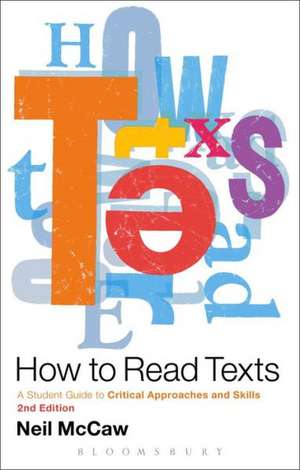
How to Read Texts: A Student Guide to Critical Approaches and Skills
Autor Dr Neil McCawen Limba Engleză Paperback – 26 sep 2013
- Debates around critical theory
- The role of history and context
- The links between creativity and criticism
- The relationship between author, reader and text.
The new edition now includes guidance on analysing a range of multi-media texts, including film and online media as well as the purely literary. In addition to new practical examples, readings, exercises and 'checkpoints' that help students to build confidence in their own critical readings of both primary and secondary texts, the book now also offers guidance on writing fully-formed critical essays and tips for independent research. Comprehensively updated and revised throughout, How to Read Texts is an indispensible guide for students making the transition to university study.
Preț: 176.83 lei
Preț vechi: 237.48 lei
-26%
Puncte Express: 265
Carte tipărită la comandă
Livrare economică 07-21 decembrie
Livrare prin curier în România Termenul estimat este afișat lângă disponibilitate.
Transport gratuit de la 400.00 lei Plată online sau ramburs, în funcție de opțiunile comenzii.
Retur gratuit în 14 zile Comandă securizată și suport în română.
Specificații
ISBN-13: 9781441190666
ISBN-10: 144119066X
Pagini: 192
Dimensiuni: 136 x 216 x 14 mm
Greutate: 0.23 kg
Ediția:Revised
Editura: Bloomsbury Publishing
Colecția Bloomsbury Academic
Locul publicării:London, United Kingdom
ISBN-10: 144119066X
Pagini: 192
Dimensiuni: 136 x 216 x 14 mm
Greutate: 0.23 kg
Ediția:Revised
Editura: Bloomsbury Publishing
Colecția Bloomsbury Academic
Locul publicării:London, United Kingdom
Cuprins
1. What is a Text and What Do We Do With It?
Thinking about texts
Texts in the digital age
Terminology and differences
Levels of reading
Theories of reading
2. Creative Reading
What is criticism?
What is creativity?
Being critical and creative
Reading as a critic vs. reading as a writer
Creativity and/as research
3. Close Reading
The history of close reading
The benefits of close reading
The problems with close reading
New ways of applying close-reading-skills
Researching texts close-up
4. Biography and Authorship
The role of the author
The significance of biography
Life-writing
The limitations of author-centred approaches
Researching authors
5. History and Contexts
How history fits in
Other types of context
A critique of historical reading
The strengths of historical reading
Researching contexts
6. Reading Theoretically
What is theory?
The origins of theory
The impact of theory
The achievements of theory
After theory
Conclusion: Reading Now!
Notes
Bibliography
Index
Thinking about texts
Texts in the digital age
Terminology and differences
Levels of reading
Theories of reading
2. Creative Reading
What is criticism?
What is creativity?
Being critical and creative
Reading as a critic vs. reading as a writer
Creativity and/as research
3. Close Reading
The history of close reading
The benefits of close reading
The problems with close reading
New ways of applying close-reading-skills
Researching texts close-up
4. Biography and Authorship
The role of the author
The significance of biography
Life-writing
The limitations of author-centred approaches
Researching authors
5. History and Contexts
How history fits in
Other types of context
A critique of historical reading
The strengths of historical reading
Researching contexts
6. Reading Theoretically
What is theory?
The origins of theory
The impact of theory
The achievements of theory
After theory
Conclusion: Reading Now!
Notes
Bibliography
Index
Recenzii
How to Read Texts is filled with a passion for reading and for authorship. Lively and approachable, this is a great book for anyone interested in how we approach the texts we encounter in our lives.
Neil McCaw's How to Read Texts: A Student Guide to Critical Approaches and Skills offers an invaluable and expansive introduction to the often vexing worlds of avant-garde critical theory and literary interpretation. Yet even more significantly, McCaw challenges us to discover our own critical voices, to seek out brave new textual frontiers of our own making, and to think creatively about the nature and direction of our reading experiences. Suitable for academic and general readers alike, How to Read Texts affords us with the attendant tools and historical background for unlocking and appreciating the rich texts that mark our lives.
How to Read Texts will encourage both students - and, as importantly, their teachers - to re-think the very basics of reading and analysing texts.
With a solid set of appendixes and an index, How to Read Texts is enthusiastically recommended for those facing a tough pile of books in their future.
How to Read Texts: A Student Guide to Critical Approaches and Skills offers high school and college-level students a fine survey of critical theory paired with exercises and checklists to help students in their own readings of primary and secondary texts. Students learn how to gain confidence in their skills and learn the methods of recognizing and challenging assumptions in this fine survey of critical thinking skills.
Neil McCaw's How to Read Texts: A Student Guide to Critical Approaches and Skills offers an invaluable and expansive introduction to the often vexing worlds of avant-garde critical theory and literary interpretation. Yet even more significantly, McCaw challenges us to discover our own critical voices, to seek out brave new textual frontiers of our own making, and to think creatively about the nature and direction of our reading experiences. Suitable for academic and general readers alike, How to Read Texts affords us with the attendant tools and historical background for unlocking and appreciating the rich texts that mark our lives.
How to Read Texts will encourage both students - and, as importantly, their teachers - to re-think the very basics of reading and analysing texts.
With a solid set of appendixes and an index, How to Read Texts is enthusiastically recommended for those facing a tough pile of books in their future.
How to Read Texts: A Student Guide to Critical Approaches and Skills offers high school and college-level students a fine survey of critical theory paired with exercises and checklists to help students in their own readings of primary and secondary texts. Students learn how to gain confidence in their skills and learn the methods of recognizing and challenging assumptions in this fine survey of critical thinking skills.