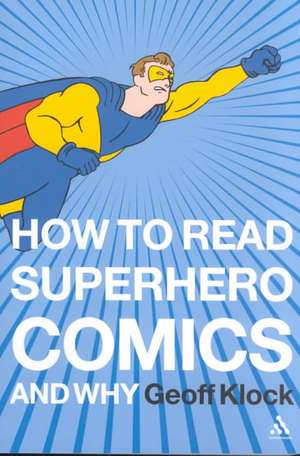
How to Read Superhero Comics and Why
Autor Geoff Klocken Limba Engleză Paperback – oct 2002
In this book, Geoff Klock presents a study of the Third Movement of superhero comic books. He avoids, at all costs, the temptation to refer to this movement as "Postmodern," "Deconstructionist," or something equally tedious. Analyzing the works of Frank Miller, Alan Moore, Warren Ellis, and Grant Morrison among others, and taking his cue from Harold Bloom, Klock unearths the birth of self-consciousness in the superhero narrative and guides us through an intricate world of traditions, influences, nostalgia and innovations - a world where comic books do indeed become literature.
Preț: 223.68 lei
Puncte Express: 336
Preț estimativ în valută:
39.56€ • 46.42$ • 34.31£
39.56€ • 46.42$ • 34.31£
Carte tipărită la comandă
Livrare economică 09-23 martie
Specificații
ISBN-13: 9780826414199
ISBN-10: 0826414192
Pagini: 216
Ilustrații: 1
Dimensiuni: 150 x 228 x 16 mm
Greutate: 0.3 kg
Ediția:New.
Editura: Bloomsbury Publishing
Colecția Continuum
Locul publicării:New York, United States
ISBN-10: 0826414192
Pagini: 216
Ilustrații: 1
Dimensiuni: 150 x 228 x 16 mm
Greutate: 0.3 kg
Ediția:New.
Editura: Bloomsbury Publishing
Colecția Continuum
Locul publicării:New York, United States
V-ar putea interesa
-
 Imaginary BiographiesGeoff Klock-26%Preț: 917.71 lei1235.20 lei
 -
 -34%Preț: 523.46 lei789.80 lei
 -
 Preț: 262.93 lei
 -
 Shaker MöbelKerry PiercePreț: 247.26 lei
 -
 Das Papiergeld von Deutsch-SüdwestafrikaJörg ZborowskaPreț: 151.19 lei
 -
 -23%Preț: 1186.49 lei1540.89 lei
Cuprins
1. Melancholy and the Infinite Earths
2. The Bat and the Watchmen: Introducing the Revisionary Superhero Narrative
3. 'It is with considerable difficulty...': The Revisionary Superhero Narrative, Phase Two
4. America's Best Comics: Tracing the (Re)visionary Company
5. Pumping up the Volume: The Revisionary Superhero Narrative Approaches the New Age
6. The Superhero as Critic: The Birth of the Modern Age
7. Epilogue: Pop Comics, Harold Bloom at Harvard, and the Oedipal Fallacy
2. The Bat and the Watchmen: Introducing the Revisionary Superhero Narrative
3. 'It is with considerable difficulty...': The Revisionary Superhero Narrative, Phase Two
4. America's Best Comics: Tracing the (Re)visionary Company
5. Pumping up the Volume: The Revisionary Superhero Narrative Approaches the New Age
6. The Superhero as Critic: The Birth of the Modern Age
7. Epilogue: Pop Comics, Harold Bloom at Harvard, and the Oedipal Fallacy
Recenzii
"A book like this is way overdue. I'm just glad someone finally had the balls to write it."--Joe Casey, writer of Wildcats and Automatic Kafk
"Exceptional"--Today's Books
"...a fascinating exegesis of superhero comics, outlining how the main movement of the genre since its inception has been toward self-cannibalization, which some have chosen to call metafiction...he does a pretty good job explaining why they are what they are and why they're never likely to really ascend to anything else. An entertaining read...it's nice for a change to see comics taken seriously as subjects of literary criticism. We could use more of it."--Comicbookresources.com
"The strengths of the book are the many [...] connections made to literary and psychoanalytical figures, the attempt to explain the metamorphosis of a new type of superhero comic, and a close reading of the comic books used to support the book's thesis. The book does add new dimensions to the much-overworked subject of superhero comic books."--Choice, May 2002 & May 2003
"Klock's strength lies in his commitment to looking at comics in a novel way, through the lens of literary analysis. He melds his encyclopedic knowledge of the superhero genre with the language of literary theory so as to join seemingly disparate worlds and to better inform the reader how comic book narratives have built upon and referenced one another throughout the history of their development." -Children's Literature Association Quarterly
An insightful study into superhero comics ... [that] can be recommended to comics theorists, researchers and superhero comics lovers who are looking for new analytical solutions and a fresh look on "heroes in tights".
"Exceptional"--Today's Books
"...a fascinating exegesis of superhero comics, outlining how the main movement of the genre since its inception has been toward self-cannibalization, which some have chosen to call metafiction...he does a pretty good job explaining why they are what they are and why they're never likely to really ascend to anything else. An entertaining read...it's nice for a change to see comics taken seriously as subjects of literary criticism. We could use more of it."--Comicbookresources.com
"The strengths of the book are the many [...] connections made to literary and psychoanalytical figures, the attempt to explain the metamorphosis of a new type of superhero comic, and a close reading of the comic books used to support the book's thesis. The book does add new dimensions to the much-overworked subject of superhero comic books."--Choice, May 2002 & May 2003
"Klock's strength lies in his commitment to looking at comics in a novel way, through the lens of literary analysis. He melds his encyclopedic knowledge of the superhero genre with the language of literary theory so as to join seemingly disparate worlds and to better inform the reader how comic book narratives have built upon and referenced one another throughout the history of their development." -Children's Literature Association Quarterly
An insightful study into superhero comics ... [that] can be recommended to comics theorists, researchers and superhero comics lovers who are looking for new analytical solutions and a fresh look on "heroes in tights".