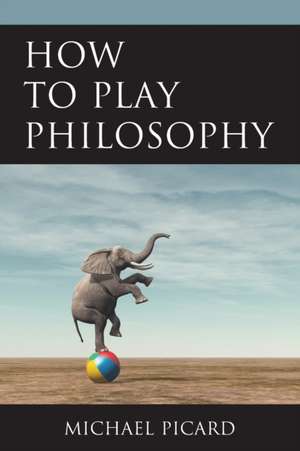
How to Play Philosophy
Autor Michael Picarden Limba Engleză Paperback – 14 feb 2022
How to Play Philosophy is a breezy array of lyrical, creative essays that explore timeless and timely ideas about who we are, how we live and what we think. MIT-trained philosopher Michael Picard gives airing to numerous philosophers from conflicting traditions and builds an intellectual background to enable readers to draw their own conclusions.
Written in a spirit of free and playful inquiry, the essays were composed originally to support public participatory philosophy, or Café Philosophy, which the author has facilitated for decades. Subjects include Play it With Feeling (Desire, Stress, Anger); Games We Play (Intimacy, Loyalty, Betrayal) and Playing Fair (Values, Good, Integrity), alongside epistemological topics including Truth (Knowledge, Certainty, Objectivity) and the perennial metaphysical quandaries (Human Nature, The Sacred, God).
Written for everyone interested in exploring age-old subjects in an age of disposable content, How to Play Philosophy offers playful provocations with the aim of enabling independent thinking and deeper public conversations.
Preț: 144.72 lei
Preț vechi: 202.76 lei
-29%
Puncte Express: 217
Carte tipărită la comandă
Livrare economică 20 noiembrie-04 decembrie
Livrare prin curier în România Termenul estimat este afișat lângă disponibilitate.
Transport gratuit de la 400.00 lei Plată online sau ramburs, în funcție de opțiunile comenzii.
Retur gratuit în 14 zile Comandă securizată și suport în română.
Specificații
ISBN-13: 9780761873068
ISBN-10: 0761873066
Pagini: 248
Ilustrații: 1 tables; 2 graphs;
Dimensiuni: 156 x 230 x 17 mm
Greutate: 0.34 kg
Editura: Bloomsbury Publishing
Colecția Hamilton Books
Locul publicării:New York, United States
ISBN-10: 0761873066
Pagini: 248
Ilustrații: 1 tables; 2 graphs;
Dimensiuni: 156 x 230 x 17 mm
Greutate: 0.34 kg
Editura: Bloomsbury Publishing
Colecția Hamilton Books
Locul publicării:New York, United States
Cuprins
List of Illustrations
List of Tables
Acknowledgments
Introduction
Chapter 1: Playtime
Chapter 2:Playing Me
Chapter 3: Play It With Feeling
Chapter 4: Games We Play
Chapter 5: Playing Fair
Chapter 6: Truth Sports
Chapter 7: Playing for Keeps
Chapter 8: Playing (With) God
Bibliography
Discography
About the Author
Index
List of Tables
Acknowledgments
Introduction
Chapter 1: Playtime
Chapter 2:Playing Me
Chapter 3: Play It With Feeling
Chapter 4: Games We Play
Chapter 5: Playing Fair
Chapter 6: Truth Sports
Chapter 7: Playing for Keeps
Chapter 8: Playing (With) God
Bibliography
Discography
About the Author
Index
Recenzii
In this insightful, original, profound yet playful, guide to the philosophical ideas which shape our daily lives, Michael Picard uses his knowledge of various disciplines and his gift for nuanced and sensitive accounts to masterfully show us how to navigate them. Written in an accessible way, this book is a remarkable initiation to philosophy and to its practice in everyday life that would benefit newcomers and seasoned philosophers alike.
This rollicking, captivating series of essays by one of our foremost public philosophers and scholars covers a dazzling spectrum of philosophy matters. Best of all, it manages to achieve the near-impossible: namely, Michael Picard presents an in-depth look at many of the most timely and timeless existential and epistemological posers without being the least bit pretentious; and without ever making one feel the least bit obliged to stake out any particular stance, but rather to discover further and deeper her own outlook. A gift to us all, by a most gifted writer and thinker.
Michael Picard's humorous, yet humble way of writing allows the reader to engage intimately with some of the most profound philosophical questions: turning abstract notions into urgent matters of everyday public life. Picard shows the reader that there is no philosophical discourse separated from philosophical life, just as there is no philosophical life without philosophical discourse. The essays in this book can be read on their own or in sequence. Picard's engaging, quick-witted and accessible writing style makes this an ideal book for people of all age groups. It will inspire thinking and dialogue among experienced philosophers, newcomers and even high school students. The most play- and thoughtful introduction to philosophical thinking and living I have seen so far.
Michael Picard-one of the hardest working, most creative and dedicated scholars I know-is doing world-class work in philosophy and public education. His brilliant conceptual and practical work includes innovations as a pedagogue, translator and editor of significant contributions to the field of philosophical praxis. This original book is a case in point. How to Play Philosophy effectively disarms what so many find intimidating, inviting readers along for the ride, even allowing them to steer. The book extends his pioneering public philosophical practice, and is suffused with the same warm, evocative and dynamic style as his engaging facilitation, which always draws strong interest.
This rollicking, captivating series of essays by one of our foremost public philosophers and scholars covers a dazzling spectrum of philosophy matters. Best of all, it manages to achieve the near-impossible: namely, Michael Picard presents an in-depth look at many of the most timely and timeless existential and epistemological posers without being the least bit pretentious; and without ever making one feel the least bit obliged to stake out any particular stance, but rather to discover further and deeper her own outlook. A gift to us all, by a most gifted writer and thinker.
Michael Picard's humorous, yet humble way of writing allows the reader to engage intimately with some of the most profound philosophical questions: turning abstract notions into urgent matters of everyday public life. Picard shows the reader that there is no philosophical discourse separated from philosophical life, just as there is no philosophical life without philosophical discourse. The essays in this book can be read on their own or in sequence. Picard's engaging, quick-witted and accessible writing style makes this an ideal book for people of all age groups. It will inspire thinking and dialogue among experienced philosophers, newcomers and even high school students. The most play- and thoughtful introduction to philosophical thinking and living I have seen so far.
Michael Picard-one of the hardest working, most creative and dedicated scholars I know-is doing world-class work in philosophy and public education. His brilliant conceptual and practical work includes innovations as a pedagogue, translator and editor of significant contributions to the field of philosophical praxis. This original book is a case in point. How to Play Philosophy effectively disarms what so many find intimidating, inviting readers along for the ride, even allowing them to steer. The book extends his pioneering public philosophical practice, and is suffused with the same warm, evocative and dynamic style as his engaging facilitation, which always draws strong interest.