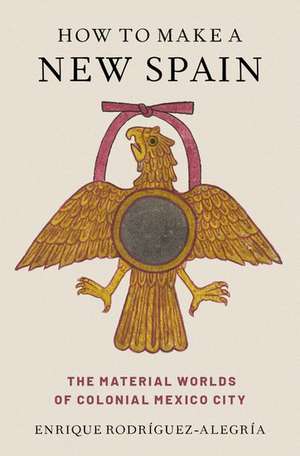
How to Make a New Spain: The Material Worlds of Colonial Mexico City
Autor Enrique Rodríguez-Alegríaen Limba Engleză Hardback – 4 mai 2023
Preț: 660.83 lei
Preț vechi: 969.34 lei
-32%
Puncte Express: 991
Carte disponibilă
Livrare economică 06-17 noiembrie
Livrare prin curier în România Termenul estimat este afișat lângă disponibilitate.
Transport gratuit pentru acest produs Plată online sau ramburs, în funcție de opțiunile comenzii.
Retur gratuit în 14 zile Comandă securizată și suport în română.
Specificații
ISBN-13: 9780197682296
ISBN-10: 0197682294
Pagini: 344
Dimensiuni: 242 x 162 x 24 mm
Greutate: 0.8 kg
Editura: Oxford University Press
Colecția OUP USA
Locul publicării:New York, United States
ISBN-10: 0197682294
Pagini: 344
Dimensiuni: 242 x 162 x 24 mm
Greutate: 0.8 kg
Editura: Oxford University Press
Colecția OUP USA
Locul publicării:New York, United States
Recenzii
This book serves as an exemplary work of ethnohistory, employing both archaeological findings and records of deceased early colonizers' possessions to compose a comprehensive view of the material life of the Spanish inhabitants of New Spain.... [It] should be read by all scholars and graduate students interested in materiality, urban Latin America, or colonial New Spain.
An innovative archaeological and historical study that examines how sixteenth-century colonizers attempted to re-create the material culture of Spain in the titular colony... Indeed, this pioneering work is certain to make any scholar of early colonial Latin America, whatever their specific discipline, hope for yet more studies of this kind.
Enrique Rodríguez-Alegría's How to Make a New Spain provides another important portal to the material worlds of colonial Mexico City. Through detailed analysis of the probate inventories of the colonizers and relevant archaeological data, Rodríguez-Alegría highlights the active role of people in creating material and social worlds. He demonstrates how the society of New Spain was materialized through the consumption of the colonizers, which involved engaging with the local materials, knowledge, and technologies of the Indigenous people. The objects in this study represent the interface where the intentionalities of and contingencies between colonizers and Indigenous peoples are intertwined.
As with all good books, Rodriguez-Alegria's book points to questions that demand answers; as with even better books, his offers methods to answer them.
An innovative archaeological and historical study that examines how sixteenth-century colonizers attempted to re-create the material culture of Spain in the titular colony... Indeed, this pioneering work is certain to make any scholar of early colonial Latin America, whatever their specific discipline, hope for yet more studies of this kind.
Enrique Rodríguez-Alegría's How to Make a New Spain provides another important portal to the material worlds of colonial Mexico City. Through detailed analysis of the probate inventories of the colonizers and relevant archaeological data, Rodríguez-Alegría highlights the active role of people in creating material and social worlds. He demonstrates how the society of New Spain was materialized through the consumption of the colonizers, which involved engaging with the local materials, knowledge, and technologies of the Indigenous people. The objects in this study represent the interface where the intentionalities of and contingencies between colonizers and Indigenous peoples are intertwined.
As with all good books, Rodriguez-Alegria's book points to questions that demand answers; as with even better books, his offers methods to answer them.
Notă biografică
Enrique Rodríguez-Alegría is Professor in Anthropology at the University of Texas at Austin. He is co-editor of The Oxford Handbook of the Aztecs, co-editor of The Menial Art of Cooking, and author of The Archaeology and History of Colonial Central Mexico.
Cuprins
- Preface
- Acknowledgments
- A Note on Terminology and Gentilics
- How to enter the material and social worlds
- Chapter 1: How to make money
- Chapter 2: How to build houses
- Chapter 3: How to furnish a house
- Chapter 4: How to get pottery and food
- Chapter 5: How to dress the part
- Chapter 6: How to build sociotechnical systems: tools, livestock, and slaves
- Chapter 7: How to link wealth and consumption, or not
- Conclusion: The Material Worlds of Spanish Colonizers
- Appendix 5.1: Items of clothing in the probate inventories
- Appendix 6.1: Tools listed in the documents
- Appendix 7.1: Prices of shirts with an indicated origin
- References