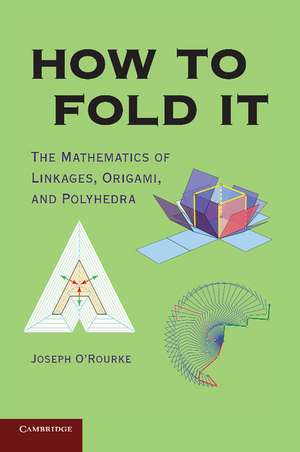
How to Fold It
Autor Joseph O'Rourkeen Limba Engleză Paperback – 29 oct 2014
Descoperim în How to Fold It o introducere riguroasă, dar accesibilă, în matematica plierii, un domeniu aflat la intersecția dintre geometrie, robotică și biologie moleculară. Autorul Joseph O’Rourke reușește să ancoreze concepte complexe în obiecte familiare, începând cu analiza brațelor robotice și a mecanismelor articulate în prima parte a lucrării. Observăm o progresie pedagogică atent structurată: de la algebra și geometria de nivel liceal, textul evoluează spre probleme de cercetare actuală, fără a pierde contactul cu latura intuitivă, vizuală a subiectului. Organizarea cărții în trei secțiuni mari — Linkages, Origami și Polyhedra — permite o explorare modulară a temelor. Partea a doua, dedicată origami-ului, tratează riguros teoreme precum „fold-and-cut”, în timp ce secțiunea finală despre poliedre abordează problema lui Dürer și desfășurarea corpurilor geometrice. Această ediție publicată de Cambridge University Press se distinge prin includerea a 48 de exerciții cu rezolvări integrale, oferind un instrument de lucru complet pentru studenți și autodidacți. Apreciem How to Fold It ca o alternativă pedagogică la Geometric Folding Algorithms pentru cursurile introductive de geometrie computațională. În timp ce volumul lui Erik D. Demaine este un tratat exhaustiv axat pe algoritmi, Joseph O’Rourke oferă avantajul unei abordări mai puțin intimidante, fiind ideal pentru cineva care dorește să înțeleagă fundamentele matematice din spatele origami-ului fără a fi copleșit de formalismul tehnic extrem. Este, în esență, puntea necesară între practica plierii și teoria matematică abstractă, facilitată de cele 171 de ilustrații și animațiile dinamice disponibile online.
Preț: 319.01 lei
Carte tipărită la comandă
Livrare economică 30 noiembrie-14 decembrie
Specificații
ISBN-10: 0521145473
Pagini: 190
Ilustrații: 171 b/w illus. 1 table 48 exercises
Dimensiuni: 152 x 229 x 11 mm
Greutate: 0.27 kg
Editura: Cambridge University Press
Locul publicării:New York, United States
V-ar putea interesa
-
 Finding MoonshineMarcus Du SautoyPreț: 105.61 lei
 -
 The Number MysteriesMarcus Du SautoyPreț: 93.07 lei
 -
 MathleticsJohn D. BarrowPreț: 110.45 lei
 -
 A Mathematician Reads the NewspaperJohn Allen PaulosPreț: 72.79 lei
 -
 Lewis Carroll in NumberlandRobin WilsonPreț: 118.40 lei
 -
 The Drunkard's WalkLeonard MlodinowPreț: 92.91 lei
 -
 -33%Preț: 662.48 lei982.57 lei
 -
 1089 and All That: A Journey into MathematicsDavid Acheson-19%Preț: 69.35 lei85.81 lei
 -
 -28%Preț: 359.06 lei500.87 lei
 -
 Geometry: Euclid and BeyondRobin HartshornePreț: 508.72 lei
 -
 Introduction to TopologyBert Mendelson-19%Preț: 83.58 lei103.54 lei
 -
 Hinged DissectionsGreg N. FredericksonPreț: 316.79 lei
 -
 MatroidsGary GordonPreț: 422.50 lei
 -
 Heegner Points and Rankin L-SeriesHenri DarmonPreț: 368.52 lei
 -
 -11%Preț: 496.78 lei558.19 lei
 -
 -11%Preț: 440.36 lei494.78 lei
 -
 A Mathematical Nature WalkJohn A AdamPreț: 173.78 lei
 -
 -26%Preț: 69.34 lei93.70 lei
 -
 Introduction to Vassiliev Knot InvariantsS. Chmutov-11%Preț: 620.32 lei696.99 lei
 -
 Topics in Critical Point TheoryKanishka Perera-11%Preț: 510.26 lei573.32 lei
 -
 Mathematics Of Life: Unlocking the Secrets of ExistenceProfessor Ian Stewart-18%Preț: 64.88 lei79.52 lei
 -
 Professor Stewart's Hoard of Mathematical TreasuresProfessor Ian Stewart-19%Preț: 68.76 lei84.94 lei
 -
 Seventeen Equations that Changed the WorldProfessor Ian Stewart-19%Preț: 69.65 lei85.47 lei
De ce să citești această carte
Recomandăm această carte studenților și pasionaților de geometrie care doresc să treacă de la manipularea practică a hârtiei la înțelegerea teoremelor matematice. Veți câștiga o perspectivă nouă asupra modului în care plierea influențează tehnologia modernă, de la nanoroboți la structuri spațiale, având la dispoziție exerciții rezolvate și probleme deschise care stimulează gândirea critică și cercetarea originală.
Descriere scurtă
Cuprins
Recenzii
'In this beautiful and inspiring book with many colour figures the reader can find a fascinating mathematical approach to linkages, foldings and unfoldings. Many exercises with detailed solutions give the reader the chance to control the acquired skills.' Hansueli Hosli, Zentralblatt MATH
'… a great book for someone who wants to learn about the mathematics behind origami without being overwhelmed by the mathematics itself. This is a great book for a high school or undergraduate student to get introduced to the open problems in computational origami.' Brittany Terese Fasy and David L. Millman, SIGACT News