
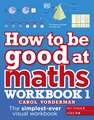
How to be Good at Maths: The Simplest-Ever Visual Guide KS2: DK How to Be Good at
Autor Carol Vordermanen Limba Engleză Hardback – iul 2016 – vârsta până la 11 ani
Designed to be used either by kids working on their own or with the help of an adult, How to be Good at Maths features colourful graphics and simple numbered steps to teach basic numeracy to children in Key Stage 2 (US grades 2-5). Real-life examples and fascinating facts reinforce the explanation - for example, fly down a zipwire to learn the basics of geometry, time a robot running race to convert decimals, and even find out how much you would weigh on Jupiter. Like all good teachers, this book shows kids how to approach a problem using more than one method, as well as setting them challenges to keep them stimulated and practise what they've learned.
With its innovative visual approach and expertly written text, How to be Good at Maths makes primary maths easier to understand than ever before.
Preț: 112.86 lei
Preț vechi: 150.48 lei
-25%
19.96€ • 23.42$ • 17.31£
Carte disponibilă
Livrare economică 16 februarie-02 martie
Livrare express 31 ianuarie-06 februarie pentru 60.40 lei
Specificații
ISBN-10: 024118598X
Pagini: 320
Dimensiuni: 224 x 282 x 26 mm
Greutate: 1.51 kg
Editura: Dorling Kindersley - DK
Colecția DK Children
Seria DK How to Be Good at
Locul publicării:London, United Kingdom
V-ar putea interesa
-
 -33%Preț: 23.34 lei34.92 lei
 -
 -21%Preț: 27.08 lei34.13 lei
 -
 Preț: 34.10 lei
 -
 Preț: 21.08 lei
 -
 -33%Preț: 23.35 lei34.93 lei
 -
 Maths Made Easy: Advanced, Ages 6-7 (Key Stage 1)Carol Vorderman-33%Preț: 23.62 lei35.10 lei
 -
 -18%Preț: 23.28 lei28.27 lei
 -
 -19%Preț: 28.36 lei34.92 lei
 -
 Preț: 28.33 lei
 -
 Science Made Easy, Ages 7-8 (Key Stage 2)Carol VordermanPreț: 35.09 lei
Notă biografică
Carol Vorderman, one of Britain's best known and loved TV personalities, feels passionately about the value of education. Carol joined forces with DK in 1999 to become DK's Education Champion and has helped them to build the bestselling "Made Easy" series, which includes topics in maths, English, and science and technology. She has also encouraged parents and their teenage children to work together in the "Help Your Kids" series, which includes Help Your Kids With Science and Help Your Kids With Music. Versatile as ever, Carol has also provided an accessible and fun entry into the world of computer programming with Computer Coding Projects For Kids.
Cuprins
- 1: Numbers
- 1: Number symbols
- 2: Place value
- 3: Sequences and patterns
- 4: Sequences and shapes
- 5: Positive and negative numbers
- 6: Comparing numbers
- 7: Ordering numbers
- 8: Estimating
- 9: Rounding
- 10: Factors
- 11: Multiples
- 12: Prime numbers
- 13: Prime factors
- 14: Square numbers
- 15: Square roots
- 16: Cube numbers
- 17: Fractions
- 18: Improper fractions and mixed numbers
- 19: Equivalent fractions
- 20: Simplifying fractions
- 21: Finding a fraction of an amount
- 22: Comparing fractions with the same denominators
- 23: Comparing unit fractions
- 24: Comparing non-unit fractions
- 25: Using the lowest common denominator
- 26: Adding fractions
- 27: Subtracting fractions
- 28: Multiplying fractions
- 29: Dividing fractions
- 30: Decimal numbers
- 31: Comparing and ordering decimals
- 32: Rounding decimals
- 33: Adding decimals
- 34: Subtracting decimals
- 35: Percentages
- 36: Calculating percentages
- 37: Percentage changes
- 38: Ratio
- 39: Proportion
- 40: Scaling
- 41: Different ways to describe fractions
- 2: Calculating
- 1: Addition
- 2: Adding with a number line
- 3: Adding with a number grid
- 4: Addition facts
- 5: Partitioning for addition
- 6: Expanded column addition
- 7: Column addition
- 8: Subtraction
- 9: Subtraction facts
- 10: Partitioning for subtraction
- 11: Subtracting with a number line
- 12: Shopkeeper’s addition
- 13: Expanded column subtraction
- 14: Column subtraction
- 15: Multiplication
- 16: Multiplication as scaling
- 17: Factor pairs
- 18: Counting in multiples
- 19: Multiplication tables
- 20: The multiplication grid
- 21: Multiplication patterns and strategies
- 22: Multiplying by 10, 100, and 1000
- 23: Multiplying by multiples of 10
- 24: Partitioning for multiplication
- 25: The grid method
- 26: Expanded short multiplication
- 27: Short multiplication
- 28: Expanded long multiplication
- 29: Long multiplication
- 30: More long multiplication
- 31: Multiplying decimals
- 32: The lattice method
- 32: Division
- 33: Dividing with multiples
- 34: The division grid
- 35: Division tables
- 36: Dividing with factor pairs
- 37: Checking for divisibility
- 38: Dividing by 10, 100 and 1000
- 39: Dividing by multiples of 10
- 40: Partitioning for division
- 41: Expanded short division
- 42: Short division
- 43: Expanded long division
- 44: Long division
- 45: Converting remainders
- 46: Dividing with decimals
- 47: The order of operations
- 48: Arithmetic laws
- 49: Using a calculator
- 3: Measurement
- 1: Length
- 2: Calculating with length
- 3: Perimeter
- 4: Using formulas to find perimeter
- 5: Area
- 6: Estimating area
- 7: Working out area with a formula
- 8: Areas of triangles
- 9: Areas of parallelograms
- 10: Areas of complex shapes
- 11: Comparing area and perimeter
- 12: Capacity
- 13: Volume
- 14: The volumes of solids
- 15: Working out volume with a formula
- 16: Mass
- 17: Mass and weight
- 18: Calculating with mass
- 19: Temperature
- 20: Calculating with temperature
- 21: Imperial units
- 22: Imperial units of length, volume, and mass
- 23: Telling the time
- 24: Dates
- 25: Calculating with time
- 26: Money
- 27: Using money
- 28: Calculating with money
- 4: Geometry
- 1: What is a line?
- 2: Horizontal and vertical lines
- 3: Diagonal lines
- 4: Parallel lines
- 5: Perpendicular lines
- 6: 2D shapes
- 7: Regular and irregular polygons
- 8: Triangles
- 9: Quadrilaterals
- 10: Naming polygons
- 11: Circles
- 12: 3D shape
- 13: Types of 3D shape
- 14: Prisms
- 15: Nets
- 16: Angles
- 17: Degrees
- 18: Right angles
- 19: Types of angle
- 20: Angles on a straight line
- 21: Angles at a point
- 22: Opposite angles
- 23: Using a protractor
- 24: Angles inside triangles
- 25: Calculating angles inside triangles
- 26: Angles inside quadrilaterals
- 27: Calculating angles inside quadrilaterals
- 28: Angles inside polygons
- 29: Calculating the angles in a polygon
- 30: Coordinates
- 31: Plotting points using coordinates
- 32: Positive and negative coordinates
- 33: Using coordinates to draw a polygon
- 34: Position and direction
- 35: Compass directions
- 36: Reflective symmetry
- 37: Rotational symmetry
- 38: Reflection
- 39: Rotation
- 40: Translation
- 5: Statistics
- 1: Data handling
- 2: Tally marks
- 3: Frequency tables
- 4: Carroll diagrams
- 5: Venn diagrams
- 6: Averages
- 7: The mean
- 8: The median
- 9: The mode
- 10: The range
- 11: Using averages
- 12: Pictograms
- 13: Block graphs
- 14: Bar charts
- 15: Drawing bar charts
- 16: Line graphs
- 17: Drawing line graphs
- 18: Pie charts
- 19: Making pie charts
- 20: Probability
- 21: Calculating probability
- 6: Algebra
- 1: Equations
- 2: Solving equations
- 3: Formulas and sequences
- 4: Formulas
- 7: Glossary
- 8: Index
- 9: Answers
- 10: Acknowledgments
Descriere
Need help with fractions? Baffled by negative numbers? Then look no further, because this simple, visual guide demystifies primary maths and makes it fun for even the most reluctant student.
Designed to be used either by kids working on their own or with the help of an adult, How to be Good at Maths features colourful graphics and simple numbered steps to teach basic numeracy to children in Key Stage 2 (US grades 2-5). Real-life examples and fascinating facts reinforce the explanation - for example, fly down a zipwire to learn the basics of geometry, time a robot running race to convert decimals, and even find out how much you would weigh on Jupiter. Like all good teachers, this book shows kids how to approach a problem using more than one method, as well as setting them challenges to keep them stimulated and practise what they've learned.
With its innovative visual approach and expertly written text, How to be Good at Maths makes primary maths easier to understand than ever before.