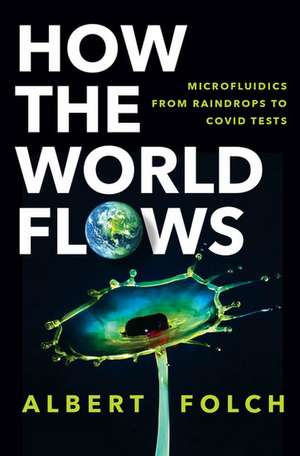
How the World Flows: Microfluidics from Raindrops to Covid Tests
Autor Albert Folchen Limba Engleză Hardback – 11 aug 2025
Preț: 176.62 lei
Preț vechi: 204.88 lei
-14%
Puncte Express: 265
Carte tipărită la comandă
Livrare economică 10-15 decembrie
Livrare express 30 octombrie-05 noiembrie pentru 66.100 lei
Livrare prin curier în România Termenul estimat este afișat lângă disponibilitate.
Transport gratuit de la 400.00 lei Plată online sau ramburs, în funcție de opțiunile comenzii.
Retur gratuit în 14 zile Comandă securizată și suport în română.
Specificații
ISBN-13: 9780197772829
ISBN-10: 019777282X
Pagini: 306
Dimensiuni: 163 x 241 x 26 mm
Greutate: 0.66 kg
Editura: Oxford University Press
Colecția OUP USA
Locul publicării:New York, United States
ISBN-10: 019777282X
Pagini: 306
Dimensiuni: 163 x 241 x 26 mm
Greutate: 0.66 kg
Editura: Oxford University Press
Colecția OUP USA
Locul publicării:New York, United States
V-ar putea interesa
-
 Introduction to MicrofluidicsPatrick Tabeling-19%Preț: 476.82 lei591.59 lei
 -
 Microbiology: A Very Short IntroductionNicholas P. Money-24%Preț: 57.45 lei75.24 lei
 -
 -11%Preț: 222.73 lei249.93 lei
 -
 -13%Preț: 66.36 lei76.56 lei
 -
 What a Wonderful WorldMarcus ChownPreț: 108.62 lei
 -
 Small WorldNick Crumpton-15%Preț: 127.22 lei149.85 lei
 -
 Air-BorneCarl Zimmer-34%Preț: 82.42 lei125.70 lei
 -
 Discovering the Microscopic WorldMarianne TaylorPreț: 129.67 lei
 -
 Meet the Microbes!: The Tiny Living Things That Mould Our LivesDr Emily Grossman-25%Preț: 43.49 lei57.90 lei
 -
 MicrocosmosBrandon BrollPreț: 147.33 lei
 -
 MicrobesAlix WoodPreț: 63.91 lei
 -
 Preț: 57.23 lei
 -
 Preț: 144.50 lei
 -
 Thinking Small and LargePeter ForbesPreț: 109.04 lei
 -
 Nature's Tiny ChampionsBen LerwillPreț: 136.63 lei
 -
 MicrocosmsJill PflugheberPreț: 345.27 lei
 -
 A Cup of Coffee and the OceanSung Yong KimPreț: 263.19 lei
Recenzii
This book weaves together personal stories, explanations of natural phenomena, and technological innovations to bring to life the invisible cosmos of tiny droplets of fluid that deeply influence so many phenomena in our world. Readers will be both entertained and fascinated by Folch's revelations about the microdroplets that drive rainbows and monsoons, or the microscopic channels that fuel plants, people, and covid tests. I found it impossible to put down.
How the World Flows makes a significant contribution to the field of microfluidics. It will become a reference work for those seeking a comprehensive introduction, as well as for teachers and experts.
Folch's new book is a dazzling exploration of the myriad ways that microfluidics underpins our world. Above all, this feels like a book that could convince you to become an engineer if you read it at a young enough age. It could also remind you at any age of the sheer intricacy and wonder of any object when you put it under a microscope. It overflows with curiosity.
There have been a range of books that attempt to bring the wonders of science and engineering to the reading (i.e., nonspecialist) public, but few have done it better than Folch (Univ. of Washington) in this new book. The author strikes a perfect balance of interesting biographical asides, a wide range of different examples and systems involving microscale flows, visually engaging images, and just enough technical explanation to satisfy those with STEM backgrounds or a driving curiosity. A great read for all levels.
How the World Flows makes a significant contribution to the field of microfluidics. It will become a reference work for those seeking a comprehensive introduction, as well as for teachers and experts.
Folch's new book is a dazzling exploration of the myriad ways that microfluidics underpins our world. Above all, this feels like a book that could convince you to become an engineer if you read it at a young enough age. It could also remind you at any age of the sheer intricacy and wonder of any object when you put it under a microscope. It overflows with curiosity.
There have been a range of books that attempt to bring the wonders of science and engineering to the reading (i.e., nonspecialist) public, but few have done it better than Folch (Univ. of Washington) in this new book. The author strikes a perfect balance of interesting biographical asides, a wide range of different examples and systems involving microscale flows, visually engaging images, and just enough technical explanation to satisfy those with STEM backgrounds or a driving curiosity. A great read for all levels.
Notă biografică
Albert Folch is a Professor of Bioengineering at the University of Washington in Seattle, WA. He was born in Barcelona, Catalonia (Spain) and he graduated in Physics (B.Sc. 1989 & Ph.D. 1994) from the University of Barcelona. He did postdocs at MIT (1994-96) and at Harvard-MGH (1997-2000). His lab works on cancer microfluidics and 3D-printing. He received an NSF CAREER Award (2001) and was elected a member of the AIMBE College of Fellows (2014) and of the Institute of Catalan Studies (2022). Since 2007, his lab has produced an art outreach program called Bringing Art Into Technology (BAIT). Among other books, the author has written Introduction to BioMEMS (2012) and Hidden in Plain Sight (2022).