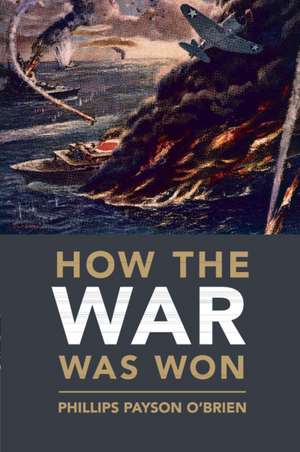
How the War Was Won
Autor Phillips Payson O'Brienen Limba Engleză Paperback – 31 ian 2019
În volumul How the War Was Won, Phillips Payson O'Brien propune o schimbare radicală de paradigmă în istoriografia militară, structurând materialul pe o metodologie bazată pe analiza producției și a fluxurilor logistice. Remarcăm modul în care autorul reorganizează cronologia conflictului nu prin prisma confruntărilor terestre clasice, ci prin fazele de distrugere a echipamentului militar. Organizată în unsprezece capitole dense, lucrarea începe cu dominanța producției aeriene și navale, explorând ulterior modul în care strategiile globale au prioritizat controlul mărilor și al spațiului aerian pentru a exercita o presiune insuportabilă asupra mașinăriei de război a Axei. Această perspectivă extinde cadrul propus de The Air War de Richard Overy cu date noi din sfera puterii navale și a integrării tehnologice. În timp ce lucrări precum The Second World War (3) de Professor Alastair Finlan susțin că războiul a fost câștigat la sol dar ar fi putut fi pierdut pe mare, O'Brien inversează această teză, demonstrând prin cele 33 de tabele și 100 de ilustrații că victoria a fost construită aproape exclusiv prin superioritatea aeronavală. Autorul poziționează acest studiu ca o continuare firească a preocupărilor sale din Technology and Naval Combat in the Twentieth Century and Beyond, rafinând analiza modului în care inovația tehnologică dictează deznodământul conflictelor moderne. Volumul publicat de Cambridge University Press oferă o progresie logică de la cifrele de producție din 1940 până la controlul total al mobilității din 1945, oferind o explicație structurală pentru colapsul Germaniei și al Japoniei, dincolo de mitul „marii bătălii” decisive.
Preț: 206.19 lei
Carte disponibilă
Livrare economică 11-25 mai
Livrare express 24-30 aprilie pentru 47.79 lei
Specificații
ISBN-10: 110871689X
Pagini: 656
Ilustrații: 100 b/w illus. 8 maps 33 tables
Dimensiuni: 153 x 228 x 38 mm
Greutate: 0.91 kg
Editura: Cambridge University Press
Locul publicării:Cambridge, United Kingdom
De ce să citești această carte
Recomandăm How the War Was Won istoricilor și pasionaților de strategie care doresc o alternativă fundamentată statistic la narațiunile tradiționale axate pe infanterie. Cititorul câștigă o înțelegere profundă a modului în care logistica și tehnologia aeronavală au anihilat resursele Axei înainte ca acestea să tragă un singur foc. Este o lecție esențială despre cum puterea economică și controlul spațiului global decid soarta imperiilor moderne.
Despre autor
Phillips Payson O'Brien deține un doctorat în istorie și o experiență vastă în analiza strategică, dobândită atât în mediul academic, cât și în sectorul financiar de pe Wall Street. Este un expert recunoscut în istoria politică și strategică a Marii Britanii și a Statelor Unite din prima jumătate a secolului XX. Pe lângă activitatea sa de cercetare, O'Brien este un comentator frecvent pe teme de apărare pentru BBC și consilier pentru diverse guverne europene, aducând o perspectivă pragmatică și interdisciplinară asupra istoriei militare contemporane.
Descriere scurtă
Cuprins
Recenzii
'This is a book anyone interested in the Second World War will want to read. It refocuses the story of the war away from the battlefield, to the air and the sea, and also to the transit depot, the maintenance facility, the training base. This is an imaginative, cliché-busting work which lays bare exactly when, how and where the Axis lost the war.' David Edgerton, author of Britain's War Machine: Weapons, Resources and Experts in the Second World War and Warfare State: Britain, 1920–1970
'This extremely serious book attempts to re-evaluate World War II not in terms of great battles … but in terms of production, mobility, and economics. O'Brien argues that victory or defeat in World War II must be seen during preproduction, production, and deployment … The work focuses on equipment, mobility, and détente … Especially for graduate students, professors of military history, and those generally interested in the history of Europe or the Far East. Summing up: essential.' R. Higham, Choice
'A novel, provocative, and well-written study based on extensive documentary sources on both sides of the Atlantic. Its author's conviction that 'the effectiveness of tactical air power over strategic … was the most important lesson of the war, one that remains true to this day' makes the book worth careful reading. With his emphasis on degrading an enemy's 'mobility' (perhaps a nod to Basil H. Liddell Hart's 'indirect approach'?) Phillips Payson O'Brien offers a way forward for those working on 'AirSea Battle', area access, and area denial problems in modern warfare. His work will engage and instruct historians of World War II as well as current military officers, strategists, and decision-makers.' Christopher Rein, Michigan War Studies Review
'Such a thoroughgoing revision of the history of the war will outrage many historians. … This is a brave, important and impressively researched book, and all who have written on the Second World War will have to consider O'Brien's cogent arguments.' A. W. Purdue, The Times Higher Education Supplement
'Phillips Payson O'Brien's book is revisionist history at its best: thoughtful, well grounded in secondary and primary sources, and provocative. It is a mature work, the result of several years of research and reflection. … O'Brien deserves high praise for writing a book that will force scholars to think hard about the nature of World War II and perhaps also about the nature of modern warfare in general.' Talbot C. Imlay, The Journal of Modern History
'… recommended …' Geoffrey Till, The Naval Review