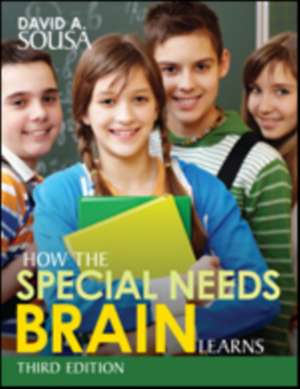
How the Special Needs Brain Learns
Autor David A. Sousaen Limba Engleză Paperback – 18 mai 2016
Recomandăm această a treia ediție a lucrării How the Special Needs Brain Learns ca pe o resursă pragmatică, ce debutează cu o listă extinsă de strategii concrete de implementat în sala de clasă. Accentul cade pe componenta practică, oferind soluții pentru adaptarea instruirii în funcție de modul în care creierul elevului procesează informația. Structura cărții este organizată riguros, dedicând capitole individuale pentru ADHD, tulburările de spectru autist, dislexie și dificultățile în matematică sau scriere, facilitând astfel accesul rapid la intervenții specifice.
Notăm cu interes modul în care David A. Sousa integrează utilizarea tehnologiilor asistive, transformându-le dintr-un accesoriu într-un instrument esențial pentru eliminarea barierelor educaționale. Față de edițiile anterioare, acest volum recalibrează strategiile de diferențiere a instruirii, bazându-se pe cele mai noi date din neuroștiințe. Merită menționat că lucrarea completează organic seria autorului, făcând trecerea de la teoria generală din How the Brain Learns către aplicații nișate pentru nevoi speciale, similar abordării din How the Brain Learns Mathematics.
În peisajul literaturii de specialitate, acest titlu reprezintă o alternativă la Handbook of Learning Disabilities, Third Edition pentru cursurile de educație specială, având avantajul unei abordări mai accesibile, orientate spre practicianul de la catedră. În timp ce Handbook of Learning Disabilities, Third Edition oferă o perspectivă enciclopedică de cercetare, How the Special Needs Brain Learns se concentrează pe mecanismele neurologice ale învățării și pe traducerea acestora în metode pedagogice imediate. Progresia capitolelor, de la fundamentele creierului la tulburări emoționale și comportamentale, asigură o acoperire comprehensivă a curriculumului pentru incluziune.
Preț: 326.07 lei
Carte disponibilă
Livrare economică 11-25 septembrie
Livrare express 28 august-03 septembrie pentru 63.80 lei
Specificații
ISBN-10: 1506327028
Pagini: 296
Dimensiuni: 216 x 279 x 23 mm
Greutate: 0.91 kg
Ediția:Third Edition
Editura: SAGE Publications
Colecția Corwin
Locul publicării:Thousand Oaks, United States
V-ar putea interesa
-
 The Lost ChildrenMary MaccrackenPreț: 57.10 lei
 -
 Theories of Inclusive EducationPeter Clough-8%Preț: 450.69 lei489.89 lei
 -
 Preț: 351.46 lei
 -
 Identifying Special Needs in the Early YearsKay MathiesonPreț: 351.46 lei
 -
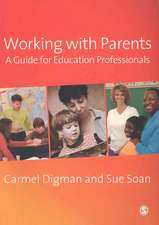 Working with ParentsCarmel DigmanPreț: 375.66 lei
 -
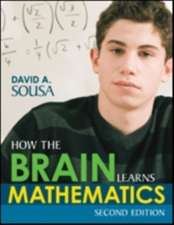 How the Brain Learns MathematicsDavid A. SousaPreț: 315.72 lei
 -
 -21%Preț: 128.92 lei162.26 lei
 -
 -21%Preț: 121.13 lei153.16 lei
 -
 -20%Preț: 159.25 lei199.69 lei
 -
 Parenting ASD Teens: A Guide to Making it Up As You GoAndrew Schlegelmilch-20%Preț: 117.28 lei146.09 lei
De ce să citești această carte
Această carte este indispensabilă cadrelor didactice și psihopedagogilor care lucrează cu elevi ce prezintă provocări de învățare. Cititorul câștigă o înțelegere clară a cauzelor neurologice din spatele ADHD-ului sau autismului și, cel mai important, primește un set de instrumente practice pentru a diferenția predarea. Este un ghid esențial pentru a transforma incluziunea din concept teoretic în realitate funcțională la clasă.
Despre autor
David A. Sousa, Ed.D., este un consultant internațional de prestigiu în domeniul neuroștiințelor educaționale. Cu o formație academică solidă ce include studii la Harvard University și un doctorat în educație, Sousa a instruit peste 200.000 de educatori la nivel global. Expertiza sa se concentrează pe traducerea cercetărilor complexe despre creier în strategii didactice aplicabile, fiind autorul mai multor bestselleruri care explorează modul în care creierul învață cititul, matematica sau limbile străine. Lucrările sale sunt puncte de referință în formarea continuă a profesorilor din SUA, Europa și Asia.
Descriere scurtă
Recenzii
"Understanding how individuals learn…or why they may fail to learn…is an integral part of what makes teachers effective with students who have special learning needs as well as with those who don’t. Dr. Sousa’s text provides an easy-to-read explanation of both how the brain functions and how that functioning impacts the learning process. But it doesn’t stop there. Each chapter offers practical information, suggestions, or strategies that can be used to help struggling students learn."
"Understanding brain development is of critical importance to the field of education. Of all the books I have used, those written by David Sousa have been the most readable and understandable. The strategies included in this new edition of How the Special Needs Brain Learns can be easily carried out in the classroom. I think I have all that he has written regarding the brain."
"How the Special Needs Brain Learns, Third Edition provides key biological and neurological information for issues that I think many teachers attribute purely to attitude and will. By providing the specific neurological processes behind learning difficulties, Dr. Sousa gives teachers and teacher candidates a useful resource to understand and respond to challenges experienced by students with learning difficulties and special educational needs."
"A major strength of the third edition of How the Special Needs Brain Learns is that it clearly addresses all major areas of learning in which students with disabilities experience problems. The author has done an excellent job in balancing what we know about the brain and how this can be applied in the classroom. It bridges the field of neuroscience and education well!"
Cuprins
About the Author
Preface to the Third Edition
Acknowledgments
Introduction
Chapter 1 - The Brain and Learning
Chapter 2 - When Learning Difficulties Arise
Chapter 3 - Attention Disorders
Chapter 4 - Speech Difficulties
Chapter 5 - Reading Disabilities
Chapter 6 - Writing Disabilities
Chapter 7 - Mathematical Disabilities
Chapter 8 - Emotional and Behavioral Disorders
Chapter 9 - Autism Spectrum Disorder
Chapter 10 - Putting It All Together
Glossary
References
Resources
Index
Descriere
If you’ve been searching for effective strategies to meet the needs of learning challenged students, look no further. In this newly revised and updated third edition, expert David A. Sousa addresses the causes of common learning disabilities and provides alternative instructional strategies to ensure learning occurs. Discover cutting-edge brain research to help you:
- Effectively instruct students with ADHD, LD, dyslexia, autism, and more
- Utilize assistive technologies to remove barriers to learning
- Differentiate instruction in speech, reading, writing, and mathematics