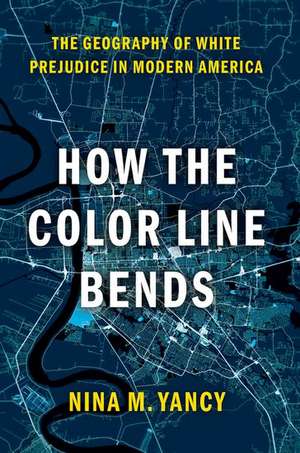
How the Color Line Bends: The Geography of White Prejudice in Modern America
Autor Nina M. Yancyen Limba Engleză Paperback – 27 mai 2022
Preț: 195.27 lei
Preț vechi: 210.20 lei
-7%
Puncte Express: 293
Carte disponibilă
Livrare economică 13-24 noiembrie
Livrare express 30 octombrie-05 noiembrie pentru 49.22 lei
Livrare prin curier în România Termenul estimat este afișat lângă disponibilitate.
Transport gratuit de la 400.00 lei Plată online sau ramburs, în funcție de opțiunile comenzii.
Retur gratuit în 14 zile Comandă securizată și suport în română.
Specificații
ISBN-13: 9780197599433
ISBN-10: 0197599435
Pagini: 336
Dimensiuni: 218 x 149 x 20 mm
Greutate: 0.49 kg
Editura: Oxford University Press
Colecția OUP USA
Locul publicării:New York, United States
ISBN-10: 0197599435
Pagini: 336
Dimensiuni: 218 x 149 x 20 mm
Greutate: 0.49 kg
Editura: Oxford University Press
Colecția OUP USA
Locul publicării:New York, United States
Recenzii
It takes work to maintain the centuries-old racial hierarchy in the United States. In How the Color Line Bends, through a sophisticated analysis of a school district secession effort in Baton Rouge, Nina Yancy shows us how White people, including progressives, do this work. The book has as much to teach us about the critical reflection needed of dominant social science practices and assumptions as of White identity and its political implications.
How the Color Line Bends is compelling. Yancy provides a well-written, deeply theoretical, and passionate examination of the ways in which Whites' racial identity shapes their understanding of local geography and racialized policies. This project is both methodologically broad and informed by a nuanced understanding of the historical context of national, regional, and local politics. I strongly recommend this timely and important book.
How the Color Line Bends is a masterpiece of theory, method, and insight into White people's perspectives on segregation, the safety net, and affirmative action. Yancy goes deep into Baton Rouge, Louisiana, and broadly to metropolitan areas across the country to illustrate the importance and consequence of the advantaged perch from which White people form their policy preferences and politics. This book will fundamentally reorient the research on White racial attitudes.
How the Color Line Bends is compelling. Yancy provides a well-written, deeply theoretical, and passionate examination of the ways in which Whites' racial identity shapes their understanding of local geography and racialized policies. This project is both methodologically broad and informed by a nuanced understanding of the historical context of national, regional, and local politics. I strongly recommend this timely and important book.
How the Color Line Bends is a masterpiece of theory, method, and insight into White people's perspectives on segregation, the safety net, and affirmative action. Yancy goes deep into Baton Rouge, Louisiana, and broadly to metropolitan areas across the country to illustrate the importance and consequence of the advantaged perch from which White people form their policy preferences and politics. This book will fundamentally reorient the research on White racial attitudes.
Notă biografică
Nina M. Yancy holds a doctorate in Politics from the University of Oxford, where she was a Rhodes Scholar.