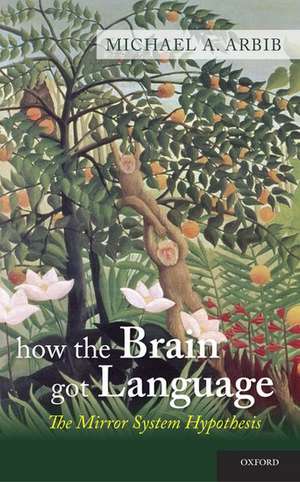
How the Brain Got Language: The Mirror System Hypothesis
Autor Michael A. Arbiben Limba Engleză Hardback – 5 iul 2012
Preț: 459.88 lei
Preț vechi: 571.52 lei
-20%
Puncte Express: 690
Carte tipărită la comandă
Livrare economică 04-15 decembrie
Livrare prin curier în România Termenul estimat este afișat lângă disponibilitate.
Transport gratuit pentru acest produs Plată online sau ramburs, în funcție de opțiunile comenzii.
Retur gratuit în 14 zile Comandă securizată și suport în română.
Specificații
ISBN-13: 9780199896684
ISBN-10: 0199896682
Pagini: 432
Ilustrații: 58 illustrations
Dimensiuni: 236 x 165 x 28 mm
Greutate: 0.76 kg
Editura: Oxford University Press
Colecția OUP USA
Locul publicării:New York, United States
ISBN-10: 0199896682
Pagini: 432
Ilustrații: 58 illustrations
Dimensiuni: 236 x 165 x 28 mm
Greutate: 0.76 kg
Editura: Oxford University Press
Colecția OUP USA
Locul publicării:New York, United States
V-ar putea interesa
-
 The Unfolding of LanguageGuy Deutscher-24%Preț: 65.90 lei86.58 lei
 -
 From Bacteria to Bach and BackDaniel C Dennett-18%Preț: 88.92 lei108.57 lei
 -
 The Language InstinctSteven Pinker-29%Preț: 77.56 lei108.48 lei
 -
 Reading in the BrainStanislas DehaenePreț: 114.00 lei
 -
 Gesture: A Slim GuideLauren Gawne-16%Preț: 115.55 lei137.66 lei
 -
 The Symbolic SpeciesTerrence W. DeaconPreț: 209.57 lei
 -
 Words And RulesProf Steven Pinker-25%Preț: 76.30 lei101.45 lei
 -
 The Singing Neanderthals: The Origins of Music, Language, Mind and BodyProf Steven Mithen-25%Preț: 81.59 lei108.60 lei
 -
 Adam's TongueDerek BickertonPreț: 123.74 lei
 -
 The Origin of Language: How We Learned to Speak and WhyMadeleine Beekman-13%Preț: 105.98 lei122.43 leiRecomandat
 -
 Mirror Thinking: How Role Models Make Us HumanFiona Murden-36%Preț: 66.58 lei103.65 lei
 -
 -19%Preț: 76.02 lei93.44 lei
 -
 The Kingdom of SpeechTom WolfePreț: 92.78 lei
 -
 Speaking in TonguesJ. M. CoetzeePreț: 105.11 lei
 -
 One Hand ClappingNikolay KukushkinPreț: 159.17 lei
 -
 -16%Preț: 80.35 lei95.77 lei
 -
 The Language GameMorten H. Christiansen-25%Preț: 65.25 lei86.55 lei
 -
 Language: The Cultural ToolDaniel Everett-19%Preț: 75.50 lei93.38 lei
 -
 Speech: A Natural HistoryFrancisco Gaona-21%Preț: 251.48 lei319.05 lei
Recenzii
A stimulating review of recent thinking on language evolution along with the most complete explication to date of his mirror system hypothesis, which has been presented in several recent articles...The theoretical breadth is impressive [and it] will be accessible to readers with different backgrounds. I recommend Arbibs book to serious students of language evolution and it should be a valuable resource.
Arbib's book copiously illustrates the interdisciplinarity of research on language evolution, drawing on data from neuroscience, etholohy, linguistics, human palaeontology and prehistoric archaeology.
Arbib's book is well written and engaging. Especially the chapters dealing with mirror neurons and how they function are very interesting.
Arbib's book copiously illustrates the interdisciplinarity of research on language evolution, drawing on data from neuroscience, etholohy, linguistics, human palaeontology and prehistoric archaeology.
Arbib's book is well written and engaging. Especially the chapters dealing with mirror neurons and how they function are very interesting.
Notă biografică
Michael Arbib was a pioneer in the interdisciplinary study of computers and brains, and has long studied brain mechanisms underlying the visual control of action. For more than a decade he has devoted much energy to understanding the relevance of this work, and especially of mirror neurons, to the evolution of the language-ready brain.