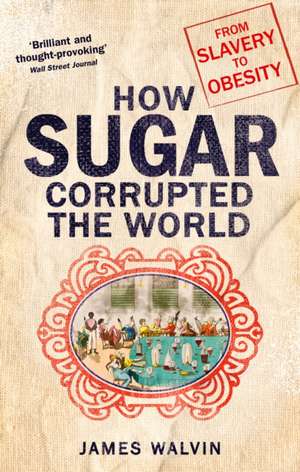
How Sugar Corrupted the World: From Slavery to Obesity
Autor Professor James Walvinen Limba Engleză Paperback – 7 feb 2019
Sven Beckert, the Laird Bell professor of American history at Harvard University and the author of Empire of Cotton: A Global History, in the New York Times
'A brilliant and thought-provoking history of sugar and its ironies'
Bee Wilson, Wall Street Journal
'Shocking and revelatory . . . no other product has so changed the world, and no other book reveals the scale of its impact.' David Olusoga
'This study could not be more timely.' Laura Sandy, Lecturer in the History of Slavery, University of Liverpool
The story of sugar, and of mankind's desire for sweetness in food and drink is a compelling, though confusing story. It is also an historical story.
The story of mankind's love of sweetness - the need to consume honey, cane sugar, beet sugar and chemical sweeteners - has important historical origins. To take a simple example, two centuries ago, cane sugar was vital to the burgeoning European domestic and colonial economies. For all its recent origins, today's obesity epidemic - if that is what it is - did not emerge overnight, but instead evolved from a complexity of historical forces which stretch back centuries. We can only fully understand this modern problem, by coming to terms with its genesis and history: and we need to consider the historical relationship between society and sweetness over a long historical span. This book seeks to do just that: to tell the story of how the consumption of sugar - the addition of sugar to food and drink - became a fundamental and increasingly troublesome feature of modern life.
Walvin's book is the heir to Sidney Mintz's Sweetness and Power, a brilliant sociological account, but now thirty years old. In addition, the problem of sugar, and the consequent intellectual and political debate about the role of sugar, has been totally transformed in the years since that book's publication.
Preț: 63.77 lei
Preț vechi: 88.73 lei
-28%
Puncte Express: 96
Preț estimativ în valută:
11.28€ • 13.23$ • 9.78£
11.28€ • 13.23$ • 9.78£
Carte disponibilă
Livrare economică 17 februarie-03 martie
Livrare express 31 ianuarie-06 februarie pentru 45.64 lei
Specificații
ISBN-13: 9781472138125
ISBN-10: 1472138120
Pagini: 352
Dimensiuni: 126 x 198 x 26 mm
Greutate: 0.24 kg
Editura: Little Brown
Colecția Robinson
Locul publicării:London, United Kingdom
ISBN-10: 1472138120
Pagini: 352
Dimensiuni: 126 x 198 x 26 mm
Greutate: 0.24 kg
Editura: Little Brown
Colecția Robinson
Locul publicării:London, United Kingdom
V-ar putea interesa
-
 A History of South Sudan: From Slavery to IndependenceØystein H. RolandsenPreț: 203.91 lei
 -
 Attila The HunJohn Man-20%Preț: 61.32 lei76.19 lei
 -
 Preț: 451.71 lei
 -
 SudanJok Madut Jok-5%Preț: 105.51 lei111.40 lei
 -
 When the Body Says NoGabor Mate-21%Preț: 69.97 lei88.53 lei
Recenzii
A brilliant and thought-provoking history of sugar and its ironies
As an historian of slavery, Walvin is well-versed in the triangular trade and explains the role of sugar cane in bringing Africans to the Caribbean. His survey of sugar in our lives is very readable.
A convincing, deep history of this (in)famous product . . . This is not simply the tale of those who toiled to produce sugar . . . Something more than just a scholarly text, this study could not be more timely
This study could not be more timely.
A refreshingly historical look at a substance we often take for granted
Former history professor James Walvin's latest book aims to untangle the social, political, and economic history of sugar, a commodity that began as the preserve of the elite, but which now saturates cultures the world over'
An 'entertaining, informative and utterly depressing global history of an important commodity . . . By alerting readers to the ways that modernity's very origins are entangled with a seemingly benign and delicious substance, How Sugar Corrupted the World raises fundamental questions about our world.'
How did a simple commodity, once the prized monopoly of the wealthy, become an essential ingredient in the lives of millions, before mutating yet again into the cause of a global health epidemic?
Prior to 1600, sugar was a costly luxury, but with the rise of the European colonies in the Americas in the seventeenth century, sugar became cheap, ubiquitous and hugely popular - an everyday necessity.
Today, sugar is regularly denounced as a dangerous addiction, on a par with tobacco, and the cause of global epidemics of obesity and diabetes. While consumption remains higher than ever, sugar has become a pariah.
Only now is the extensive ecological harm caused by sugar plantations being fully recognised, but it is the brutal human cost, from enslaved Africans to indentured Indians, that has struck us most forcibly in the recent past.
Walvin shows that we can only fully understand our contemporary dietary concerns by coming to terms with the relationship between society and sweetness over a long historical span, dating back two centuries to a time when sugar was vital to the burgeoning European domestic and colonial economies.
An 'entertaining, informative and utterly depressing global history of an important commodity . . . By alerting readers to the ways that modernity's very origins are entangled with a seemingly benign and delicious substance, How Sugar Corrupted the World raises fundamental questions about our world.'
Sven Beckert, Laird Bell Professor of American History at Harvard University, and author of Empire of Cotton: A Global History
As an historian of slavery, Walvin is well-versed in the triangular trade and explains the role of sugar cane in bringing Africans to the Caribbean. His survey of sugar in our lives is very readable.
A convincing, deep history of this (in)famous product . . . This is not simply the tale of those who toiled to produce sugar . . . Something more than just a scholarly text, this study could not be more timely
This study could not be more timely.
A refreshingly historical look at a substance we often take for granted
Former history professor James Walvin's latest book aims to untangle the social, political, and economic history of sugar, a commodity that began as the preserve of the elite, but which now saturates cultures the world over'
An 'entertaining, informative and utterly depressing global history of an important commodity . . . By alerting readers to the ways that modernity's very origins are entangled with a seemingly benign and delicious substance, How Sugar Corrupted the World raises fundamental questions about our world.'
How did a simple commodity, once the prized monopoly of the wealthy, become an essential ingredient in the lives of millions, before mutating yet again into the cause of a global health epidemic?
Prior to 1600, sugar was a costly luxury, but with the rise of the European colonies in the Americas in the seventeenth century, sugar became cheap, ubiquitous and hugely popular - an everyday necessity.
Today, sugar is regularly denounced as a dangerous addiction, on a par with tobacco, and the cause of global epidemics of obesity and diabetes. While consumption remains higher than ever, sugar has become a pariah.
Only now is the extensive ecological harm caused by sugar plantations being fully recognised, but it is the brutal human cost, from enslaved Africans to indentured Indians, that has struck us most forcibly in the recent past.
Walvin shows that we can only fully understand our contemporary dietary concerns by coming to terms with the relationship between society and sweetness over a long historical span, dating back two centuries to a time when sugar was vital to the burgeoning European domestic and colonial economies.
An 'entertaining, informative and utterly depressing global history of an important commodity . . . By alerting readers to the ways that modernity's very origins are entangled with a seemingly benign and delicious substance, How Sugar Corrupted the World raises fundamental questions about our world.'
Sven Beckert, Laird Bell Professor of American History at Harvard University, and author of Empire of Cotton: A Global History