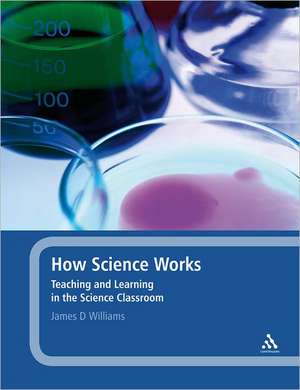
How Science Works: Teaching and Learning in the Science Classroom
Autor James D. Williamsen Limba Engleză Hardback – 17 feb 2011
Preț: 1050.30 lei
Preț vechi: 1364.40 lei
-23%
Puncte Express: 1575
Carte disponibilă
Livrare economică 10-24 noiembrie
Livrare prin curier în România Termenul estimat este afișat lângă disponibilitate.
Transport gratuit pentru acest produs Plată online sau ramburs, în funcție de opțiunile comenzii.
Retur gratuit în 14 zile Comandă securizată și suport în română.
Specificații
ISBN-13: 9781441136428
ISBN-10: 1441136428
Pagini: 156
Dimensiuni: 169 x 244 x 15 mm
Greutate: 0.47 kg
Editura: Bloomsbury Publishing
Colecția Continuum
Locul publicării:London, United Kingdom
ISBN-10: 1441136428
Pagini: 156
Dimensiuni: 169 x 244 x 15 mm
Greutate: 0.47 kg
Editura: Bloomsbury Publishing
Colecția Continuum
Locul publicării:London, United Kingdom
Cuprins
Introduction \ 1. Understanding the Nature of Science \ 2. A Brief History of Science \ 3. What Makes Science 'Science'? \ 4. Laws. Facts, Theories and Hypotheses \ 5. Questions and Critical Thinking in Science \ 6. Is this How Science Works \ 7. Argumentation in Science \ 8. Moral and Ethical Issues in Science Education \ 9. Investigation and Experimentation in Science \ 10. Communicating Science \ 11. How Scientists Work \ References \ Index
Recenzii
'This book is well written, easy to read and engages the reader in thoughtful reflection about How Science Works (HSW). It takes the reader beyond the conventional approach, with its focus on experimental and investigative work, and explores the historical, philosophical, moral and ethical elements as well as providing a focus on how scientists work. This should be a key source for all those involved in science education from science teachers and teacher trainers to trainees. For the latter it offers essential support for work at Masters level.' Roger Lock, Senior Lecturer in Science Education, School of Education, University of Birmingham, UK
'This is a highly readable and comprehensive account that unravels the mysteries of how Science works. The book is an invaluable source of background information and practical advice. It is an ideal introduction for trainee science teachers, newly qualified teachers and experienced practitioners who wish to develop their teaching skills further.' Neil Ingram, Senior Lecturer in Science Education (Biology), Bristol University, UK
'James' ambitious book explores aspects How Science Works (HSW) in a radical, and sometimes controversial way, but from his deep and extensive knowledge of this subject. His style is readily accessible for teachers in their busy lives. They will find themselves well-informed, sometimes unsettled, occasionally rattled, but will also be able to be critically aware of the value of incorporating HSW into the science curriculum, and of the challenge of doing this in an authentic way. They will also understand, and perhaps, be sympathetic to our fumbling attempts to deal with the Nature of Science in our classes, and will be able to play a part in improving learning in these classes, and to be able to contribute to improving the curriculum after reading this book. I thoroughly recommend it to all who wish to be reflective on their science teaching.' John Oversby, recently PGCE Science Course Leader, University of Reading, UK
Author article in The Times Educational Supplement.
This is a very accessible book with excellent practical applications that can be used as a reference when adapting new schemes of work or delivering science in-service training. This book would support the reflective practice of teachers carrying out action research, whether for initial teacher training or working at Master's level.
'This is a highly readable and comprehensive account that unravels the mysteries of how Science works. The book is an invaluable source of background information and practical advice. It is an ideal introduction for trainee science teachers, newly qualified teachers and experienced practitioners who wish to develop their teaching skills further.' Neil Ingram, Senior Lecturer in Science Education (Biology), Bristol University, UK
'James' ambitious book explores aspects How Science Works (HSW) in a radical, and sometimes controversial way, but from his deep and extensive knowledge of this subject. His style is readily accessible for teachers in their busy lives. They will find themselves well-informed, sometimes unsettled, occasionally rattled, but will also be able to be critically aware of the value of incorporating HSW into the science curriculum, and of the challenge of doing this in an authentic way. They will also understand, and perhaps, be sympathetic to our fumbling attempts to deal with the Nature of Science in our classes, and will be able to play a part in improving learning in these classes, and to be able to contribute to improving the curriculum after reading this book. I thoroughly recommend it to all who wish to be reflective on their science teaching.' John Oversby, recently PGCE Science Course Leader, University of Reading, UK
Author article in The Times Educational Supplement.
This is a very accessible book with excellent practical applications that can be used as a reference when adapting new schemes of work or delivering science in-service training. This book would support the reflective practice of teachers carrying out action research, whether for initial teacher training or working at Master's level.