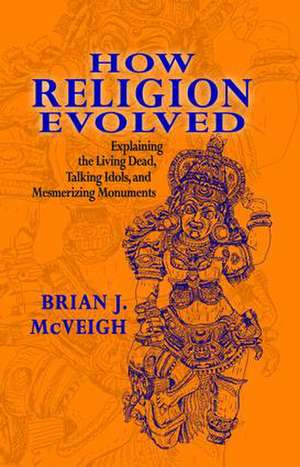
How Religion Evolved: Explaining the Living Dead, Talking Idols, and Mesmerizing Monuments
Autor Brian McVeighen Limba Engleză Hardback – 30 iul 2016
Brian J. McVeigh answers these riddles by updating "bicameralism." First proposed by the psychologist Julian Jaynes, this theory postulates that an earlier mentality existed: a "human" (the brain's left hemisphere) heard voices of "gods" or "ancestors" (the brain's right hemisphere). Therefore, ancient religious texts reporting divine voices were recounting of audio-visual hallucinations—a method of social control when early populations expanded. As growing political economic complexity destabilized god-governed states in the late second millennium BCE, divine voices became inadequate.
Eventually, humans had to culturally acquire new cognitive skills (modern religions) to accommodate increasing social pressures: selves replaced the gods and history witnessed an "inward turn." This psychological interiorization of spiritual experience laid the foundations for the world's great religions and philosophies that arose in India, China, Greece, and the Middle East in the middle of the first millennium BCE.
Preț: 1053.12 lei
Preț vechi: 1224.56 lei
-14%
Puncte Express: 1580
Carte disponibilă
Livrare economică 07-21 noiembrie
Livrare express 24-30 octombrie pentru 34.87 lei
Livrare prin curier în România Termenul estimat este afișat lângă disponibilitate.
Transport gratuit pentru acest produs Plată online sau ramburs, în funcție de opțiunile comenzii.
Retur gratuit în 14 zile Comandă securizată și suport în română.
Specificații
ISBN-13: 9781412862868
ISBN-10: 1412862868
Pagini: 310
Dimensiuni: 152 x 229 x 23 mm
Greutate: 0.48 kg
Ediția:1
Editura: Taylor & Francis
Colecția Routledge
Locul publicării:Oxford, United Kingdom
ISBN-10: 1412862868
Pagini: 310
Dimensiuni: 152 x 229 x 23 mm
Greutate: 0.48 kg
Ediția:1
Editura: Taylor & Francis
Colecția Routledge
Locul publicării:Oxford, United Kingdom
V-ar putea interesa
-
 -21%Preț: 347.66 lei437.80 lei
 -
 The Religion FactorGreenPreț: 288.97 lei
 -
 -28%Preț: 346.63 lei484.55 lei
 -
 Japanese Higher Education as MythBrian J. McVeighPreț: 410.99 lei
 -
 Preț: 474.90 lei
 -
 Religion of the Semites: The Fundamental InstitutionsRoberta Segal-15%Preț: 460.02 lei541.20 lei
 -
 Preț: 303.19 lei
 -
 Matter, Magic, and SpiritDavid Murray-11%Preț: 486.76 lei546.92 lei
 -
 The Nature of the Japanese State: Rationality and RitualityBrian J. McVeigh-15%Preț: 425.72 lei500.84 lei
 -
 Christ Versus KrishnaL. A. SakesPreț: 153.15 lei
 -
 Pantheism - Its Story and SignificanceJ. Allanson PictonPreț: 158.44 lei
 -
 An Introduction To Comparative PsychologyC. Lloyd MorganPreț: 250.68 lei
 -
 Creed and DeedFelix AdlerPreț: 187.08 lei
 -
 Preț: 257.68 lei
 -
 The History of Japanese Psychology: Global Perspectives, 1875-1950Dr. Brian J. McVeigh-33%Preț: 838.13 lei1244.22 lei
 -
 Burmese SupernaturalismMelford E. SpiroPreț: 473.80 lei
 -
 Wise Secrets of AlohaKahuna Harry Uhane JimPreț: 92.41 lei
 -
 The Edinburgh Lectures on Mental Science (1909)Thomas TrowardPreț: 107.05 lei
 -
 Preț: 287.86 lei
 -
 The Great Indian ReligionsG. T. BettanyPreț: 108.98 lei
 -
 Look Behind The FacadeAbbas SundiataPreț: 228.99 lei
Cuprins
Contents
Foreword by Marcel Kuijsten
Acknowledgments
Prologue: Chasing Ghosts in Tokyo
Part I: The World According to the Gods
1 The Failure of Science to Explain Religion
2 Why the Gods Began to Speak
3 Divine Voices and Visions as Social Adaptation
Part II: When the Gods Spoke and Walked among Us
4 The Living Dead: Explaining Entombment and Ancestor Worship
5 Towns as the Domain of the Gods
6 Temples as Relay Stations: Transmitting Divine Commands
7 Talking Idols: Tools of Divine Control
8 Mortuary Monuments: How the Gods Awed Their Followers
9 Heavenly Ambassadors: God–Kings and Sacred Rulers
10 Ancient Civilizations as God-Governed
11 Mesoamerica: Theocentric Civilizations of the New World
12 Trimming the Theological Tree: Monotheism as Adaptation
13 Angels, Divine Messengers, and Swarms of Demons
Part III: When the Gods Fell Silent
14 Prayers, Possessions, and Prophecies: Conjuring Up the Missing Gods
15 The Gods Depart: The Late-Bronze-Period Dark Ages
16 A Change of Mind in the Ancient World
17 The Axial Age: The World Reborn without Gods
18 Imagining the Transcendent: A New Cognitive Ability
19 Introcosm: A New World of Space and Time
20 The Self Replaces the Gods
21 From Revelation to Reasoning
22 When the Gods Still Whisper: Strange Behaviors Explained
Epilogue: Science and Politics as Neo-Religion
Appendices and Supplementary Charts
A How to Chase Ghosts
B Explaining Religion versus Explaining Religion Away
C Gods on the Brain: Neurotheology
D The Problem with "Cultural Evolution"
E Six Hypotheses of Jaynesian Psychology
F The Limitations of Evolutionary Psychology
G Prehistoric and Historic Mentalities in Perspective
H Predictable Objections, Rebuttals, and Qualifications
I Verification and Applications of Jaynes's Theories
J Primitive Psychopolitics and Neurocultural Adaptation
K A History of Mentalities
L Population Size of Ancient Towns and Cities
M Dreams: A Form of Conscious Interiority
N Pre-Axial and Axial Ages Compared
O Solving the Mystery of Hallucinations
P Autoscopy: Seeing One's Double
Q What the Gods Can Teach Us: A New Understanding of the Mind
Timelines of Mentalities
Explanation
1 Three Major Shifts in Human Mentality
2 Prehistoric Mentalities
3 Middle East
4 Africa
5 Europe
6 South Asia
7 East Asia
8 Southeast Asia
9 Oceania
10 North America
11 South America
12 Mesoamerica
Glossary
References
Index
Foreword by Marcel Kuijsten
Acknowledgments
Prologue: Chasing Ghosts in Tokyo
Part I: The World According to the Gods
1 The Failure of Science to Explain Religion
2 Why the Gods Began to Speak
3 Divine Voices and Visions as Social Adaptation
Part II: When the Gods Spoke and Walked among Us
4 The Living Dead: Explaining Entombment and Ancestor Worship
5 Towns as the Domain of the Gods
6 Temples as Relay Stations: Transmitting Divine Commands
7 Talking Idols: Tools of Divine Control
8 Mortuary Monuments: How the Gods Awed Their Followers
9 Heavenly Ambassadors: God–Kings and Sacred Rulers
10 Ancient Civilizations as God-Governed
11 Mesoamerica: Theocentric Civilizations of the New World
12 Trimming the Theological Tree: Monotheism as Adaptation
13 Angels, Divine Messengers, and Swarms of Demons
Part III: When the Gods Fell Silent
14 Prayers, Possessions, and Prophecies: Conjuring Up the Missing Gods
15 The Gods Depart: The Late-Bronze-Period Dark Ages
16 A Change of Mind in the Ancient World
17 The Axial Age: The World Reborn without Gods
18 Imagining the Transcendent: A New Cognitive Ability
19 Introcosm: A New World of Space and Time
20 The Self Replaces the Gods
21 From Revelation to Reasoning
22 When the Gods Still Whisper: Strange Behaviors Explained
Epilogue: Science and Politics as Neo-Religion
Appendices and Supplementary Charts
A How to Chase Ghosts
B Explaining Religion versus Explaining Religion Away
C Gods on the Brain: Neurotheology
D The Problem with "Cultural Evolution"
E Six Hypotheses of Jaynesian Psychology
F The Limitations of Evolutionary Psychology
G Prehistoric and Historic Mentalities in Perspective
H Predictable Objections, Rebuttals, and Qualifications
I Verification and Applications of Jaynes's Theories
J Primitive Psychopolitics and Neurocultural Adaptation
K A History of Mentalities
L Population Size of Ancient Towns and Cities
M Dreams: A Form of Conscious Interiority
N Pre-Axial and Axial Ages Compared
O Solving the Mystery of Hallucinations
P Autoscopy: Seeing One's Double
Q What the Gods Can Teach Us: A New Understanding of the Mind
Timelines of Mentalities
Explanation
1 Three Major Shifts in Human Mentality
2 Prehistoric Mentalities
3 Middle East
4 Africa
5 Europe
6 South Asia
7 East Asia
8 Southeast Asia
9 Oceania
10 North America
11 South America
12 Mesoamerica
Glossary
References
Index
Descriere
Why did many religious leaders—Moses, Old Testament prophets, Zoroaster—claim they heard divine voices? Why do ancient civilizations exhibit key similarities, e