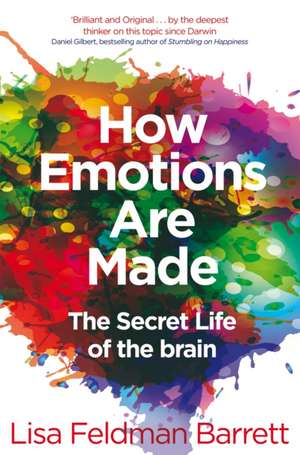
How Emotions Are Made: The Secret Life of the Brain: Cărți despre Emoții engleză
Autor Lisa Feldman Barretten Limba Engleză Paperback – 8 feb 2018 – vârsta de la 18 ani
În cadrul studiilor de psihologie cognitivă și neuroștiințe, How Emotions Are Made ocupă un loc central, fiind lucrarea care deconstruiește paradigma clasică a emoțiilor ca reacții instinctive, universale. Descoperim aici o perspectivă radicală: emoțiile nu sunt „declanșate” de lumea exterioară, ci sunt construcții psihologice complexe realizate de creier în timp real. Lisa Feldman Barrett utilizează datele din neuroimagistică pentru a demonstra că nu există „amprente” biologice fixe pentru furie sau fericire, invalidând astfel ipoteze vechi de două milenii. Textul este organizat riguros, pornind de la critica mitului universalității (capitolul 3) și avansând spre fundamentul biologic în „How the Brain Makes Emotions”. Reținem că această abordare este mai accesibilă și mai orientată spre implicații sociale decât volumul academic anterior al autoarei, The Psychological Construction of Emotion. Dacă acea lucrare se concentra pe fundamentele teoretice pentru cercetători, titlul de față extinde analiza spre realitatea socială și sistemul juridic. De asemenea, deși acoperă o arie similară cu Emotion de Dylan Evans, lucrarea Lisei Barrett oferă o argumentație mult mai tehnică și ancorată în neuroștiințe, depășind nivelul introductiv pentru a propune un nou model al naturii umane. Structura cărții ghidează cititorul de la mecanismele de bază ale creierului până la aplicații practice în medicină și drept. Analiza modului în care conceptele și cuvintele ne modelează biologia transformă lectura într-un instrument de înțelegere a propriei sănătăți și a modului în care interacționăm cu ceilalți, oferind în final strategii pentru „stăpânirea emoțiilor”.


Preț: 62.90 lei
Preț vechi: 94.14 lei
-33%
Carte disponibilă
Livrare economică 30 octombrie-13 noiembrie
Livrare express 16-22 octombrie pentru 56.09 lei
Specificații
ISBN-10: 1509837523
Pagini: 448
Dimensiuni: 128 x 198 x 32 mm
Greutate: 0.32 kg
Editura: Pan Macmillan
Colecția Pan Books
Seria Cărți despre Emoții engleză
V-ar putea interesa
-
 Thinking, Fast and SlowDaniel Kahneman-27%Preț: 90.73 lei123.57 leiRecomandat
 -
 The Brain That Changes ItselfNorman Doidge-29%Preț: 66.97 lei94.56 lei
 -
 -16%Preț: 865.74 lei1032.36 leiRecomandat
 -
 -29%Preț: 66.68 lei94.39 lei
 -
 Puzzle Ideal Bookshelf: UniversalJane MountPreț: 105.84 lei
 -
 -5%Preț: 174.66 lei183.85 lei
 -
 The GruffaloJulia Donaldson-18%Preț: 41.77 lei50.98 lei
 -
 I Am BatMorag Hood-41%Preț: 37.84 lei63.96 lei
 -
 Smarter Faster BetterCharles Duhigg-24%Preț: 65.67 lei86.85 lei
De ce să citești această carte
Această carte este esențială pentru oricine dorește să înțeleagă biologia din spatele sentimentelor. Cititorul câștigă o perspectivă nouă asupra controlului emoțional și a modului în care experiențele trecute influențează reacțiile prezente. Este o recomandare excelentă pentru studenții la psihologie, dar și pentru profesioniștii din drept sau medicină care vor să înțeleagă cum prejudecățile despre emoții pot afecta deciziile profesionale critice.
Despre autor
Lisa Feldman Barrett, Ph.D., este profesor universitar distins la Northeastern University, deținând poziții de cercetare și la Harvard Medical School și Massachusetts General Hospital în departamentele de Psihiatrie și Radiologie. Recunoscută la nivel mondial pentru studiile sale inovatoare, a primit premiul NIH Director's Pioneer Award pentru cercetările privind bazele neurologice ale emoțiilor. În afara lucrărilor academice de referință, precum Handbook of Emotions, Fourth Edition, ea a publicat și volume de popularizare a științei, inclusiv Seven and a Half Lessons About the Brain, consolidându-și reputația de specialist care poate traduce concepte neuroștiințifice complexe pentru publicul larg.
Descriere
'How Emotions Are Made did what all great books do. It took a subject I thought I understood and turned my understanding upside down' - Malcolm GladwellWhen you feel anxious, angry, happy, or surprised, what's really going on inside of you? Many scientists believe that emotions come from a specific part of the brain, triggered by the world around us. The thrill of seeing an old friend, the fear of losing someone we love - each of these sensations seems to arise automatically and uncontrollably from within us, finding expression on our faces and in our behaviour, carrying us away with the experience.
This understanding of emotion has been around since Plato. But what if it is wrong? In How Emotions Are Made, pioneering psychologist and neuroscientist Lisa Feldman Barrett draws on the latest scientific evidence to reveal that our common-sense ideas about emotions are dramatically, even dangerously, out of date - and that we have been paying the price. Emotions aren't universally pre-programmed in our brains and bodies; rather they are psychological experiences that each of us constructs based on our unique personal history, physiology and environment.
This new view of emotions has serious implications: when judges issue lesser sentences for crimes of passion, when police officers fire at threatening suspects, or when doctors choose between one diagnosis and another, they're all, in some way, relying on the ancient assumption that emotions are hardwired into our brains and bodies. Revising that conception of emotion isn't just good science, Barrett shows; it's vital to our well-being and the health of society itself.
Notă biografică
Lisa Feldman Barrett, Ph.D., is a University Distinguished Professor of Psychology at Northeastern University, with appointments at Harvard Medical School and Massachusetts General Hospital in Psychiatry and Radiology. She received a NIH Director's Pioneer Award for her research on emotion in the brain. She lives in Boston.
Cuprins
Introduction - i: Introduction: The Two Thousand Year Old Assumption Chapter - 1: The Search For Emotion's ''Fingerprints'' Chapter - 2: Emotions Are Constructed Chapter - 3: The Myth of Universal Emotions Chapter - 4: The Origin of Feeling Chapter - 5: Concepts, Goals, and Words Chapter - 6: How the Brain Makes Emotions Chapter - 7: Emotions As A Social Reality Chapter - 8: A New View of Human Nature Chapter - 9: Mastering Your Emotions Chapter - 10: Emotions and Illness Chapter - 11: Emotion and the Law Chapter - 12: Is a Growling Dog Angry? Chapter - 13: From Brain to Mind: The New Frontier Acknowledgements - ii: Acknowledgments Section - iii: Appendix A: Brain Basics Section - iv: Appendix B: Supplement for Chapter 2 Section - v: Appendix C: Supplement for Chapter 3 Section - vi: Appendix D: Evidence for the Concept Cascade Section - vii: Bibliography Section - viii: Notes Section - ix: Illustration Credits Index - x: Index