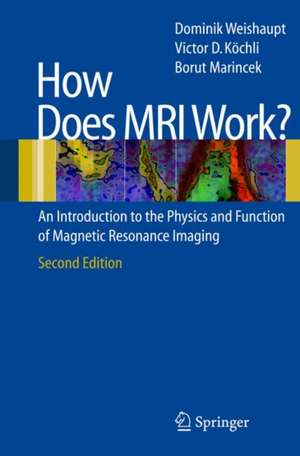
How does MRI work?: An Introduction to the Physics and Function of Magnetic Resonance Imaging
Autor Dominik Weishaupt Contribuţii de J.M. Froehlich Autor Victor D. Köchli Contribuţii de D. Nanz Autor Borut Marincek Contribuţii de K.P. Pruessmannen Limba Engleză Paperback – 18 iul 2006
Remarcăm în această a doua ediție a lucrării How does MRI work?, publicată de Springer, un format pedagogic riguros, conceput special pentru rezidenți, studenți și tehnologi care necesită o înțelegere conceptuală a fizicii imagisticii prin rezonanță magnetică, fără a fi experți în fizică teoretică. Organizată în 15 capitole cu o progresie liniară, cartea pornește de la fenomenul rezonanței magnetice nucleare și relaxare, avansând către codificarea spațială și secvențe de puls complexe. Apreciem în mod deosebit structura logică ce facilitează asimilarea conceptelor dificile, culminând cu aspecte practice esențiale precum artefactele și siguranța biologică.
Această ediție actualizată integrează progresele tehnologice recente prin introducerea a două secțiuni noi dedicate tehnicilor de suprimare a grăsimii și imagisticii clinice de câmp înalt. De asemenea, capitolul despre imagistica cardiovasculară a fost extins pentru a reflecta complexitatea actuală a protocoalelor clinice. Lucrarea păstrează spiritul clar al ediției originale germane, Wie funktioniert MRI?, fundamentând succesul internațional al autorului Dominik Weishaupt și al echipei sale.
În contextul literaturii de specialitate, How does MRI work? completează excelent titlul Magnetic Resonance Imaging de Stewart C. Bushong prin abordarea sa mai sintetică și focalizată pe mecanismele funcționale imediate. În timp ce lucrarea lui Bushong oferă o acoperire vastă a principiilor biologice, textul de față se distinge printr-o rigoare clinică specifică școlii europene de radiologie, fiind o resursă mai accesibilă pentru pregătirea examenelor de specialitate față de manualele tehnice exhaustive.
Preț: 500.63 lei
Preț vechi: 526.98 lei
-5%
Carte tipărită la comandă
Livrare economică 15-29 iunie
Specificații
ISBN-10: 3540300678
Pagini: 170
Ilustrații: XII, 170 p. 57 illus.
Dimensiuni: 155 x 235 x 15 mm
Greutate: 0.27 kg
Ediția:2nd ed. 2006
Editura: Springer Berlin, Heidelberg
Colecția Springer
Locul publicării:Berlin, Heidelberg, Germany
V-ar putea interesa
-
 Lange Q&A MRI Examination, First EditionBarry Southers-34%Preț: 350.87 lei529.18 lei
 -
 Magnetic Resonance Imaging: Physical and Biological PrinciplesStewart C. Bushong-5%Preț: 538.83 lei567.19 lei
 -
 -28%Preț: 931.23 lei1300.85 lei
 -
 Duke Review of MRI Physics: Case Review SeriesWells Mangrum-28%Preț: 370.06 lei514.16 lei
 -
 Fundamentals of Body MRIChristopher G. Roth-29%Preț: 613.03 lei861.94 lei
 -
 Sectional Anatomy by MRI and CTMark W. Anderson-30%Preț: 1726.80 lei2455.03 lei
 -
 MRI in PracticeCatherine Westbrook-5%Preț: 352.45 lei371.00 lei
 -
 Rad Tech's Guide to MRIWilliam H. Faulkner-5%Preț: 323.63 lei340.67 lei
 -
 Handbook of MRI TechniqueCatherine Westbrook-5%Preț: 432.63 lei455.40 lei
 -
 -5%Preț: 814.16 lei857.01 lei
 -
 MRI in PracticeCatherine Westbrook-5%Preț: 313.63 lei330.14 lei
 -
 MRI: The BasicsRay H. Hashemi MD, PhD-29%Preț: 482.11 lei674.67 lei
 -
 Diagnostic MRI in Dogs and CatsWilfried Mai-9%Preț: 2148.41 lei2360.88 lei
 -
 The Essential Physics of Medical ImagingJerrold T. Bushberg PhD-26%Preț: 1181.91 lei1605.44 lei
 -
 The Physics of Clinical MR Taught Through ImagesVal M. Runge-5%Preț: 623.08 lei655.87 lei
 -
 Case-based Atlas of Cardiovascular Magnetic ResonanceAndrea Barison-5%Preț: 1303.93 lei1372.56 lei
 -
 High-Field MR ImagingJürgen Hennig-5%Preț: 1065.82 lei1121.92 lei
 -
 Clinical MR ImagingPeter Reimer-5%Preț: 1355.88 lei1427.24 lei
 -
 MRI Made Easy (for Beginners)Govind B Chavhan-5%Preț: 273.34 lei287.72 lei
 -
 -57%Preț: 1697.00 lei3908.44 lei
Public țintă
Professional/practitionerDe ce să citești această carte
Recomandăm această resursă oricărui profesionist aflat la începutul instruirii în imagistică medicală. Cititorul câștigă o înțelegere clară a modului în care parametrii tehnici influențează calitatea imaginii, fără a se pierde în ecuații matematice complexe. Este un instrument esențial pentru a trece de la operarea intuitivă a echipamentului la o practică bazată pe înțelegerea fenomenelor fizice, asigurând astfel optimizarea protocoalelor și siguranța pacientului.
Descriere scurtă
Cuprins
Recenzii
Radiology 2008: "... The book is well organized, with a linear and logical sequence. The chapters progress from basic to more complex concepts, and subsequent chapters build well on their predecessors. ... The authors employ clear and concise language, and explanations of even the most difficult concepts were quite adequate. ... The authors are concise yet thorough in their discussion of MR, as well as the many procedures and sequences for producing MR images. This book is reasonably priced and provides a good framework for further study into this complex topic." (Brian Suddarth, MD, Radiology: Volume 246: Number 3, March 2008)
Surgical and Radiological Anatomy Vol. 26, Issue 3, 2004: ..the authors describe in English in the plainest fashion, and within hardly more than 100 pages, the theroretical and technical bases of magnetic resonance imaging. ...the book should be warmly recommended to anyone after thry have become accustomed to MRI. In such circumstances this is a very comprehensive handbook, particularly useful as a reminder of the concepts of MRI.... a valuable technical handbook...
"This volume is the first translation into English of the German edition … . it is a text for those who wish to familiarize themselves with the workings of magnetic resonance imaging. … has a lucid yet not oversimplified text and extremely informative, high-quality images. The very useful glossary completes the book. … the book is easy to carry around in a bag or brief case, and you will soon find yourself reading it whenever you have time. An excellent publication!" (E. K. J. Pauwels, European Journal of Nuclear Medicine and Molecular Imaging, Vol. 32 (3), March, 2005)
From the reviews of the second edition:
"The book presents short, bite-sized chapters of MR information that can be easily digested. … This book would suit part 1 trainees undertaking an MRI placement, or students wantingto cover the basics of MR. … Similarly, this book would also be well suited to radiologists doing their training or radiographers … . As an introduction to MRI this book meets its aim, and it does it very well too. … a worthwhile purchase for anyone wishing to gain a good grounding in MRI." (John McLean, SCOPE, June, 2007)