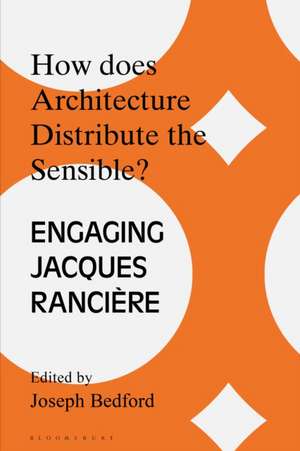
How Does Architecture Distribute the Sensible?: Engaging Jacques Rancière: Architecture Exchange: Engagements with Contemporary Theory and Philosophy
Editat de Joseph Bedforden Limba Engleză Hardback – 11 dec 2025
This book brings Jacques Rancière's demand for equality and his reformulation of aesthetics into direct dialogue with architecture. In doing so, it inquires into the role that architecture plays in distributing the sensible, in creating aesthetic experiences, in creating order or dissensus, in serving as a mode of critique, and in emancipating or stultifying its users and subjects.
Through this detailed exchange between Rancière and four of the world's leading architectural thinkers; Anthony Vidler, Joan Ockman, Peggy Deamer and Michael Young, a debate unfolds within the book that tests the implications of Rancière's aesthetic philosophy for architectural practice today; questioning the way we write architectural history, how architects draw, what the labor of the architect is, and that questions key architectural ideas such as the distribution, function, use, ornament, discipline and design.


Preț: 527.26 lei
Preț vechi: 791.01 lei
-33%
Puncte Express: 791
Carte disponibilă
Livrare economică 06-20 noiembrie
Livrare prin curier în România Termenul estimat este afișat lângă disponibilitate.
Transport gratuit pentru acest produs Plată online sau ramburs, în funcție de opțiunile comenzii.
Retur gratuit în 14 zile Comandă securizată și suport în română.
Specificații
ISBN-13: 9781350342804
ISBN-10: 1350342807
Pagini: 208
Ilustrații: 20 bw photos
Dimensiuni: 160 x 236 x 18 mm
Greutate: 0.46 kg
Editura: Bloomsbury Publishing
Colecția Bloomsbury Academic
Seria Architecture Exchange: Engagements with Contemporary Theory and Philosophy
Locul publicării:London, United Kingdom
ISBN-10: 1350342807
Pagini: 208
Ilustrații: 20 bw photos
Dimensiuni: 160 x 236 x 18 mm
Greutate: 0.46 kg
Editura: Bloomsbury Publishing
Colecția Bloomsbury Academic
Seria Architecture Exchange: Engagements with Contemporary Theory and Philosophy
Locul publicării:London, United Kingdom
Cuprins
Chapter 1: Introduction: Joseph Bedford (Virginia tech), How does Architecture Distribute the Sensible?
Chapter 2: Peggy Deamer (Yale University), The (Working) Subject of Architecture
Interview: Peggy Deamer
Chapter 3: Anthony Vidler (The Cooper Union), Partage de l'utopie
Interview: Anthony Vidler
Chapter 4: Michael Young (The Cooper Union), The Interruption of the Image
Interview: Michael Young
Chapter 5: Joan Ockman (The University of Pennsylvania), An Apparatus for Emancipated Spectatorship
Interview: Joan Ockman
Chapter 6: Jacques Rancière (Université de Paris, VIII), Architecture and Aesthetics
Interview: Jacques Rancière
Chapter 8: Discussion
9: Bibliography
Chapter 2: Peggy Deamer (Yale University), The (Working) Subject of Architecture
Interview: Peggy Deamer
Chapter 3: Anthony Vidler (The Cooper Union), Partage de l'utopie
Interview: Anthony Vidler
Chapter 4: Michael Young (The Cooper Union), The Interruption of the Image
Interview: Michael Young
Chapter 5: Joan Ockman (The University of Pennsylvania), An Apparatus for Emancipated Spectatorship
Interview: Joan Ockman
Chapter 6: Jacques Rancière (Université de Paris, VIII), Architecture and Aesthetics
Interview: Jacques Rancière
Chapter 8: Discussion
9: Bibliography
Recenzii
The Architecture Exchange has found a unique means to expand and advance architectural thinking and plumb the possibilities that lie between theory and architecture. Rather than simply transcribing conference presentations, How Does Architecture Distribute the Sensible? models real exchange (fittingly enough) among the collection's participants. Each entry has been workshopped, in person and by email, by the group, giving a depth to the texts that transforms this from a book to a robust seminar on Rancière's relevance to architecture.
As an exploration of ethical, representative, and aesthetic concerns, How Does Architecture Distribute the Sensible? offers new insights into longstanding considerations, specifically the capacities of philosophy and architecture to each inscribe the other. Drawing on the work of philosopher Jacques Rancière, in dialogue with contemporary architectural thinkers, this collection explores the interiority and exteriority of architecture (as a physical entity and discursive framework) as a relationship between aesthetics and politics. How Does Architecture Distribute the Sensible? does not offer the definitions of new norms; instead, it questions capabilities (and limitations).
As an exploration of ethical, representative, and aesthetic concerns, How Does Architecture Distribute the Sensible? offers new insights into longstanding considerations, specifically the capacities of philosophy and architecture to each inscribe the other. Drawing on the work of philosopher Jacques Rancière, in dialogue with contemporary architectural thinkers, this collection explores the interiority and exteriority of architecture (as a physical entity and discursive framework) as a relationship between aesthetics and politics. How Does Architecture Distribute the Sensible? does not offer the definitions of new norms; instead, it questions capabilities (and limitations).