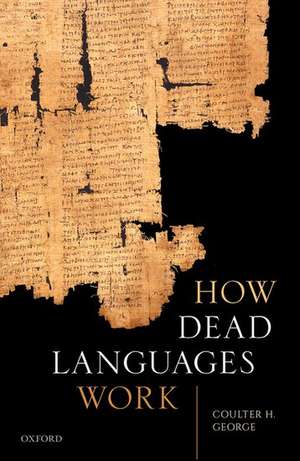
How Dead Languages Work
Autor Coulter H. Georgeen Limba Engleză Hardback – 20 apr 2020
What could Greek poets or Roman historians say in their own language that would be lost in translation? After all, different languages have different personalities, and this is especially clear with languages of the ancient and medieval world. This volume celebrates six such languages - Ancient Greek, Latin, Old English, Sanskrit, Old Irish, and Biblical Hebrew - by first introducing readers to their most distinctive features, then showing how these linguistic traitsplay out in short excerpts from actual ancient texts. It explores, for instance, how Homer's Greek shows signs of oral composition, how Horace achieves striking poetic effects through interlaced word order in his Latin, and how the poet of Beowulf attains remarkable intensity of expression throughthe resources of Old English. But these are languages that have shared connections as well. Readers will see how the Sanskrit of the Rig Veda uses words that come from roots found also in English, how turns of phrase characteristic of the Hebrew Bible found their way into English, and that even as unusual a language as Old Irish still builds on common Indo-European linguistic patterns. Very few people have the opportunity to learn these languages, and they can often seem mysterious andinaccessible: drawing on a lucid and engaging writing style and with the aid of clear English translations throughout, this book aims to give all readers, whether scholars, students, or interested novices, an aesthetic appreciation of just how rich and varied they are.
Preț: 182.60 lei
Preț vechi: 217.07 lei
-16%
Carte tipărită la comandă
Livrare economică 10-16 decembrie
Livrare express 03-07 noiembrie pentru 65.97 lei
Specificații
ISBN-10: 0198852827
Pagini: 234
Dimensiuni: 157 x 240 x 17 mm
Greutate: 0.5 kg
Editura: OUP OXFORD
Colecția OUP Oxford
Locul publicării:Oxford, United Kingdom
Recenzii
On the whole, this is an excellent book, and it should prove a very stimulating introduction to ancient languages in general and to comparative linguistics for students and for interested laypersons. The author claims that he wishes to convey enthusiasm for learning the languages discussed in the book, as well as to acquaint students with a certain degree of linguistic diversity, and he masterfully succeeds in doing this.
(...) this is a book about the impossibility or the limits of translation and the awareness of how much is lost when, by changing the language, the expressive resources also have to be altered.
Notă biografică
Coulter H. George is Professor of Classics at the University of Virginia. The author of Expressions of Agency in Ancient Greek (CUP, 2005) and Expressions of Time in Ancient Greek (CUP, 2014), he has also taught at Rice University and was a Junior Research Fellow at Trinity College, Cambridge.
Cuprins
- 1: Introduction
- 2: Greek
- The sounds of Greek
- Word-forms
- The Iliad
- Formulas
- Thucydides and abstract language
- Pauline prepositions
- 3: Latin
- How Latin works
- Lucretius
- Horace and Housman
- Tacitus
- 4: Old English and the Germanic Languages
- Grimm's Law and umlaut
- Verbs, strong and weak
- Old English
- Beowulf
- 5: Sanskrit
- The sounds of Sanskrit
- Sandhi
- Nouns in Sanskrit
- The Rig Veda
- How to kill a dragon
- The hidden names of the dawn-cows
- 6: Old Irish and the Celtic Languages
- The eccentricities of the Irish language
- Old Irish in action
- Welsh
- 7: Hebrew
- The sounds of Semitic
- How Semitic words change shape
- Let there be light
- Noun chains
- 8: Epilogue and Further Reading
- Endmatter
- Index