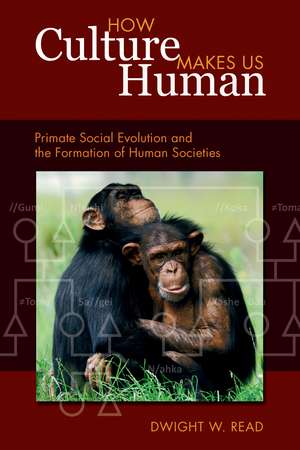
How Culture Makes Us Human: Primate Social Evolution and the Formation of Human Societies: Key Questions in Anthropology
Autor Dwight W Readen Limba Engleză Hardback – 31 oct 2011
Preț: 1114.85 lei
Preț vechi: 1359.57 lei
-18%
Puncte Express: 1672
Carte tipărită la comandă
Livrare economică 07-21 decembrie
Livrare prin curier în România Termenul estimat este afișat lângă disponibilitate.
Transport gratuit pentru acest produs Plată online sau ramburs, în funcție de opțiunile comenzii.
Retur gratuit în 14 zile Comandă securizată și suport în română.
Specificații
ISBN-13: 9781598745887
ISBN-10: 1598745883
Pagini: 238
Ilustrații: 30 illustrations and tables, notes, references, index
Dimensiuni: 152 x 229 x 20 mm
Greutate: 0.52 kg
Ediția:New.
Editura: Taylor & Francis
Colecția Routledge
Seria Key Questions in Anthropology
Locul publicării:Oxford, United Kingdom
ISBN-10: 1598745883
Pagini: 238
Ilustrații: 30 illustrations and tables, notes, references, index
Dimensiuni: 152 x 229 x 20 mm
Greutate: 0.52 kg
Ediția:New.
Editura: Taylor & Francis
Colecția Routledge
Seria Key Questions in Anthropology
Locul publicării:Oxford, United Kingdom
Cuprins
Introduction1. The Primate Beginning Point2. The Hunter-Gatherer Ending Point3. The Chimpanzee Middle Point4. From OW Monkeys to Chimpanzees to Humans5. Transition to Relational Systems of Social OrganizationConclusionReferencesIndex
Recenzii
"...Dwight Read has brought his strong mathematical and logical skills to bear on the fundmental issue of what distinguishes cultural phenomena, both as systems and as evolutionary phenomena. Anyone concerned with 'what makes us human' will find new and important perspectives in this work."... --Henry Wright, University of Michigan
"Read argues for the emergence of enhanced cognitive abilities, and especially an increase in short-term working memory, as a driving force behind human behavioral evolution. The author reviews the diversity of social systems among Old World monkeys and chimpanzees, humans' closest living relatives, in an attempt to establish the foundation of human social organization. The book lead readers from an appreciation of the complexities of monkey and ape societies to an understanding of the sophistication of modern human communities; this transition is accompanied by an organizationl shift from biological kin selection to cultural group selection.
Summing up: Recommended. Undergraduate students and general readers."- A. Delgado Jr., CHOICE
"How Culture Makes Us Human is an intriguing book that I like very much. My appreciation stems from the author's ability to explicitly outline the cognitive capabilities within various primate lineages in order to demonstrate qualities of mind that allow for a cultural kinship system to develop. The book should appeal to both the evolutionary theory camp and the culture-is-unique camp in anthropology (and the social sciences) because it implies that both sides have a point. Clearly written, the book also contains numerous useful figures and illustrations. I recommend it highly for use in both graduate and undergraduate anthropology courses pertaining to evolution, the primates, hunter-gatherers, and culture."--William Raymond Yaworsky, Anthropology Review Database
"Read argues for the emergence of enhanced cognitive abilities, and especially an increase in short-term working memory, as a driving force behind human behavioral evolution. The author reviews the diversity of social systems among Old World monkeys and chimpanzees, humans' closest living relatives, in an attempt to establish the foundation of human social organization. The book lead readers from an appreciation of the complexities of monkey and ape societies to an understanding of the sophistication of modern human communities; this transition is accompanied by an organizationl shift from biological kin selection to cultural group selection.
Summing up: Recommended. Undergraduate students and general readers."- A. Delgado Jr., CHOICE
"How Culture Makes Us Human is an intriguing book that I like very much. My appreciation stems from the author's ability to explicitly outline the cognitive capabilities within various primate lineages in order to demonstrate qualities of mind that allow for a cultural kinship system to develop. The book should appeal to both the evolutionary theory camp and the culture-is-unique camp in anthropology (and the social sciences) because it implies that both sides have a point. Clearly written, the book also contains numerous useful figures and illustrations. I recommend it highly for use in both graduate and undergraduate anthropology courses pertaining to evolution, the primates, hunter-gatherers, and culture."--William Raymond Yaworsky, Anthropology Review Database
Descriere
In this engaging, thought-provoking book, Dwight Read explores the fundamental scientific debate about how culture and social organization separate humans from our primate cousins.