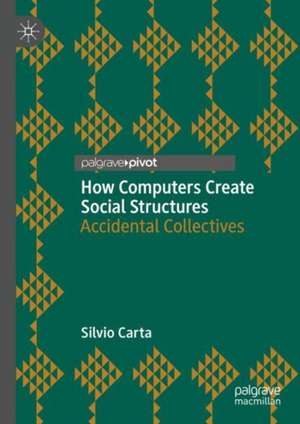
How Computers Create Social Structures
Autor Silvio Cartaen Limba Engleză Hardback – 18 sep 2024
Preț: 320.82 lei
Puncte Express: 481
Carte tipărită la comandă
Livrare economică 23-30 noiembrie
Livrare prin curier în România Termenul estimat este afișat lângă disponibilitate.
Transport gratuit de la 400.00 lei Plată online sau ramburs, în funcție de opțiunile comenzii.
Retur gratuit în 14 zile Comandă securizată și suport în română.
Specificații
ISBN-13: 9783031628511
ISBN-10: 3031628519
Pagini: 132
Ilustrații: Approx. 150 p. 25 illus.
Dimensiuni: 153 x 216 x 12 mm
Greutate: 0.29 kg
Ediția:2024
Editura: Springer
Locul publicării:Cham, Switzerland
ISBN-10: 3031628519
Pagini: 132
Ilustrații: Approx. 150 p. 25 illus.
Dimensiuni: 153 x 216 x 12 mm
Greutate: 0.29 kg
Ediția:2024
Editura: Springer
Locul publicării:Cham, Switzerland
Cuprins
.- Chapter 1: Introduction - Human Geography, Information and Communication Technology and Digital Sociology.
.- Chapter 2: The Role of Computers in the Generation of Social Groups.
.- Chapter 3: Collectives, Technology, Online Apps and Social Networks.
.- Chapter 4: Software, Automated Spatial Configurations and the Built Environment.
.- Chapter 5: Data Ethics, Fairness and Bias.
.- Chapter 6: Conclusion: The Future of Automatic and Accidental Collectives.
.- Chapter 2: The Role of Computers in the Generation of Social Groups.
.- Chapter 3: Collectives, Technology, Online Apps and Social Networks.
.- Chapter 4: Software, Automated Spatial Configurations and the Built Environment.
.- Chapter 5: Data Ethics, Fairness and Bias.
.- Chapter 6: Conclusion: The Future of Automatic and Accidental Collectives.
Textul de pe ultima copertă
This book introduces the idea of accidental collectives: the grouping of people that occurs as a by-product of the automated work of computers. Software has a growing influence in our lives automating and optimising mundane, time-consuming and repetitive tasks. In doing this, groups of people are automatically created as the result of classification and data analysis. Once grouped by the invisible agency of software, people interact and establish new relationships, generating new collectives and communities. With the support of case studies and real-life examples, this work explores the accidental nature of the generation of new social groups and questions the role of software in social interactions.
Silvio Carta is an architect (ARB/RIBA), Chartered Building Engineer (MCABE) and Professor of Architecture at the University of Greenwich. He is the author of Big Data, Code and the Discrete City: Shaping Public Realms (2019) and Machine Learning and the City: Applications in Architecture and Urban Design (2022).
Silvio Carta is an architect (ARB/RIBA), Chartered Building Engineer (MCABE) and Professor of Architecture at the University of Greenwich. He is the author of Big Data, Code and the Discrete City: Shaping Public Realms (2019) and Machine Learning and the City: Applications in Architecture and Urban Design (2022).
Caracteristici
Examines the relationship between computers and people, technology and society, coding and ethics Discusses the future of the automatic and accidental generation of collectives in the next 10-50 years