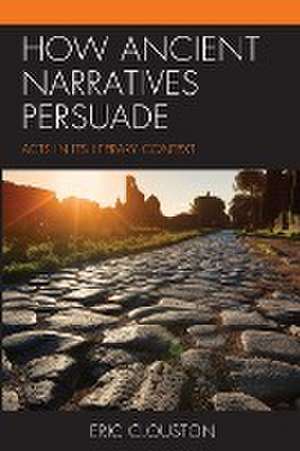
How Ancient Narratives Persuade: Acts in Its Literary Context
Autor Eric Cloustonen Limba Engleză Paperback – 15 mar 2022
| Toate formatele și edițiile | Preț | Express |
|---|---|---|
| Paperback (1) | 245.11 lei 6-8 săpt. | |
| Bloomsbury Publishing – 15 mar 2022 | 245.11 lei 6-8 săpt. | |
| Hardback (1) | 585.45 lei 6-8 săpt. | |
| Bloomsbury Publishing – 6 feb 2020 | 585.45 lei 6-8 săpt. |
Preț: 245.11 lei
Preț vechi: 331.27 lei
-26%
Puncte Express: 368
Preț estimativ în valută:
43.38€ • 50.70$ • 37.66£
43.38€ • 50.70$ • 37.66£
Carte tipărită la comandă
Livrare economică 20 februarie-06 martie
Preluare comenzi: 021 569.72.76
Specificații
ISBN-13: 9781978706620
ISBN-10: 1978706626
Pagini: 280
Ilustrații: 2 b/w illustrations; 10 tables;
Dimensiuni: 155 x 219 x 21 mm
Greutate: 0.42 kg
Editura: Bloomsbury Publishing
Colecția Fortress Academic
Locul publicării:New York, United States
ISBN-10: 1978706626
Pagini: 280
Ilustrații: 2 b/w illustrations; 10 tables;
Dimensiuni: 155 x 219 x 21 mm
Greutate: 0.42 kg
Editura: Bloomsbury Publishing
Colecția Fortress Academic
Locul publicării:New York, United States
Cuprins
1. Why Study the Persuasiveness of Narrative?
2. How to Identify the Persuasive Features of a Narrative
3. Narrative Persuasion in Philo's Embassy to Gaius
4. Narrative Persuasion in Josephus's Jewish War
5. Narrative Persuasion in Joseph and Aseneth
6. Narrative Persuasion in the Letter of Aristeas
7. Basic Literary Analysis of Acts
8. Narrative Persuasion in Acts
9. Case Study: The Cornelius Episode, Acts 10:1-11:18
10. Comparison Between the Five Texts
11. Revisiting the Purpose of Acts
12. Conclusions
2. How to Identify the Persuasive Features of a Narrative
3. Narrative Persuasion in Philo's Embassy to Gaius
4. Narrative Persuasion in Josephus's Jewish War
5. Narrative Persuasion in Joseph and Aseneth
6. Narrative Persuasion in the Letter of Aristeas
7. Basic Literary Analysis of Acts
8. Narrative Persuasion in Acts
9. Case Study: The Cornelius Episode, Acts 10:1-11:18
10. Comparison Between the Five Texts
11. Revisiting the Purpose of Acts
12. Conclusions
Recenzii
In How Ancient Narratives Persuade, Eric Clouston offers a refreshing engagement with the persuasive elements in Acts' narrative. Clouston sets out with audacious aims for a single monograph but achieves his overall goal to assess the role of persuasion in Act. This volume presents a compelling invitation to view narratives as significant contributors to the suasory skills of the NT writers and sets the stage for others to follow.
Through a host of literary techniques, the author of the Acts of the Apostles seeks to persuade his readers of the truthfulness of his narrative. How he does this is the major contribution offered by Eric Clouston, who, through a detailed comparison with four non-biblical texts, carefully provides a systematic method for demonstrating the persuasive nature of Luke's storytelling. All those interested in the Acts of the Apostles and literary analysis will benefit from this convincing book!
Clouston enhances narrative criticism by developing a new method for identifying techniques of persuasion in ancient narratives. His analysis of 'narrative persuasion' in Acts and other non-biblical texts is promising and advances the discipline.
Eric Clouston has given us a fresh perspective on how narrative persuades in this fascinating comparison of Acts and several Jewish authors from the same period. He makes a new contribution to scholarship by constructing a systematic approach to how ancient narratives persuade. He provides an engaging and convincing picture of each of these authors' organization of their narratives in order to win over their audiences, and thereby enlarges and enlightens our understanding of Acts, Philo, Josephus, Joseph and Aseneth, and the Letter of Aristeas. Bravo!
Eric Clouston presents an eminently readable exploration of techniques of persuasion in Jewish texts, with a focus on the Book of Acts and on the question of how actors and actions are either accredited or discredited by the author. This monograph is an important contribution to rhetorical and narrative criticism in general and to the study of Acts in particular.
Through a host of literary techniques, the author of the Acts of the Apostles seeks to persuade his readers of the truthfulness of his narrative. How he does this is the major contribution offered by Eric Clouston, who, through a detailed comparison with four non-biblical texts, carefully provides a systematic method for demonstrating the persuasive nature of Luke's storytelling. All those interested in the Acts of the Apostles and literary analysis will benefit from this convincing book!
Clouston enhances narrative criticism by developing a new method for identifying techniques of persuasion in ancient narratives. His analysis of 'narrative persuasion' in Acts and other non-biblical texts is promising and advances the discipline.
Eric Clouston has given us a fresh perspective on how narrative persuades in this fascinating comparison of Acts and several Jewish authors from the same period. He makes a new contribution to scholarship by constructing a systematic approach to how ancient narratives persuade. He provides an engaging and convincing picture of each of these authors' organization of their narratives in order to win over their audiences, and thereby enlarges and enlightens our understanding of Acts, Philo, Josephus, Joseph and Aseneth, and the Letter of Aristeas. Bravo!
Eric Clouston presents an eminently readable exploration of techniques of persuasion in Jewish texts, with a focus on the Book of Acts and on the question of how actors and actions are either accredited or discredited by the author. This monograph is an important contribution to rhetorical and narrative criticism in general and to the study of Acts in particular.