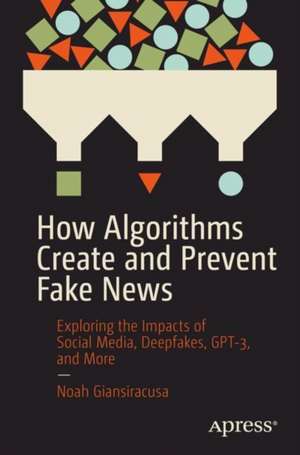
How Algorithms Create and Prevent Fake News
Autor Noah Giansiracusaen Limba Engleză Paperback – 15 iul 2021
Adresată atât începătorilor curioși de mecanismele din spatele ecranului, cât și managerilor tehnici care trebuie să navigheze dilemele etice ale inteligenței artificiale, How Algorithms Create and Prevent Fake News oferă o perspectivă lucidă asupra ecosistemului informațional actual. Observăm cum Noah Giansiracusa reușește să demistifice concepte complexe precum învățarea profundă (deep learning), fără a sacrifica rigoarea matematică, explicând cum algoritmii de agregare și recomandare ai giganților tech filtrează realitatea. Cititorul care a aplicat ideile din Truth and Fake in the Post-Factual Digital Age va găsi aici o completare tehnică esențială, axată pe modul în care etichetarea datelor și buclele de feedback amplifică prejudecățile algoritmice. Structura volumului este una progresivă: pornește de la capcanele vizualizărilor și ale publicității digitale (Perils of Pageview), trece prin analiza tehnică a conținutului generat de computer și a deepfake-urilor, pentru ca în final să se concentreze pe soluții. Descoperim aici o analiză pertinentă a algoritmului YouTube și a modului în care GPT-3 a redefinit producția de text. Spre deosebire de DeepFakes, care se concentrează strict pe arhitecturile de rețele neuronale adversariale, lucrarea de față pune accent pe intersecția dintre cod și societate. Tonul este echilibrat, evitând alarmismul și prezentând instrumentele algoritmice disponibile pentru detectarea automată a dezinformării (automated fact-checking). Este o resursă indispensabilă pentru a înțelege cum datele colectate și stocate astăzi devin fundamentul adevărului de mâine.
Preț: 214.25 lei
Preț vechi: 267.82 lei
-20%
Carte disponibilă
Livrare economică 02-16 noiembrie
Specificații
ISBN-10: 1484271548
Pagini: 248
Ilustrații: XII, 235 p. 2 illus.
Dimensiuni: 155 x 235 x 14 mm
Greutate: 0.35 kg
Ediția:First Edition
Editura: Apress
Locul publicării:Berkeley, CA, United States
De ce să citești această carte
Recomandăm această carte liderilor de business și utilizatorilor avizați de tehnologie care doresc să înțeleagă nu doar 'ce' este știrea falsă, ci 'cum' este ea produsă și combătută la nivel de cod. Veți câștiga o înțelegere clară asupra limitelor AI și a modului în care algoritmii de recomandare pot fi recalibrați pentru a proteja integritatea informației, oferindu-vă un avantaj strategic în interpretarea tendințelor digitale actuale.
Despre autor
Noah Giansiracusa este profesor de matematică și știința datelor, recunoscut pentru capacitatea sa de a traduce concepte abstracte în analize sociale concrete. Expertiza sa în algoritmi îi permite să abordeze subiectul dezinformării dintr-o perspectivă structurală, fiind apreciat de laureați Nobel precum Paul Romer pentru claritatea stilului său. Prin munca sa, Giansiracusa face puntea între mediul academic și publicul larg, analizând critic rolul tehnologiei în modelarea democrației moderne.
Descriere scurtă
---Paul Romer, Nobel Laureate, University Professor in Economics at NYU, and former Chief Economist at the World Bank.
“By explaining the flaws and foibles of everything from Google search to QAnon—and by providing level-headed evaluations of efforts to fix them—Noah Giansiracusa offers the perfect starting point for anyone entering the maze of modern digital media.”
—Jonathan Rauch, senior fellow at the Brookings Institute and contributing editor of The Atlantic
From deepfakes to GPT-3, deep learning is now powering a new assault on our ability to tell what’s real and what’s not, bringing a whole new algorithmic side to fake news. On the other hand, remarkable methods are being developed to help automate fact-checking and the detection of fake news and doctored media. Success in the modern business world requires you to understand these algorithmic currents, and to recognize the strengths, limits, and impacts of deep learning---especially when it comes to discerning the truth and differentiating fact from fiction.
This book tells the stories of this algorithmic battle for the truth and how it impacts individuals and society at large. In doing so, it weaves together the human stories and what’s at stake here, a simplified technical background on how these algorithms work, and an accessible survey of the research literature exploring these various topics.
How Algorithms Create and Prevent Fake News is an accessible, broad account of the various ways that data-driven algorithms have been distorting reality and rendering the truth harder to grasp. From news aggregators to Google searches to YouTube recommendations to Facebook news feeds, the way we obtain information todayis filtered through the lens of tech giant algorithms. The way data is collected, labelled, and stored has a big impact on the machine learning algorithms that are trained on it, and this is a main source of algorithmic bias – which gets amplified in harmful data feedback loops. Don’t be afraid: with this book you’ll see the remedies and technical solutions that are being applied to oppose these harmful trends. There is hope.
What You Will Learn
- The ways that data labeling and storage impact machine learning and how feedback loops can occur
- The history and inner-workings of YouTube’s recommendation algorithm
- The state-of-the-art capabilities of AI-powered text generation (GPT-3) and video synthesis/doctoring (deepfakes) and how these technologies have been used so far
- The algorithmic tools available to help with automated fact-checking and truth-detection
People who don’t have a technical background (in data, computers, etc.) but who would like to learn how algorithms impact society; business leaders who want to know the powers and perils of relying on artificial intelligence. A secondary audience is people with a technical background who want to explore the larger social and societal impact of their work.