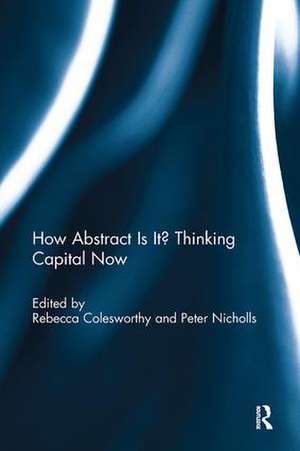
How Abstract Is It? Thinking Capital Now
Editat de Rebecca Colesworthy, Peter Nichollsen Limba Engleză Paperback – 16 iun 2017
Preț: 351.06 lei
Puncte Express: 527
Carte tipărită la comandă
Livrare economică 19 noiembrie-03 decembrie
Livrare prin curier în România Termenul estimat este afișat lângă disponibilitate.
Transport gratuit de la 400.00 lei Plată online sau ramburs, în funcție de opțiunile comenzii.
Retur gratuit în 14 zile Comandă securizată și suport în română.
Specificații
ISBN-13: 9781138294974
ISBN-10: 1138294977
Pagini: 184
Dimensiuni: 156 x 234 x 10 mm
Greutate: 0.45 kg
Ediția:1
Editura: Taylor & Francis
Colecția Routledge
Locul publicării:Oxford, United Kingdom
ISBN-10: 1138294977
Pagini: 184
Dimensiuni: 156 x 234 x 10 mm
Greutate: 0.45 kg
Ediția:1
Editura: Taylor & Francis
Colecția Routledge
Locul publicării:Oxford, United Kingdom
V-ar putea interesa
-
 George Oppen and the Fate of ModernismPeter Nicholls-21%Preț: 301.50 lei379.96 lei
 -
 -18%Preț: 1002.46 lei1222.51 lei
 -
 -18%Preț: 1254.60 lei1530.00 lei
 -
 -18%Preț: 793.11 lei967.20 lei
 -
 Fair Trade: The Challenges of Transforming GlobalizationLaura T. Raynolds-18%Preț: 1255.17 lei1530.69 lei
 -
 -23%Preț: 827.78 lei1075.05 lei
 -
 -15%Preț: 426.22 lei501.43 lei
 -
 An Outline Of International Price TheoriesChi-Yuen WuPreț: 216.32 lei
 -
 Environment and Regional Trade AgreementsOECD PublishingPreț: 269.66 lei
Public țintă
Postgraduate and UndergraduateCuprins
Introduction: Capital’s abstractions 1. ‘Paradise falls: a land lost in time’: representing credit, debt and work after the crisis 2. To think without abstraction: on the problem of standpoint in cultural criticism 3. Materialism without matter: abstraction, absence and social form 4a. An exchange with Susan Stewart 4b. Abstraction set 5. From capitalist to communist abstraction: The Pale King’s cultural fix 6. The bodies in the bubble: David Foster Wallace’s The Pale King 7. Shareholder existence: on the turn to numbers in recent French theory
Descriere
Since the start of the financial crisis in 2008, the notion that capitalism has become too abstract for all but the most rarefied specialists to understand has been widely presupposed. How Abstract Is It? Thinking Capital Now provides an indispensable counterpoint to the "economic turn" in the humanities, bringing together leading literary and cultural critics to reconsider the question of abstraction - an issue at the heart of the recent financial crisis, yet seldom addressed directly in the wealth of criticism to which it has given rise. This book was originally published as a special issue of Textual Practice.