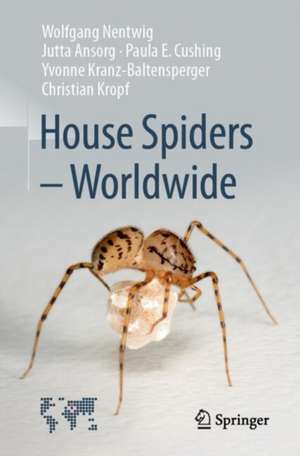
House Spiders - Worldwide
Autor Wolfgang Nentwig, Jutta Ansorg, Paula E. Cushing, Yvonne Kranz-Baltensperger, Christian Kropfen Limba Engleză Paperback – 4 ian 2025
Nivel de studiu: Licență și referință profesională. În volumul House Spiders - Worldwide, publicat de Springer, observăm o abordare științifică riguroasă a unui fenomen adesea trecut cu vederea: sinantropia arahnidelor. Ediția 2025 propune o sinteză globală a speciilor care s-au adaptat mediului artificial din locuințele umane, beneficiind de rutele comerciale internaționale pentru a coloniza clădiri de pe toate continentele. Premisa centrală a lucrării este fascinantă: deși condițiile din interiorul caselor sunt ostile majorității speciilor — din cauza umidității reduse și a curățeniei excesive — un grup restrâns de aproximativ 50 de specii a reușit să transforme aceste spații într-un habitat global uniform.
Din punct de vedere structural, cartea este împărțită într-o parte generală, care facilitează înțelegerea morfologiei și a mecanismelor de selecție a speciilor domestice, și o parte sistematică vastă. Aceasta din urmă analizează detaliat 22 de familii, de la faimoșii Cellar Spiders (Pholcidae) până la Giant Crab Spiders (Sparassidae). Stilul narativ este unul precis, eliminând antropomorfizarea în favoarea datelor factuale, susținute de 115 ilustrații color și hărți de distribuție esențiale pentru diagnoză.
Comparativ cu Spiders of the World de Norman I Platnick, care oferă o privire panoramică asupra diversității globale în habitate naturale, House Spiders - Worldwide se concentrează exclusiv pe nișa ecologică a locuinței, oferind detalii mult mai specifice despre comportamentul în spații închise. De asemenea, lucrarea completează perspectiva din The Common Spiders of the United States, extinzând analiza de la nivel regional la cel global. Wolfgang Nentwig continuă aici direcția începută în All You Need to Know About Spiders, însă rafinează discursul către o specializare taxonomică și ecologică mai profundă, transformând un subiect cotidian într-un obiect de studiu academic solid.
Preț: 215.20 lei
Carte disponibilă
Livrare economică 18 mai-01 iunie
Livrare express 01-07 mai pentru 29.69 lei
Specificații
ISBN-10: 3031704479
Pagini: 240
Ilustrații: Approx. 230 p. 115 illus. in color.
Dimensiuni: 155 x 235 x 13 mm
Greutate: 0.41 kg
Ediția:2025
Editura: Springer
Locul publicării:Cham, Switzerland
De ce să citești această carte
Această lucrare este esențială pentru studenții la biologie, entomologi și profesioniștii din domeniul controlului dăunătorilor care au nevoie de o identificare corectă a speciilor sinantrope. Cititorul câștigă o înțelegere clară a modului în care activitatea umană modelează biodiversitatea urbană. Este o resursă rară care tratează păianjenii de casă nu ca pe o curiozitate, ci ca pe un subiect de ecologie evolutivă, oferind instrumente vizuale de înaltă calitate pentru recunoașterea lor imediată.
Despre autor
Professor Dr. Wolfgang Nentwig este un cercetător de renume în cadrul Institutului de Zoologie al Universității din Berna, Elveția. Cu o carieră dedicată ecologiei și arahnologiei, el a coordonat numeroase proiecte de cercetare asupra speciilor invazive și a tehnicilor de vânătoare ale păianjenilor. Experiența sa este reflectată în lucrări de referință precum Ökologie kompakt, un manual standard în universitățile de limbă germană. În House Spiders - Worldwide, Nentwig colaborează cu o echipă internațională de experți din muzee și universități, combinând rigoarea academică cu pasiunea de decenii pentru studiul arahnidelor în contextul expansiunii umane.
Descriere scurtă
The authors of this book are experts who work at museums, universities and in administration in Europe and North America. They are not only recognized scientists, but have also been avowed spider fans for decades.
Cuprins
Notă biografică
Jutta Ansorg: she studied energy- and process engineering at the Technical University of Berlin, Germany, 2001 PhD, 1993-98 lecturer in mathematics and researcher in thermodynamics, 1998-2014 engineer in Switzerland for international power plant and waste incineration plant construction, since 2014 specialist for air pollution control and noise protection for the Canton of Aargau, Switzerland. She has been studying spiders in her spare time for about 45 years.
Paula Cushing: she received a PhD in Zoology at the University of Florida in 1995. Has been doing research on spiders for 40 years and has published on spiders, solifuges, and scorpions. Has been the Curator of Invertebrate Zoology at the Denver Museum of Nature & Science in the United States since 1998. Is very active in the American Arachnological Society and the International Society of Arachnology and has served as past president of both societies. Has also hosted several arachnological conferences and has mentored early career arachnologists.
Yvonne Kranz-Baltensperger: she studied biology at the University of Bern, Switzerland, PhD thesis 2014. Since 1997 scientific assistant for the collections in the Departments of Arachnology and Entomology at the Natural History Museum Bern. Research work within the PBI project (Planetary Biodiversity Inventory) with dwarf six-eyed spiders (Oonopidae).
Christian Kropf: he studied biology at the University of Graz, Austria, 1992 PhD, 1992-1995 assistant. Curator for invertebrate animals at the Natural History Museum Bern, Switzerland, 1995 – 2023. Curator of Biological Sciences at the Natural History Museum Basel, Switzerland, since 2024. Since 1996 lecturer at the University of Bern, 2011 habilitation. Co-organizer of the European spiders identification website and of the World Spider Catalog.