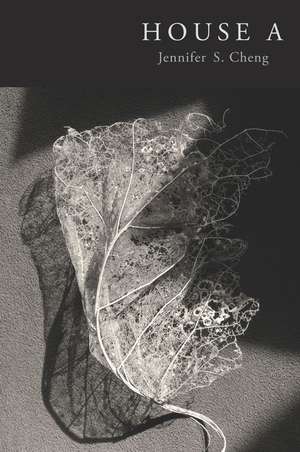
House A
Autor Jennifer S Chengen Limba Engleză Paperback – 4 oct 2016
House A investigates the tones and textures of immigrant home-building by asking: How is the body inscribed with a cosmology of home, and vice versa? With evocative and intellectual precision, House A weaves personal, discursive, and lyrical textures to invoke the immersive-obscured experience of an immigrant home’s entanglement while mapping a new poetics of American Home, steeped in longing and rooted by displacement.
House A is the winner of the 2015 Omnidawn 1st/2nd Poetry Book Prize, selected by Claudia Rankine.
House A is the winner of the 2015 Omnidawn 1st/2nd Poetry Book Prize, selected by Claudia Rankine.
Preț: 94.64 lei
Preț vechi: 121.18 lei
-22%
Puncte Express: 142
Carte indisponibilă temporar
Doresc să fiu notificat când acest titlu va fi disponibil:
Se trimite...
Specificații
ISBN-13: 9781632430236
ISBN-10: 1632430231
Pagini: 128
Dimensiuni: 150 x 226 x 10 mm
Greutate: 0.2 kg
Ediția:1
Editura: Omnidawn Publishing, Inc.
ISBN-10: 1632430231
Pagini: 128
Dimensiuni: 150 x 226 x 10 mm
Greutate: 0.2 kg
Ediția:1
Editura: Omnidawn Publishing, Inc.
Notă biografică
Jennifer S. Cheng is a poet and essayist with MFA degrees from the University of Iowa and San Francisco State University and a BA from Brown University. A US Fulbright scholar, Kundiman fellow, and Pushcart Prize nominee, she is the author of an image-text chapbook, Invocation: An Essay (New Michigan Press). Having grown up in Texas, Hong Kong, and Connecticut, she currently lives in San Francisco.
Cuprins
Letters to Mao • House A; Geometry B • How to Build an American Home
Recenzii
"Jennifer S. Cheng’s House A is an exquisite exploration of the ability of diasporic longing to live within a continuous and full life. These tender epistolary prose poems embody the constant sense of dislocation for the immigrant, while redefining affiliation nonetheless. The poems, addressed to 'Dear Mao' in the first section, weave, correct and redirect. They chronicle, in the alphabetically-organized second section, and instruct on 'How to Build an American Home' in the third section, in order to make apparent the illusive tone and mood of an upbringing—its porousness relative to history, myth and location. Not since Michael Ondaatje’s Running in the Family and Calvino’s Invisible Cities have I encountered such attention to the construction of love and love’s capacity to transform unimagined locations."
"In Jennifer S. Cheng’s House A the susurration of the tides pull at the posts that make a home, or at least the idea of home. A wound is a dwelling place. The smells of cooking, the sticky warmth of Texas summers, and the blueprints that map the human heart attempt elegies superimposed against the doors of childhood. Cheng deftly juxtaposes the world and the word in an intimate meditation on space and reverie, ultimately understanding that '. . . before language . . . children experience memories as image and sound, which is to say they experience them as poetry.' House A is radiant."
"In Jennifer S. Cheng’s House A we find an intelligence so deep it feels primal, a sensory perception so acute it links us to the phases of the moon, the tidal patterns of the ocean, the movements beneath the earth’s surface, a tremulous upheaval which becomes a kind of knowing. Cheng shows us that this knowing is akin to a child’s—the child beneath the kitchen table, the child attuned not to language, or fact, or even story, but to atmosphere, spinning her web of silken presences at the juncture of the table leg. Family (and history) here is echo, heartbeat, windows and doors being opened, shadow and sunlight on the floors and walls—the texture of being cared for. Cheng’s poems paradoxically, beautifully, become the tools of a super-fine archaeology which unearths the foundations of our (almost) lost dwelling places before language—for in these poems sensation and instinct are at once elemental and as eloquent as the flight of migratory birds. How can it be that the history of a particular American immigrant family takes us to such earthly origins? Well, we have to keep reading Cheng’s poems with their atmospheric disjunctions, their rhetorical precisions that cut into and refine, that scrape back and debride the cells of home building (nest and hive and shell), that take their microscopically thin samplings, in order to find out."