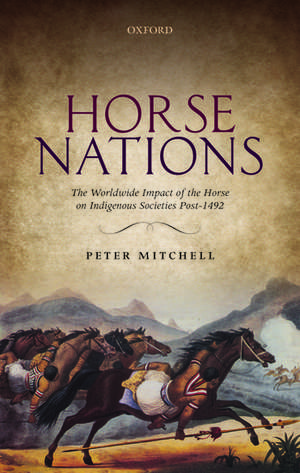
Horse Nations: The Worldwide Impact of the Horse on Indigenous Societies Post-1492
Autor Peter Mitchellen Limba Engleză Hardback – 26 mar 2015
Preț: 484.86 lei
Preț vechi: 612.58 lei
-21%
Puncte Express: 727
Carte tipărită la comandă
Livrare economică 26 noiembrie-01 decembrie
Livrare prin curier în România Termenul estimat este afișat lângă disponibilitate.
Transport gratuit pentru acest produs Plată online sau ramburs, în funcție de opțiunile comenzii.
Retur gratuit în 14 zile Comandă securizată și suport în română.
Specificații
ISBN-13: 9780198703839
ISBN-10: 019870383X
Pagini: 464
Ilustrații: 97 black and white illustrations and 16 colour plates
Dimensiuni: 148 x 222 x 29 mm
Greutate: 0.79 kg
Editura: OUP OXFORD
Colecția OUP Oxford
Locul publicării:Oxford, United Kingdom
ISBN-10: 019870383X
Pagini: 464
Ilustrații: 97 black and white illustrations and 16 colour plates
Dimensiuni: 148 x 222 x 29 mm
Greutate: 0.79 kg
Editura: OUP OXFORD
Colecția OUP Oxford
Locul publicării:Oxford, United Kingdom
V-ar putea interesa
-
 1777: Tipping Point at SaratogaDean Snow-10%Preț: 223.27 lei249.06 lei
 -
 The Crucible of Creation: The Burgess Shale and the Rise of AnimalsSimon Conway Morris-14%Preț: 252.90 lei295.68 lei
 -
 Scotland: An Oxford Archaeological GuideAnna Ritchie-19%Preț: 283.12 lei350.07 lei
 -
 -31%Preț: 826.23 lei1196.11 lei
 -
 -29%Preț: 503.15 lei704.77 lei
 -
 The Oxford Handbook of African ArchaeologyPeter Mitchell-32%Preț: 1233.18 lei1808.17 lei
 -
 The Birth of Neolithic Britain: An Interpretive AccountJulian Thomas-31%Preț: 907.18 lei1313.04 lei
 -
 How To Think Like a NeandertalThomas Wynn-25%Preț: 166.98 lei223.41 lei
 -
 Hunter-Gatherer Mortuary Practices during the Central Texas ArchaicLeland C. BementPreț: 166.93 lei
 -
 Archaeological InvestigationMartin CarverPreț: 376.00 lei
 -
 Heritage and GlobalisationSophia Labadi-15%Preț: 441.60 lei519.54 lei
 -
 Preț: 470.09 lei
 -
 -15%Preț: 475.10 lei558.94 lei
 -
 The Prehistory of Asia MinorBleda S. DuringPreț: 423.00 lei
 -
 Understanding the Archaeological RecordGavin LucasPreț: 247.50 lei
 -
 BirdsDale SerjeantsonPreț: 349.37 lei
 -
 Handbook of Landscape ArchaeologyBruno David-8%Preț: 451.75 lei491.03 lei
Recenzii
As well as offering a template for the melding of historical, anthropological and archaeological data, methods and perspectives, Horse Nations is a substantial contribution to the study of borderland environments, middle grounds and hybrid societies. It is also a major addition to the field of horse history
Horse Nations enriches the potential engagement between archaeology, history and anthropology on the topic of the horse, and in human-animal studies more generally ... Horse Nations points the way to more work to come.
essential reading for all those interested in the study of human-animal relations, offering valuable access to documentary, iconographic, and bibliographic sources taken from colonial and contemporary history, archaeology, and anthropology.
a long awaited work that fills a significant lacuna in equine literature. The book adeptly mines an abundance of relevant, but often previously unrecognized, geographic, archaeological, ethnographic and historical references to reconstruct the complex conditions that grew out of the appearance of the horse in North and South America, South Africa and Australasia from the late 15th century on. Eloquently woven, the story unfolds in a captivating manner that expertly leads the reader through the tangled web of history like a native guide through a rainforest ... this volume certainly will not disappoint. It has the ingredients to become an oft-referenced guide for historic periods in which the horse burst out of Eurasia and surprised countless indigenous peoples with its peculiar looks and amazing swiftness. It shall, no doubt, earn a favorite spot in the libraries of equine experts and enthusiasts internationally.
Horse Nations provides the first in-depth synthesis of the impact that horses had on indigenous groups located on the periphery of European colonialismin the post-1442 period ... presents interesting comparative fodder for researchers studying the adoption of new commodities or domesticates from any time period and also to those interested in exploring the diverse ways indigenous societies interacted with colonial processes.
Mining an impressive collection of ... sources in multiple languages, Mitchell has produced an interpretative compilation full of information and insight that should be an important reference for researchers who are continuing to blaze new trails in our knowledge and understanding of indigenous peoples' reception and integration of the horse. ... Mitchell's work should spark and stoke even more scholarship that situates this region's rich history in its global context.
highly interesting for historians or others interested in understanding continuity and change and not the least researchers interested in colonial impact and interaction between Europeans and indigenous people.
Horse Nations enriches the potential engagement between archaeology, history and anthropology on the topic of the horse, and in human-animal studies more generally ... Horse Nations points the way to more work to come.
essential reading for all those interested in the study of human-animal relations, offering valuable access to documentary, iconographic, and bibliographic sources taken from colonial and contemporary history, archaeology, and anthropology.
a long awaited work that fills a significant lacuna in equine literature. The book adeptly mines an abundance of relevant, but often previously unrecognized, geographic, archaeological, ethnographic and historical references to reconstruct the complex conditions that grew out of the appearance of the horse in North and South America, South Africa and Australasia from the late 15th century on. Eloquently woven, the story unfolds in a captivating manner that expertly leads the reader through the tangled web of history like a native guide through a rainforest ... this volume certainly will not disappoint. It has the ingredients to become an oft-referenced guide for historic periods in which the horse burst out of Eurasia and surprised countless indigenous peoples with its peculiar looks and amazing swiftness. It shall, no doubt, earn a favorite spot in the libraries of equine experts and enthusiasts internationally.
Horse Nations provides the first in-depth synthesis of the impact that horses had on indigenous groups located on the periphery of European colonialismin the post-1442 period ... presents interesting comparative fodder for researchers studying the adoption of new commodities or domesticates from any time period and also to those interested in exploring the diverse ways indigenous societies interacted with colonial processes.
Mining an impressive collection of ... sources in multiple languages, Mitchell has produced an interpretative compilation full of information and insight that should be an important reference for researchers who are continuing to blaze new trails in our knowledge and understanding of indigenous peoples' reception and integration of the horse. ... Mitchell's work should spark and stoke even more scholarship that situates this region's rich history in its global context.
highly interesting for historians or others interested in understanding continuity and change and not the least researchers interested in colonial impact and interaction between Europeans and indigenous people.
Notă biografică
Peter Mitchell is Professor of African Archaeology and Fellow at St. Hugh's College, Oxford, and Honorary Research Fellow at the University of the Witwatersrand in South Africa.