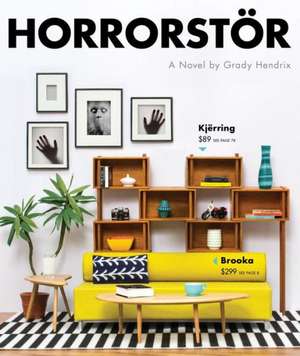
Horrorstor: A Novel
Autor Grady Hendrixen Limba Engleză Paperback – 23 sep 2014
From the New York Times best-selling author of The Southern Book Club's Guide to Slaying Vampires comes a hilarious and terrifying haunted house story in a thoroughly contemporary setting: a furniture superstore.
Something strange is happening at the Orsk furniture superstore in Cleveland, Ohio. Every morning, employees arrive to find broken Kjerring bookshelves, shattered Glans water goblets, and smashed Liripip wardrobes. Sales are down, security cameras reveal nothing, and store managers are panicking.
To unravel the mystery, three employees volunteer to work a nine-hour dusk-till-dawn shift. In the dead of the night, they’ll patrol the empty showroom floor, investigate strange sights and sounds, and encounter horrors that defy the imagination.
Preț: 91.75 lei
Preț vechi: 110.19 lei
-17%
Carte disponibilă
Livrare economică 13-25 noiembrie
Specificații
ISBN-10: 1594745269
Pagini: 248
Dimensiuni: 187 x 221 x 15 mm
Greutate: 0.48 kg
Editura: QUIRK BOOKS
Colecția Quirk Books
V-ar putea interesa
-
 Hallows HillOlivia Isaac-HenryPreț: 137.35 lei
 -
 House of the BeastMichelle WongPreț: 124.99 leiRecomandat
 -
 The Forever HouseLisa StonePreț: 72.45 lei
 -
 Preț: 65.20 lei
 -
 The Last Day of OctoberPhil HickesPreț: 56.59 lei
 -
 Four Weddings and a Funeral DirectorHazel GravesPreț: 71.58 lei
 -
 The Amberglow Candy StoreHiyoko KurisuPreț: 105.84 lei
 -
 Be Right BackBill WoodPreț: 64.54 lei
 -
 The Book of Frights for Spooky NightsLeisa Stewart-SharpePreț: 104.83 lei
 -
 Darker DaysThomas Olde HeuveltPreț: 110.60 lei
 -
 The DamnedHarper L. WoodsPreț: 109.34 lei
 -
 The Works of VerminHiron EnnesPreț: 165.07 lei
 -
 Preț: 71.03 lei
 -
 We Are Already Haunting Here!Gideon Sterer-28%Preț: 74.26 lei103.32 lei
 -
 Preț: 61.99 lei
 -
 The HotelDaisy JohnsonPreț: 71.03 lei
 -
 Nightmare in 3-DR. L. StinePreț: 43.60 leiRecomandat
 -
 Preț: 124.99 lei
 -
 The Place Where They Buried Your HeartChristina HenryPreț: 72.54 lei
 -
 The Executioners ThreeSusan DennardPreț: 72.99 lei
Notă biografică
Grady Hendrix is an award-winning novelist and screenwriter living in New York City. He is the author of several New York Times best sellers including How to Sell a Haunted House, The Final Girl Support Group, The Southern Book Club’s Guide to Slaying Vampires, and many more. His books have been translated into more than twenty languages and sold over two million copies. He also writes nonfiction, and his history of the horror paperback boom of the seventies and eighties, Paperbacks from Hell, won the Bram Stoker Award for Superior Achievement in Nonfiction.
Extras
But every morning, five days a week (seven during the holidays), they dragged themselves here, to the one thing in their lives that never changed, the one thing they could count on come rain, or shine, or dead pets, or divorce: work.
Orsk was the all-American furniture superstore in Scandinavian drag, offering well-designed lifestyles at below-Ikea prices, and its forward-thinking slogan promised “a better life for the everyone.” Especially for Orsk shareholders, who trekked to company headquarters in Milwaukee, Wisconsin, every year to hear how their chain of Ikea knockoff stores was earning big returns. Orsk promised customers “the everything they needed” in the every phase of their lives, from Balsak cradles to Gutevol rocking chairs. The only thing it didn’t offer was coffins. Yet.
Orsk was an enormous heart pumping 318 partners—228 full-time, 90 part-time—through its ventricles in a ceaseless circular flow. Every morning, floor partners poured in to swipe their IDs, power up their computers, and help customers size the perfect Knäbble cabinets, find the most comfortable Müskk beds, and source exactly the right Lågniå water glasses. Every afternoon, replenishment partners flowed in and restocked the Self-Service Warehouse, pulled the picks, refilled the impulse bins, and hauled pallets onto the Market Floor. It was a perfect system, precision-engineered to offer optimal retail functionality in all 112 Orsk locations across North America and in its thirty-eight locations around the world.
But on the first Thursday of June at 7:30 a.m., at Orsk Location #00108 in Cuyahoga County, Ohio, this well-calibrated system came grinding to a halt.
The trouble started when the card reader next to the employee entrance gave up the ghost. Store partners arrived and piled up against the door in a confused chaotic crowd, helplessly waving their IDs over the scanner until Basil, the deputy store manager, appeared and directed them all to go around the side of the building to the customer entrance.
Customers entered Orsk through a towering two-story glass atrium and ascended an escalator to the second floor, where they began a walk of the labyrinthine Showroom floor designed to expose them to the Orsk lifestyle in the optimal manner, as determined by an army of interior designers, architects, and retail consultants. Only here was yet another problem: the escalator was running down instead of up. Floor partners shoved their way into the atrium and came to a baffled halt, unsure what to do next. IT partners jammed up behind them, followed by a swarm of post-sales partners, HR partners, and cart partners. Soon they were all packed in butt to gut and spilling out the double doors.
Amy spotted the human traffic jam from across the parking lot as she power-walked toward the crowd, a soggy cup of coffee leaking in one hand.
“Not now,” she thought. “Not today.”
She’d bought the coffee cup at the Speedway three weeks ago because it promised unlimited free refills and Amy needed to stretch her $1.49 as far as it would go. This was as far as it went. As she stared in dismay at the mass of partners, the bottom of her cup finally gave up and let go, dumping coffee all over her sneakers. Amy didn’t even notice. She knew that a crowd meant a problem, and a problem meant a manager, and this early in the day a manager meant Basil. She could not let Basil see her. Today she had to be Basil Invisible.
Matt lurked on the edge of the semicircle, dressed in his usual black hoodie. He was glumly eating an Egg McMuffin and squinting painfully in the morning sun.
“What happened?” Amy asked.
“They can’t open the prison, so we can’t do our time,” he said, picking crumbs from his enormous hipster beard.
“What about the employee entrance?”
“Busted.”
“So how do we clock in?”
“Don’t be in such a hurry,” Matt said, trying to suck a strand of cheese off the mass of hair surrounding his mouth. “There’s nothing waiting inside but retail slavery, endless exploitation, and personal subjugation to the whims of our corporate overlords.”
If Amy squinted, she could dimly see Basil’s tall, gawky silhouette through the front windows, trying to direct the human traffic jam by waving his spaghetti-noodle arms in the air. Getting even this close to him sent a cold bolt of fear through her stomach, but his back was turned. Maybe she had a chance.
“Good thoughts, Matt,” she said.
Seizing her moment, Amy ninjaed her way through the crowd, ducking behind backs, stepping on toes, and slipping into open spaces. She entered the atrium and was immediately enveloped in the soothing embrace of Orsk—where it was always the perfect temperature, where the rooms were always perfectly lit, where the piped-in music was always the perfect volume, where it was always perfectly calm. But this morning the air had an edge to it, the faint scent of something rancid.
“I didn’t think this escalator could run in reverse,” Basil was saying to an operations partner who was pounding on the emergency stop button to no effect. “Is this even mechanically possible?”
Amy didn’t stick around to find out. Her sole objective for the day—and for the next several days—was to avoid Basil at all costs. As long as he didn’t see her, she reasoned, he couldn’t fire her.
Recenzii
“Disarming.”—The Wall Street Journal
“Wildly inventive...Hendrix delivers both a palm-sweating horror story and a laugh-out-loud satire of retail.”—Esquire
“Highly giftable.”—Buzzfeed
“Hendrix conjures up some wonderfully gruesome imagery.”—Nerdist
“An inventive, hilarious haunted house tale.”—Bustle
“Hendrix’s one-of-a-kind novel is an innovative hybrid of ghost story and satire, at once clever, gruesome, and hilarious.”—Amazon Book Review
“If you’ve ever been frustrated trying to put together furniture from IKEA, you’ll get a laugh out of Hendrix’s spoof mystery.”—New York Post
“Hendrix is an engaging writer.”—Santa Fe New Mexican
“A clever little horror story...[and] a treat for fans of The Evil Dead or Zombieland, complete with affordable solutions for better living.”—Kirkus Reviews
“A fun horror novel.”—Library Journal
“A very clever ghost story.”—Booklist
“The book’s packaging as a catalog—complete with illustrations of increasingly sinister-looking furniture with faux Scandinavian names—gives it a charmingly oddball allure.”—Publishers Weekly
More praise for Grady Hendrix:
“National treasure Grady Hendrix follows his classic account of a haunted IKEA-like furniture showroom, Horrorstor (2014), with a nostalgia-soaked ghost story, My Best Friend’s Exorcism.”—The Wall Street Journal, on My Best Friend’s Exorcism
“Pure, demented delight.”—The New York Times Book Review, on Paperbacks from Hell
“Terrific... Sharply written... [My Best Friend’s Exorcism] makes a convincing case for [Hendrix’s] powers as a sharp observer of human behavior.”—The A.V. Club, on My Best Friend’s Exorcism
“Hendrix’s darkest novel yet will leave readers begging for an encore.”—Booklist, starred review, on We Sold Our Souls
“A true appreciation of the genre.”—Los Angeles Times, on Paperbacks from Hell
“Campy. Heartfelt. Horrifying.”—Minnesota Public Radio, on My Best Friend’s Exorcism
“Clever, heartfelt, and get-under-your-skin unnerving.”—Fangoria, on My Best Friend’s Exorcism
“A good, creepy, music-tinged thriller.”—CNET, on We Sold Our Souls
Descriere
From the New York Times best-selling author of The Southern Book Club's Guide to Slaying Vampires comes a hilarious and terrifying haunted house story in a thoroughly contemporary setting: a furniture superstore.