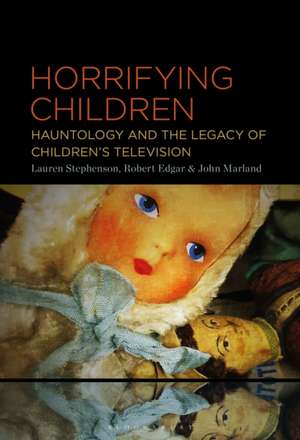
Horrifying Children
Editat de Lauren Stephenson, Robert Edgar, John Marlanden Limba Engleză Paperback – 30 oct 2025
There has been an explosion of interest in the impact of children's television and literature of the late twentieth century. In particular, the 1970s, '80s and '90s are seen as decades that shaped a great deal of the contemporary cultural landscape. Television of this period dominated the world of childhood entertainment, drawing freely upon literature and popular culture, like the Garbage Pail Kids and Stranger Things, and much of it continues to resonate powerfully with the generation of cultural producers (fiction writers, screenwriters, directors, musicians and artists) that grew up watching the weird, the eerie and the horrific: the essence of 21st-century Hauntology. In these terms this book is not about children's television as it exists now, but rather as it features as a facet of memory in the 21st century.
As such it is the legacy of these television programmes that is at the core of Horrifying Children. The 'haunting' of adults by what we have seen on the screen is crucial to the study. This collection directly addresses that which 'scared us' in the past insomuch as there is a correlation between individual and collective cultural memory, with some chapters providing an opportunity for situating existing explorations and understandings of Gothic and Horror TV within a hauntological and experiential framework.
Preț: 208.03 lei
Preț vechi: 280.31 lei
-26%
Puncte Express: 312
Carte tipărită la comandă
Livrare economică 27 noiembrie-11 decembrie
Livrare prin curier în România Termenul estimat este afișat lângă disponibilitate.
Transport gratuit de la 400.00 lei Plată online sau ramburs, în funcție de opțiunile comenzii.
Retur gratuit în 14 zile Comandă securizată și suport în română.
Specificații
ISBN-13: 9781501390531
ISBN-10: 1501390538
Pagini: 272
Dimensiuni: 148 x 226 x 18 mm
Greutate: 0.37 kg
Editura: BLOOMSBURY ACADEMIC
Locul publicării:New York, United States
ISBN-10: 1501390538
Pagini: 272
Dimensiuni: 148 x 226 x 18 mm
Greutate: 0.37 kg
Editura: BLOOMSBURY ACADEMIC
Locul publicării:New York, United States
Cuprins
List of Figures
List of Contributors
Acknowledgements
Introduction: The Edwardian Legacy and Children's Fiction
Lauren Stephenson, Robert Edgar and John Marland (York St. John University, UK)
Part I: Hauntings and Spectres
1.'What is it like to be dead and a ghost? Oh, do tell me Tom, I've been simply longing to know': Hauntology and Spectrality in the 1989 BBC Television Series Tom's Midnight Garden
Stella Miriam Pryce (University of Cambridge, UK)
2. Coming of Age in The Owl Service: England and the Uncertain Future
Fernando Gabriel Pagnoni Berns (University of Buenos Aires, Argentina)
3. 'Oh please, let us come undone!' States of Independence: Female Temporality in the Supernatural Children's Television and Literature of the 1970s and '80s
Fiona Cameron (Bangor University, North Wales)
4. 'It came from beneath the sink': Children's Horror Television as an Uncanny Mirror
Merinda Staubli (RMIT University in Melbourne, Australia)
5. An Adult Nightmare: Garbage Pail Kids and the Fear of the Queer Child
Max Hart (independent scholar)
6. The Transgender Twist: Mermen and Gender-nonconformity in Round the Twist
Jackson Phoenix Nash (independent scholar)
7. Weird Doubling in Wes Craven's Stranger in Our House (1978)
Miranda Corcoran (University College Cork, Ireland)
8. Suburban Eerie: The Demon Headmaster (BBC1, 1996-8) and The Demon Headmaster (CBBC, 2019) as Neoliberal Folk Horror
Adam Whybray (University of Suffolk, UK)
9. 'My Carnaby cassock': Jimmy Savile, Jim'll Fix It and Top of the Pops
Benjamin Halligan (University of Wolverhampton, UK)
Part II: Memory, Process and Practice
10. The Technological Uncanny: The Role of Memory Prosthetics in Hauntological Practice
Michael Schofield (University of Leeds, UK)
11. The Pandemic and The Bomb
Flannán Delaney (independent scholar)
12. Killing a Cow on Kids' TV: The Case of Die Sendung mit der Maus
Alexander Hartley (Harvard University, USA)
13. Confronting Ghosts: The Inherited Horrors of the Kent State Shooting
Elizabeth Tussey (independent scholar)
14. Creeping Dread in The Singing, Ringing Tree: East German Cinematic Fairytale as Children's Tea-Time Entertainment
Wayne Johnson (York St John University, UK)
15. 'May cause drowsiness': A (False) Memory of Weekday Morning Television in the Mid-1970s Through the Filter of Prepubescent Illness and Sedation
Jez Conolly (independent scholar)
16. Bleak Adventures in Kenneth Johnson's V
Keith McDonald (York St John University, UK)
17. Don't Turn Tail from Horror: Using Eco-Horror in the Secondary School Classroom
Hollie Adams (independent scholar)
Index
List of Contributors
Acknowledgements
Introduction: The Edwardian Legacy and Children's Fiction
Lauren Stephenson, Robert Edgar and John Marland (York St. John University, UK)
Part I: Hauntings and Spectres
1.'What is it like to be dead and a ghost? Oh, do tell me Tom, I've been simply longing to know': Hauntology and Spectrality in the 1989 BBC Television Series Tom's Midnight Garden
Stella Miriam Pryce (University of Cambridge, UK)
2. Coming of Age in The Owl Service: England and the Uncertain Future
Fernando Gabriel Pagnoni Berns (University of Buenos Aires, Argentina)
3. 'Oh please, let us come undone!' States of Independence: Female Temporality in the Supernatural Children's Television and Literature of the 1970s and '80s
Fiona Cameron (Bangor University, North Wales)
4. 'It came from beneath the sink': Children's Horror Television as an Uncanny Mirror
Merinda Staubli (RMIT University in Melbourne, Australia)
5. An Adult Nightmare: Garbage Pail Kids and the Fear of the Queer Child
Max Hart (independent scholar)
6. The Transgender Twist: Mermen and Gender-nonconformity in Round the Twist
Jackson Phoenix Nash (independent scholar)
7. Weird Doubling in Wes Craven's Stranger in Our House (1978)
Miranda Corcoran (University College Cork, Ireland)
8. Suburban Eerie: The Demon Headmaster (BBC1, 1996-8) and The Demon Headmaster (CBBC, 2019) as Neoliberal Folk Horror
Adam Whybray (University of Suffolk, UK)
9. 'My Carnaby cassock': Jimmy Savile, Jim'll Fix It and Top of the Pops
Benjamin Halligan (University of Wolverhampton, UK)
Part II: Memory, Process and Practice
10. The Technological Uncanny: The Role of Memory Prosthetics in Hauntological Practice
Michael Schofield (University of Leeds, UK)
11. The Pandemic and The Bomb
Flannán Delaney (independent scholar)
12. Killing a Cow on Kids' TV: The Case of Die Sendung mit der Maus
Alexander Hartley (Harvard University, USA)
13. Confronting Ghosts: The Inherited Horrors of the Kent State Shooting
Elizabeth Tussey (independent scholar)
14. Creeping Dread in The Singing, Ringing Tree: East German Cinematic Fairytale as Children's Tea-Time Entertainment
Wayne Johnson (York St John University, UK)
15. 'May cause drowsiness': A (False) Memory of Weekday Morning Television in the Mid-1970s Through the Filter of Prepubescent Illness and Sedation
Jez Conolly (independent scholar)
16. Bleak Adventures in Kenneth Johnson's V
Keith McDonald (York St John University, UK)
17. Don't Turn Tail from Horror: Using Eco-Horror in the Secondary School Classroom
Hollie Adams (independent scholar)
Index
Recenzii
Horrifying Children presents a fascinating and multifaceted analysis of five decades of gothic and supernatural British children's television shows and discusses the hauntological effects of these shows in (re)presenting the pre-War nostalgia and Post-war anxieties of British culture. We learn how the liminal figure of the child within the original 60's and 70's television series "haunted" subsequent generations of children in the 80s, 90s and 00s when the series were re-broadcasted. Addressing specifically how mysterious, spooky and ghostly children's television effects the collective cultural memory of adults, Horrifying Children enriches our understanding of the deep impact of the figure of the child in visual narrative for each generation that observes it.
This wide-ranging collection, taking us on a hauntological journey back to and through historical children's television, is impressive in its breadth and depth. It offers the reader a thorough exploration of why children's television has stayed with us, clinging to the dark recesses of our minds, remembered as an unsettling set of uncanny sounds and spectral images. What I particularly love about these essays in this book are the ways that the authors negotiate and examine their own mnemonic relationship to such a wide variety of programming. Scholars often reflect on how television makes meaning from a position of critical disengagement or detachment: this book shows that it is possible to write with clarity and critical insight while examining your own affective responses to programmes known of old and long familiar.
This wide-ranging collection, taking us on a hauntological journey back to and through historical children's television, is impressive in its breadth and depth. It offers the reader a thorough exploration of why children's television has stayed with us, clinging to the dark recesses of our minds, remembered as an unsettling set of uncanny sounds and spectral images. What I particularly love about these essays in this book are the ways that the authors negotiate and examine their own mnemonic relationship to such a wide variety of programming. Scholars often reflect on how television makes meaning from a position of critical disengagement or detachment: this book shows that it is possible to write with clarity and critical insight while examining your own affective responses to programmes known of old and long familiar.