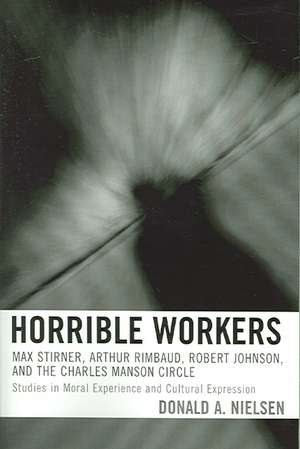
Horrible Workers: Max Stirner, Arthur Rimbaud, Robert Johnson, and the Charles Manson Circle
Autor Donald A. Nielsenen Limba Engleză Paperback – 17 iun 2005
Preț: 274.49 lei
Preț vechi: 377.07 lei
-27%
Puncte Express: 412
Carte tipărită la comandă
Livrare economică 30 noiembrie-14 decembrie
Livrare prin curier în România Termenul estimat este afișat lângă disponibilitate.
Transport gratuit de la 400.00 lei Plată online sau ramburs, în funcție de opțiunile comenzii.
Retur gratuit în 14 zile Comandă securizată și suport în română.
Specificații
ISBN-13: 9780739112007
ISBN-10: 0739112007
Pagini: 136
Dimensiuni: 154 x 219 x 10 mm
Greutate: 0.19 kg
Editura: Bloomsbury Publishing
Colecția Lexington Books
Locul publicării:New York, United States
ISBN-10: 0739112007
Pagini: 136
Dimensiuni: 154 x 219 x 10 mm
Greutate: 0.19 kg
Editura: Bloomsbury Publishing
Colecția Lexington Books
Locul publicării:New York, United States
Cuprins
Chapter 1 Polarity and Dialectic in Moral Experience and Cultural Expression
Chapter 2 The Religion of the Transcendental Ego: The Case of Max Stirner
Chapter 3 Art, Anomism, and Moral Consciousness: The Case of Arthur Rimbaud
Chapter 4 Ramblin' for Miles Around: The Life and Art of Robert Johnson
Chapter 5 Anomism, Puerilism and the Transmoral Consciousness: The Charles Manson Circle
Chapter 6 Horrible Workers in Retrospect: Comparative and Theoretical Reflections
Chapter 2 The Religion of the Transcendental Ego: The Case of Max Stirner
Chapter 3 Art, Anomism, and Moral Consciousness: The Case of Arthur Rimbaud
Chapter 4 Ramblin' for Miles Around: The Life and Art of Robert Johnson
Chapter 5 Anomism, Puerilism and the Transmoral Consciousness: The Charles Manson Circle
Chapter 6 Horrible Workers in Retrospect: Comparative and Theoretical Reflections
Recenzii
This is a fascinating little book that deals with characters usually regarded as marginal to or at the margins of Western culture and society.
In reworking the famous categories that Durkheim developed in Suicide, Nielsen offers a fascinating and thoroughly engaging account of the moral careers of four figures who on the surface appear to share little in common: Max Stirner, Arthur Rimbaud, Robert Johnson, and Charles Manson. By emphasizing the dialectical interplay of categories and foregrounding the generally neglected concept of fatalism, he offers readers an empirically rich and theoretically sophisticated comparative account of the culturally grounded vocations of these "horrible workers."
In reworking the famous categories that Durkheim developed in Suicide, Nielsen offers a fascinating and thoroughly engaging account of the moral careers of four figures who on the surface appear to share little in common: Max Stirner, Arthur Rimbaud, Robert Johnson, and Charles Manson. By emphasizing the dialectical interplay of categories and foregrounding the generally neglected concept of fatalism, he offers readers an empirically rich and theoretically sophisticated comparative account of the culturally grounded vocations of these "horrible workers."