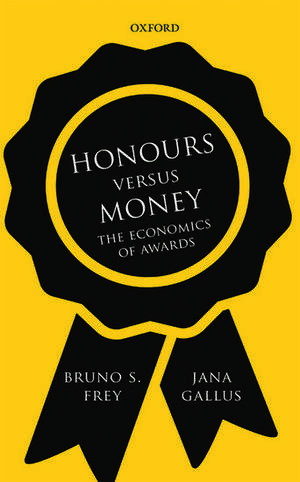
Honours versus Money: The Economics of Awards
Autor Bruno S. Frey, Jana Gallusen Limba Engleză Hardback – 24 aug 2017
Preț: 338.84 lei
Preț vechi: 377.43 lei
-10%
Puncte Express: 508
Carte tipărită la comandă
Livrare economică 04-15 decembrie
Livrare prin curier în România Termenul estimat este afișat lângă disponibilitate.
Transport gratuit de la 400.00 lei Plată online sau ramburs, în funcție de opțiunile comenzii.
Retur gratuit în 14 zile Comandă securizată și suport în română.
Specificații
ISBN-13: 9780198798507
ISBN-10: 0198798504
Pagini: 144
Dimensiuni: 154 x 224 x 15 mm
Greutate: 0.3 kg
Editura: OUP OXFORD
Colecția OUP Oxford
Locul publicării:Oxford, United Kingdom
ISBN-10: 0198798504
Pagini: 144
Dimensiuni: 154 x 224 x 15 mm
Greutate: 0.3 kg
Editura: OUP OXFORD
Colecția OUP Oxford
Locul publicării:Oxford, United Kingdom
V-ar putea interesa
-
 The Business of EconomicsJohn Kay-32%Preț: 732.53 lei1071.51 lei
 -
 Knowledge Capitalism: Business, Work, and Learning in the New EconomyAlan Burton-Jones-28%Preț: 346.36 lei482.56 lei
 -
 -24%Preț: 547.13 lei722.55 lei
 -
 Economics: An Analytical IntroductionAmos Witztum-24%Preț: 639.20 lei836.86 lei
 -
 Geography and Economy: Three LecturesAllen J. Scott-30%Preț: 877.39 lei1258.80 lei
 -
 -32%Preț: 965.36 lei1420.12 lei
 -
 Economic Facts and Fallacies: Second EditionThomas Sowell-25%Preț: 90.18 lei120.78 lei
 -
 Quick Cash: The Story of the Loan SharkRobert MayerPreț: 198.65 lei
 -
 The Armchair Economist: Economics & Everyday LifeSteven E. Landsburg-25%Preț: 59.29 lei79.33 lei
Recenzii
Frey and Gallus... agilely draw on the body of the economic literature to address and stimulate reflection and further research... including the advantages of awards, their popularity in history and today, typologies of awards, their applications to the fields of academia and to voluntary and corporate sectors, awards from the perspective of signalling, and challenges of using awards.
Notă biografică
Bruno S. Frey is Permanent Visiting Professor at the University of Basel and Research Director CREMA, Center for Research in Economics, Management and the Arts, Zurich. He studied economics at the Universities of Basel and Cambridge; Holds and PhD and became an Associate Professor at the University of Basel; Between 1970-1977 he was Full Professor at University Constance and 1977-2012 at the University Zurich. He is the author of a large number of articles in leading scholarly journals and of the following books: Not Just for the Money; Economics as a Science of Human Behaviour; Arts & Economics; Inspiring Economics; Dealing with Terrorism - Stick or Carrot?; Happiness: A Revolution in Economics.Jana Gallus is an Assistant Professor in the strategy group at UCLA, Anderson. Her research interests lie in behavioral economics and strategy, with a focus on nonfinancial incentives and their effects on human decision-making. Jana's work has been published in Management Science, Strategic Management Journal, Labour Economics, and Applied Economics, among other journals. Jana joined UCLA from Harvard, where she was a post-doctoral fellow. She received her PhD in Economics from the University of Zurich, with the distinction summa cum laude, and holds two Master's degrees, from Sciences Po Paris in France and the University of St. Gallen in Switzerland.