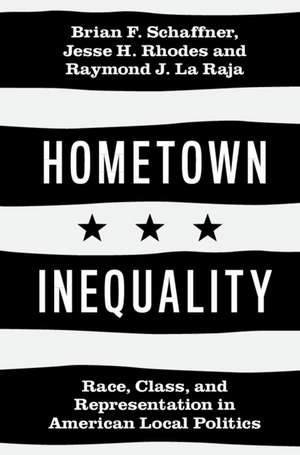
Hometown Inequality
Autor Brian F Schaffner, Jesse H Rhodes, Raymond J La Rajaen Limba Engleză Hardback – 9 iul 2020
Preț: 696.23 lei
Preț vechi: 809.57 lei
-14%
Puncte Express: 1044
Carte tipărită la comandă
Livrare economică 07-21 decembrie
Livrare prin curier în România Termenul estimat este afișat lângă disponibilitate.
Transport gratuit pentru acest produs Plată online sau ramburs, în funcție de opțiunile comenzii.
Retur gratuit în 14 zile Comandă securizată și suport în română.
Specificații
ISBN-13: 9781108485944
ISBN-10: 1108485944
Pagini: 272
Dimensiuni: 193 x 231 x 18 mm
Greutate: 0.5 kg
Editura: Cambridge University Press
Locul publicării:New York, United States
ISBN-10: 1108485944
Pagini: 272
Dimensiuni: 193 x 231 x 18 mm
Greutate: 0.5 kg
Editura: Cambridge University Press
Locul publicării:New York, United States
Cuprins
1. Race, class, and representation in local government; 2. Studying inequality in representation in local government: a new approach; 3. Municipal politics as sites of racial and class contention; 4. Local political participation, municipal elections, and the prospects for representation in local government; 5. Racial inequality in representation on municipal councils and in policy; 6. Predictors of racial inequality in representation; 7. Economic inequality in representation on municipal councils and in policy; 8. Predictors of economic inequality in representation; 9. Race, class, and representation in local politics; Bibliography; Index.
Recenzii
'This book is a powerhouse. It revises what we know about American politics using sweeping data, clear theoretical predictions, and careful conclusions. In page after page, Schaffner, Rhodes, and La Raja demonstrate deep racial inequities in local political ideologies, local political representation, and local policy outcomes. Their work will undoubtedly play a starring role in the renaissance of scholarship on cities.' Jessica Trounstine, Professor of Political Science, University of California, Merced
'Citizens in the United States elect hundreds of thousands of local officials across nearly 90,000 local governments. Hometown Inequality seeks to understand how well these officials represent their constituents and whether they represent economic and racial groups differently. To do this, Schaffner, Rhodes, and La Raja combine data from a staggering 260 million adults with ideological and policy data from over a thousand towns and cities. The result is a highly innovative and engaging book that will greatly advance the conversation about representation in the US.' Peter K. Enns, Department of Government, Cornell University
'Hometown Inequality provides an authoritative assessment of representational inequalities in local governments. It finds that local governments do not adequately represent the poor and racial minorities. It also raises a number of ideas to rejuvenate local democracy. This book should be required reading for anyone interested in democratic politics in the United States and how we can make it work better.' Christopher Warshaw, Department of Political Science, George Washington University
'Citizens in the United States elect hundreds of thousands of local officials across nearly 90,000 local governments. Hometown Inequality seeks to understand how well these officials represent their constituents and whether they represent economic and racial groups differently. To do this, Schaffner, Rhodes, and La Raja combine data from a staggering 260 million adults with ideological and policy data from over a thousand towns and cities. The result is a highly innovative and engaging book that will greatly advance the conversation about representation in the US.' Peter K. Enns, Department of Government, Cornell University
'Hometown Inequality provides an authoritative assessment of representational inequalities in local governments. It finds that local governments do not adequately represent the poor and racial minorities. It also raises a number of ideas to rejuvenate local democracy. This book should be required reading for anyone interested in democratic politics in the United States and how we can make it work better.' Christopher Warshaw, Department of Political Science, George Washington University
Descriere
Using big data, this book reveals stark racial and class inequalities in representation in local governments across the United States.