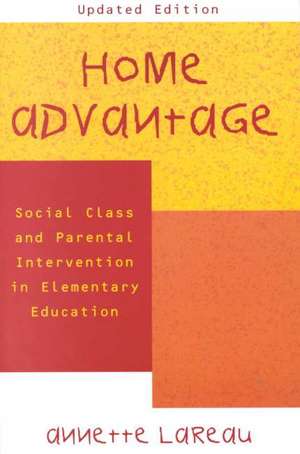
Home Advantage: Social Class and Parental Intervention in Elementary Education
Autor Annette Lareauen Limba Engleză Paperback – 26 iul 2000
Preț: 278.75 lei
Preț vechi: 362.43 lei
-23%
Puncte Express: 418
Carte tipărită la comandă
Livrare economică 05-19 decembrie
Livrare prin curier în România Termenul estimat este afișat lângă disponibilitate.
Transport gratuit de la 400.00 lei Plată online sau ramburs, în funcție de opțiunile comenzii.
Retur gratuit în 14 zile Comandă securizată și suport în română.
Specificații
ISBN-13: 9780742501454
ISBN-10: 0742501450
Pagini: 288
Dimensiuni: 148 x 228 x 18 mm
Greutate: 0.39 kg
Ediția:New.
Editura: Bloomsbury Publishing
Colecția Rowman & Littlefield
Locul publicării:New York, United States
ISBN-10: 0742501450
Pagini: 288
Dimensiuni: 148 x 228 x 18 mm
Greutate: 0.39 kg
Ediția:New.
Editura: Bloomsbury Publishing
Colecția Rowman & Littlefield
Locul publicării:New York, United States
V-ar putea interesa
-
 The Political Integration of Ethnic Minorities in BritainAnthony F. Heath-31%Preț: 804.56 lei1169.36 lei
 -
 Criminal Law and Cultural DiversityWill Kymlicka-31%Preț: 726.14 lei1048.06 lei
 -
 Unequal ChildhoodsAnnette LareauPreț: 258.00 lei
 -
 Preț: 233.66 lei
 -
 Strangers at Our DoorZygmunt BaumanPreț: 130.95 lei
 -
 Another Darkness, Another DawnBecky Taylor-7%Preț: 209.86 lei226.20 lei
 -
 Separate and DominateChristine DelphyPreț: 129.67 lei
 -
 Anders Breivik and the Rise of IslamophobiaSindre BangstadPreț: 159.63 lei
 -
 Preț: 166.21 lei
 -
 -43%Preț: 91.83 lei161.55 lei
 -
 Revitalising Indigenous LanguagesMarja-Liisa OlthuisPreț: 357.63 lei
 -
 Gypsy EmpireEAMON DILLONPreț: 78.99 lei
 -
 No Place to Call HomeKatharine QuarmbyPreț: 108.66 lei
 -
 Growing Up Asian in AustraliaAlice PungPreț: 137.75 lei
Cuprins
Acknowledgments
Foreword by Julia Wrigley
Social Class and Parent Intervention in Schooling
What Do Teachers Want From Parents?
Separation Between Family and School: Colton
Interconnectedness Between Family and School: Prescott
Mothers and Fathers: Gender Differences in Parent Involvement in Schooling
Why Does Social Class Influence Parent Involvement in Schooling?
Educational Profits: The Positive Impact of Parental Involvement on Children's School Careers
Social Class Differences in Inter-Institutional Linkages
Appendix: Common Problems in Fieldwork: A Personal Essay
Foreword by Julia Wrigley
Social Class and Parent Intervention in Schooling
What Do Teachers Want From Parents?
Separation Between Family and School: Colton
Interconnectedness Between Family and School: Prescott
Mothers and Fathers: Gender Differences in Parent Involvement in Schooling
Why Does Social Class Influence Parent Involvement in Schooling?
Educational Profits: The Positive Impact of Parental Involvement on Children's School Careers
Social Class Differences in Inter-Institutional Linkages
Appendix: Common Problems in Fieldwork: A Personal Essay
Recenzii
Home Advantage is already a classic in the sociology of education. It is theoretically rich and its findings are profound. It is also a model of excellence for qualitative research methods.
Home Advantage is a marvelous tool for teaching about both the dynamics of school-family linkages and the realities of the process of social research. The book invariably triggers spirited discussions among students, and has a lasting influence on how they think about the sociology of education and about research.
Home Advantage is a superb empirical study of family-school relations. The nuanced analysis, especially of the dynamics of social class, has given this work the well-earned status of a classic whose insights are of lasting value.
An important and timely book about the ways parents are able (and unable) to shape their children's educational experiences. . . . Should be read by all current and future educators . . . required reading for students of qualitative research.
Home Advantage is the most compelling empirical illustration I have found of the concept of cultural capital. It is a rich book to teach, and in the stratification course in which I used it, the students considered it the best of the books they were assigned.
Home Advantage is a marvelous tool for teaching about both the dynamics of school-family linkages and the realities of the process of social research. The book invariably triggers spirited discussions among students, and has a lasting influence on how they think about the sociology of education and about research.
Home Advantage is a superb empirical study of family-school relations. The nuanced analysis, especially of the dynamics of social class, has given this work the well-earned status of a classic whose insights are of lasting value.
An important and timely book about the ways parents are able (and unable) to shape their children's educational experiences. . . . Should be read by all current and future educators . . . required reading for students of qualitative research.
Home Advantage is the most compelling empirical illustration I have found of the concept of cultural capital. It is a rich book to teach, and in the stratification course in which I used it, the students considered it the best of the books they were assigned.