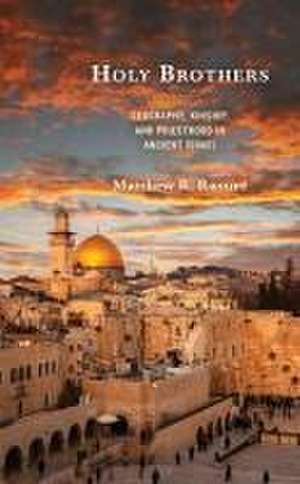
Holy Brothers: Geography, Kinship, and Priesthood in Ancient Israel
Autor Matthew R. Rasureen Limba Engleză Hardback – 30 oct 2023
Preț: 490.44 lei
Preț vechi: 723.43 lei
-32%
Puncte Express: 736
Carte tipărită la comandă
Livrare economică 17 noiembrie-01 decembrie
Livrare prin curier în România Termenul estimat este afișat lângă disponibilitate.
Transport gratuit pentru acest produs Plată online sau ramburs, în funcție de opțiunile comenzii.
Retur gratuit în 14 zile Comandă securizată și suport în română.
Specificații
ISBN-13: 9781978711280
ISBN-10: 197871128X
Pagini: 172
Ilustrații: 1 table
Dimensiuni: 160 x 232 x 20 mm
Greutate: 0.42 kg
Editura: Bloomsbury Publishing
Colecția Fortress Academic
Locul publicării:New York, United States
ISBN-10: 197871128X
Pagini: 172
Ilustrații: 1 table
Dimensiuni: 160 x 232 x 20 mm
Greutate: 0.42 kg
Editura: Bloomsbury Publishing
Colecția Fortress Academic
Locul publicării:New York, United States
Cuprins
Introduction
Chapter 1: Chasing the Priesthood in the Early First Millennium
Chapter 2: The History of the Mushite Hypothesis
Chapter 3: Holy Lands-Geography and the Israelite Priesthood
Chapter 4: Holy Families-Genealogy of the Levites, Moses, and Aaron
Chapter 5: Holy Priests-Moses, Aaron, and Priestly Authority in the Pentateuch
Chapter 6: Geography, Kinship, and Priesthood-A Synthesis
Bibliography
Chapter 1: Chasing the Priesthood in the Early First Millennium
Chapter 2: The History of the Mushite Hypothesis
Chapter 3: Holy Lands-Geography and the Israelite Priesthood
Chapter 4: Holy Families-Genealogy of the Levites, Moses, and Aaron
Chapter 5: Holy Priests-Moses, Aaron, and Priestly Authority in the Pentateuch
Chapter 6: Geography, Kinship, and Priesthood-A Synthesis
Bibliography
Recenzii
The book offers readers broader nuances and contours of the diversity and influence of various priestly groups in ancient Israel from the lenses of geography, kinship, and priestly authority. R. convincingly demonstrates and asserts that there were oppositions between Aaronand Moses and between a geographical center(Aaronites) and a periphery (Mushites).
Holy Brothers refurbishes an often-overlooked theory on the origins of the Israelite priesthood for a new era of scholarship. Matthew R. Rasure skillfully presents textual, geographical, and comparative evidence in this lucid and learned monograph. Students and scholars alike who are interested in the relationship between early Israelite history and the Hebrew Bible will benefit from Rasure's careful research and insightful conclusions.
Matthew Rasure's book takes up the thesis, best known from the scholar Frank Moore Cross, that the priesthood in ancient Israel was divided into two groups, often at odds with each other: one descended from Moses (Mushite) and the other from Aaron (Aaronide). This thesis has had a wide and controversial reception in modern scholarship, and Rasure provides a comprehensive examination of both thesis and reception in great and searching detail. He argues persuasively that the thesis needs to be explored in three dimensions, as manifest in the Hebrew Bible along with non-biblical sources and modern anthropological analogies: the priesthood in terms of its varied geographical location in ancient Israel; in terms of the genealogical traditions attached to it; and in terms of the biblical narratives about priests, particularly in the Pentateuch, the latter based on Rasure's nuanced use of the Documentary Hypothesis. The result is a book that offers an extended and probing evaluation of Cross's priestly duality, affirming its core vision, but with important revisions that bear more broadly on the nature of priestly conception and practice in Israel, on the structure of ancient Israelite society, and on the shape of biblical literature.
Holy Brothers refurbishes an often-overlooked theory on the origins of the Israelite priesthood for a new era of scholarship. Matthew R. Rasure skillfully presents textual, geographical, and comparative evidence in this lucid and learned monograph. Students and scholars alike who are interested in the relationship between early Israelite history and the Hebrew Bible will benefit from Rasure's careful research and insightful conclusions.
Matthew Rasure's book takes up the thesis, best known from the scholar Frank Moore Cross, that the priesthood in ancient Israel was divided into two groups, often at odds with each other: one descended from Moses (Mushite) and the other from Aaron (Aaronide). This thesis has had a wide and controversial reception in modern scholarship, and Rasure provides a comprehensive examination of both thesis and reception in great and searching detail. He argues persuasively that the thesis needs to be explored in three dimensions, as manifest in the Hebrew Bible along with non-biblical sources and modern anthropological analogies: the priesthood in terms of its varied geographical location in ancient Israel; in terms of the genealogical traditions attached to it; and in terms of the biblical narratives about priests, particularly in the Pentateuch, the latter based on Rasure's nuanced use of the Documentary Hypothesis. The result is a book that offers an extended and probing evaluation of Cross's priestly duality, affirming its core vision, but with important revisions that bear more broadly on the nature of priestly conception and practice in Israel, on the structure of ancient Israelite society, and on the shape of biblical literature.