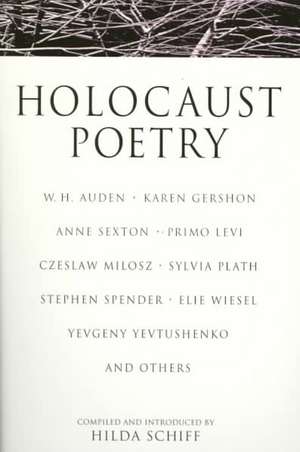
Holocaust Poetry
Autor Hilda Schiffen Limba Engleză Paperback – 15 feb 1996
The only known collection of its kind currently in print, this important volume includes the work of 59 poets--among them Auden, Brecht, Celan, Jarrell, Levi, Milosz, Plath, Sexton, Spender, Wiesel, and Yevtushenko--writing on a range of subjects that are indelibly linked with the Holocaust. Collecting 119 poems in all, Holocaust Poetry commemorates the sanctity of those who died--both Jews and non-Jews--as a result of this unimaginably horrible crime.
Yet Schiff's anthology is also a solemn affirmation of humanity's survival, for it pays homage to the past while also attesting to the often brutal struggles that we as a species still face in this world, day in and day out. Also preserved here are poems written by those who themselves perished in the Shoah, the final testaments and eternal lessons of unknown soldiers, unheralded heroes, unsilenced voices.
Yet Schiff's anthology is also a solemn affirmation of humanity's survival, for it pays homage to the past while also attesting to the often brutal struggles that we as a species still face in this world, day in and day out. Also preserved here are poems written by those who themselves perished in the Shoah, the final testaments and eternal lessons of unknown soldiers, unheralded heroes, unsilenced voices.
The only known collection of its kind currently in print, this important volume includes the work of 59 poets--among them Auden, Brecht, Celan, Jarrell, Levi, Milosz, Plath, Sexton, Spender, Wiesel, and Yevtushenko--writing on a range of subjects that are indelibly linked with the Holocaust. Collecting 119 poems in all, Holocaust Poetry commemorates the sanctity of those who died--both Jews and non-Jews--as a result of this unimaginably horrible crime.
Yet Schiff's anthology is also a solemn affirmation of humanity's survival, for it pays homage to the past while also attesting to the often brutal struggles that we as a species still face in this world, day in and day out. Also preserved here are poems written by those who themselves perished in the Shoah, the final testaments and eternal lessons of unknown soldiers, unheralded heroes, unsilenced voices.
Yet Schiff's anthology is also a solemn affirmation of humanity's survival, for it pays homage to the past while also attesting to the often brutal struggles that we as a species still face in this world, day in and day out. Also preserved here are poems written by those who themselves perished in the Shoah, the final testaments and eternal lessons of unknown soldiers, unheralded heroes, unsilenced voices.
Preț: 103.77 lei
Puncte Express: 156
Preț estimativ în valută:
18.34€ • 21.53$ • 16.06£
18.34€ • 21.53$ • 16.06£
Carte disponibilă
Livrare economică 25 martie-08 aprilie
Specificații
ISBN-13: 9780312143572
ISBN-10: 0312143575
Pagini: 256
Dimensiuni: 138 x 209 x 17 mm
Greutate: 0.29 kg
Ediția:5th edition
Editura: St. Martins Press-3pl
ISBN-10: 0312143575
Pagini: 256
Dimensiuni: 138 x 209 x 17 mm
Greutate: 0.29 kg
Ediția:5th edition
Editura: St. Martins Press-3pl
V-ar putea interesa
-
 Place: New PoemsJorie GrahamPreț: 85.24 lei
 -
 Jabberwocky and Other NonsenseLewis Carroll-19%Preț: 62.25 lei76.60 lei
 -
 The Complete PoetryGeorge Herbert-28%Preț: 74.68 lei104.42 lei
 -
 Selected and Last Poems 1931-2004Czeslaw Milosz-20%Preț: 60.82 lei75.90 lei
 -
 GossamurmurAnne WaldmanPreț: 144.02 lei
 -
 The Complete PoemsAnne SextonPreț: 124.03 lei
 -
 By Heart: 101 Poems and How to Remember ThemTed HughesPreț: 67.71 lei
 -
 Selected Poems of Anne SextonAnne SextonPreț: 115.51 lei
 -
 Anne Sexton: A Self-Portrait in LettersLois AmesPreț: 183.05 lei
 -
 Heaven and Earth: A CosmologyAlbert GoldbarthPreț: 166.98 lei
 -
 Salt PierDore KiesselbachPreț: 97.31 lei
 -
 AppetiteAaron SmithPreț: 93.73 lei
 -
 If One of Us Should FallNicole Terez DuttonPreț: 97.07 lei
 -
 WenceslasCarol Ann Duffy DBE-36%Preț: 34.54 lei54.20 lei
 -
 Fault LinesKendel HippolytePreț: 96.08 lei
 -
 Intimate GeographyIshmael Von Heidrick-BarnesPreț: 92.29 lei
Notă biografică
Hilda Schiff is a renowned translator, author, anthologist, poet, and scholar. An annual Hilda Schiff Prize in Holocaust Studies is awarded by the Oxford Centre for Hebrew and Jewish Studies at Oxford University.
Recenzii
"The power of verse to encompass a topic of mammoth scope and render it into painstakingly personal detail is keenly demonstrated in this absorbing and well thought-out anthology of grief."--"Publishers Weekly""Can there be poetry about the Holocaust? Isn't this kind of writing an attempt to escape--or to exploit--the suffering of millions? Poet and anthologist Schiff confronts these questions in her eloquent introduction. One answer she finds is that to remain silent is also to lie. Fifty years after the liberation of Auschwitz, great literature about the Holocaust has grown to a flood . . . The pieces here are of astonishing power. In English and in translation from many languages, [nearly 60] poets--including Wiesel, Fink, Brecht, Yevtushenko, Auden, and Sachs--give voice to what seems unspeakable. Schiff points out that compelling historical accounts document the facts and numbers, but a poem, like a story, makes us imagine how it felt for one person. These poems are stark and deceptively simple. No one can read them all at once. Each poem leaves you with an indelible memory. In words of one syllable, the Polish poet Rozewicz writes about having to reinvent language after Auschwitz ("this is a man / this is a tree this is bread" ). There's no healing in this tragedy: the last poem, by Primo Levi, is like a shout of rage to us to remember."--Hazel Rochman, "Booklist"
Cuprins
Introduction
The Poems
Alienation
"Heritage," Hayim Gouri
"Europe, Late," Dan Pagis
"The Shoemaker's Wife," Lotte Kramer
"The Burning of the Books," Bertolt Brecht
"First They Came for the Jews," Pastor Niemöller
"A Footnote Extended," Dannie Abse
"Refugee Blues," W. H. Auden
"How Can I See You, Love," David Vogel
Persecution
"1940," Bertolt Brecht
"The Red Cross Telegram," Lotte Kramer
"The German Frontier at Basel," Hilda Schiff
"He Was Lucky," Anna Swirszczynska
"I Saw My Father Drowning," David Vogel
"There Is a Last, Solitary Coach," David Vogel
"Clouded Sky," Miklós Radnóti
"The Butterfly," Pavel Friedmann
"Elegy," Antoni Slonimski
"A Cartload of Shoes," Abraham Sutzkever
"How They Killed My Grandmother," Boris Slutsky
(from) "Holocaust," Charles Reznikoff
"The Assumption of Miriam," Jerzy Ficowski
Destruction
(i)
"Death Fugue," Paul Celan
"O the Chimneys," Nelly Sachs
"Never Shall I Forget," Elie Wiesel
"Testimony," Dan Pagis
"The Roll Call," Dan Pagis
"Be Seeing You," Vasko Popa
"Forced March," Miklós Radnóti
"Postcards," Miklós Radnóti
"Harbach 1944," János Pilinszky
"Passion of Ravensbrück," János Pilinszky
"On the Wall of a KZ-Lager," János Pilinszky
"Fable, Detail from his KZ-Oratorio: Dark Heaven," János Pilinszky
"Roads," Peter Huchel
"A Poem of Death," George Macbeth
"Night over Birkenau," Tadeusz Borowski
"Treblinka," Michael Hamburger
"Shipment to Maidanek," Ephraim Fogel
"Remembering Dresden," Van K. Brock
20(ii)
"Passover: the Injections," William Heyen
"A Girl of Six from the Ghetto," Jerzy Ficowski
"5.8.1942, In Memory of Janusz Korczak," Jerzy Ficowski
(from) "Holocaust," Charles Reznikoff
"A Dead Child Speaks," Nelly Sachs
"Already Embraced by the Arm of Heavenly Solace," Nelly Sachs
"O the Night of the Weeping Children!," Nelly Sachs
"Massacre of the Boys," Tadeusz Rózewicz
"Pigtail," Tadeusz Rózewicz
"In the Camp There Was One Alive," Randall Jarrell
"Magda Goebbels," W. D. Snodgrass
(iii)
"Burnt," Boris Slutsky
"Innocence," Thom Gunn
(from) "Holocaust," Charles Reznikoff
Rescuers, Bystanders, Perpetrators
"Both Your Mothers," Jerzy Ficowski
"1980," Abraham Sutzkever
"I Did Not Manage to Save," Jerzy Ficowski
"A Poor Christian Looks at the Ghetto," Czeslaw Milosz
"History and Reality," Stephen Spender
"Babii Yar," Yevgeny Yevtushenko
"Ovid in the Third Reich," Geoffrey Hill
"September Song," Geoffrey Hill
"A Camp in the Prussian Forest," Randall Jarrell
"'More Light, More Light,'" Anthony Hecht
"Between the Lines," Michael Hamburger
"A German Requiem," James Fenton
Afterwards
"Archive Film Material," Ruth Fainlight
"Far, Far a City Lies (from 'My Little Sister')," Abba Kovner
"Auschwitz, 1987," Adam Zych
"Memento," Stephen Spender
"Leave Us," Tadeusz Rózewicz
"Reveille," Primo Levi
"The Survivor," Primo Levi
"The Sun of Auschwitz," Tadeusz Borowski
"Farewell to Maria," Tadeusz Borowski
"The Execution of Memory," Jerzy Ficowski
"My Mother's Friend," Lily Brett
"La Pathetique," Lily Brett
"I, the Survivor," Bertolt Brecht
"The Retum," Tadeusz Rózewicz
Second Generation
"Almost a Love Poem," Yehuda Amichai
"Draft of a Reparations Agreement," Dan Pagis
"I Was Not There," Karen Gershon
"When it Happened," Hilda Schiff
"I Keep Forgetting," Lily Brett
"Leaving You," Lily Brett
"Holocaust 1944," Anne Ranasinghe
"The Book of Yolek," Anthony Hecht
"Daddy," Sylvia Plath
"Against Parting," Natan Zach
Lessons
"Annotations of Auschwitz," Peter Porter
"If," Edward Bond
"How We See," Edward Bond
"The Survivor," Tadeusz Rózewicz
"In the Midst of Life," Tadeusz Rózewicz
"Race," Karen Gershon
"Synagogue in Prague," Alan Sillitoe
"During the Eichmann Trial," Denise Levertov
"Campo dei Fiori," Czeslaw Milosz
"Posthumous Rehabilitation," Tadeusz Rózewicz
"May, 1945," Peter Porter
"War Has Been Given a Bad Name," Bertolt Brecht
"Portrait of a House Detective," Hans Magnus Enzenberger
"Riddle," William Heyen
"Annus Mirabilis 1989," Elaine Feinstein
God
(i)
"Smoke Rose," Itamar Yaoz-Kest
"Written in Pencil," Dan Pagis
"Zürich, the Stork Inn," Paul Celan
"Who Am I?," Dietrich Bonhoeffer
"I Believe," Anonymous
"What Luck," Tadeusz Rózewicz
(ii)
"Without Jews," Jacob Glatstein
"Experiments With God," Karen Gershon
"The Jugs," Paul Celan
"Psalm," Paul Celan
"After Auschwitz," Anne Sexton
"Discovery," Hilda Schiff
"Ani Maamin," Elie Wiesel
"Shemá," Primo Levi
Biographical Details of Poets
Index of Poets
Index of Translators
Index of Titles
Index of First Lines
Acknowledgements
The Poems
Alienation
"Heritage," Hayim Gouri
"Europe, Late," Dan Pagis
"The Shoemaker's Wife," Lotte Kramer
"The Burning of the Books," Bertolt Brecht
"First They Came for the Jews," Pastor Niemöller
"A Footnote Extended," Dannie Abse
"Refugee Blues," W. H. Auden
"How Can I See You, Love," David Vogel
Persecution
"1940," Bertolt Brecht
"The Red Cross Telegram," Lotte Kramer
"The German Frontier at Basel," Hilda Schiff
"He Was Lucky," Anna Swirszczynska
"I Saw My Father Drowning," David Vogel
"There Is a Last, Solitary Coach," David Vogel
"Clouded Sky," Miklós Radnóti
"The Butterfly," Pavel Friedmann
"Elegy," Antoni Slonimski
"A Cartload of Shoes," Abraham Sutzkever
"How They Killed My Grandmother," Boris Slutsky
(from) "Holocaust," Charles Reznikoff
"The Assumption of Miriam," Jerzy Ficowski
Destruction
(i)
"Death Fugue," Paul Celan
"O the Chimneys," Nelly Sachs
"Never Shall I Forget," Elie Wiesel
"Testimony," Dan Pagis
"The Roll Call," Dan Pagis
"Be Seeing You," Vasko Popa
"Forced March," Miklós Radnóti
"Postcards," Miklós Radnóti
"Harbach 1944," János Pilinszky
"Passion of Ravensbrück," János Pilinszky
"On the Wall of a KZ-Lager," János Pilinszky
"Fable, Detail from his KZ-Oratorio: Dark Heaven," János Pilinszky
"Roads," Peter Huchel
"A Poem of Death," George Macbeth
"Night over Birkenau," Tadeusz Borowski
"Treblinka," Michael Hamburger
"Shipment to Maidanek," Ephraim Fogel
"Remembering Dresden," Van K. Brock
20(ii)
"Passover: the Injections," William Heyen
"A Girl of Six from the Ghetto," Jerzy Ficowski
"5.8.1942, In Memory of Janusz Korczak," Jerzy Ficowski
(from) "Holocaust," Charles Reznikoff
"A Dead Child Speaks," Nelly Sachs
"Already Embraced by the Arm of Heavenly Solace," Nelly Sachs
"O the Night of the Weeping Children!," Nelly Sachs
"Massacre of the Boys," Tadeusz Rózewicz
"Pigtail," Tadeusz Rózewicz
"In the Camp There Was One Alive," Randall Jarrell
"Magda Goebbels," W. D. Snodgrass
(iii)
"Burnt," Boris Slutsky
"Innocence," Thom Gunn
(from) "Holocaust," Charles Reznikoff
Rescuers, Bystanders, Perpetrators
"Both Your Mothers," Jerzy Ficowski
"1980," Abraham Sutzkever
"I Did Not Manage to Save," Jerzy Ficowski
"A Poor Christian Looks at the Ghetto," Czeslaw Milosz
"History and Reality," Stephen Spender
"Babii Yar," Yevgeny Yevtushenko
"Ovid in the Third Reich," Geoffrey Hill
"September Song," Geoffrey Hill
"A Camp in the Prussian Forest," Randall Jarrell
"'More Light, More Light,'" Anthony Hecht
"Between the Lines," Michael Hamburger
"A German Requiem," James Fenton
Afterwards
"Archive Film Material," Ruth Fainlight
"Far, Far a City Lies (from 'My Little Sister')," Abba Kovner
"Auschwitz, 1987," Adam Zych
"Memento," Stephen Spender
"Leave Us," Tadeusz Rózewicz
"Reveille," Primo Levi
"The Survivor," Primo Levi
"The Sun of Auschwitz," Tadeusz Borowski
"Farewell to Maria," Tadeusz Borowski
"The Execution of Memory," Jerzy Ficowski
"My Mother's Friend," Lily Brett
"La Pathetique," Lily Brett
"I, the Survivor," Bertolt Brecht
"The Retum," Tadeusz Rózewicz
Second Generation
"Almost a Love Poem," Yehuda Amichai
"Draft of a Reparations Agreement," Dan Pagis
"I Was Not There," Karen Gershon
"When it Happened," Hilda Schiff
"I Keep Forgetting," Lily Brett
"Leaving You," Lily Brett
"Holocaust 1944," Anne Ranasinghe
"The Book of Yolek," Anthony Hecht
"Daddy," Sylvia Plath
"Against Parting," Natan Zach
Lessons
"Annotations of Auschwitz," Peter Porter
"If," Edward Bond
"How We See," Edward Bond
"The Survivor," Tadeusz Rózewicz
"In the Midst of Life," Tadeusz Rózewicz
"Race," Karen Gershon
"Synagogue in Prague," Alan Sillitoe
"During the Eichmann Trial," Denise Levertov
"Campo dei Fiori," Czeslaw Milosz
"Posthumous Rehabilitation," Tadeusz Rózewicz
"May, 1945," Peter Porter
"War Has Been Given a Bad Name," Bertolt Brecht
"Portrait of a House Detective," Hans Magnus Enzenberger
"Riddle," William Heyen
"Annus Mirabilis 1989," Elaine Feinstein
God
(i)
"Smoke Rose," Itamar Yaoz-Kest
"Written in Pencil," Dan Pagis
"Zürich, the Stork Inn," Paul Celan
"Who Am I?," Dietrich Bonhoeffer
"I Believe," Anonymous
"What Luck," Tadeusz Rózewicz
(ii)
"Without Jews," Jacob Glatstein
"Experiments With God," Karen Gershon
"The Jugs," Paul Celan
"Psalm," Paul Celan
"After Auschwitz," Anne Sexton
"Discovery," Hilda Schiff
"Ani Maamin," Elie Wiesel
"Shemá," Primo Levi
Biographical Details of Poets
Index of Poets
Index of Translators
Index of Titles
Index of First Lines
Acknowledgements