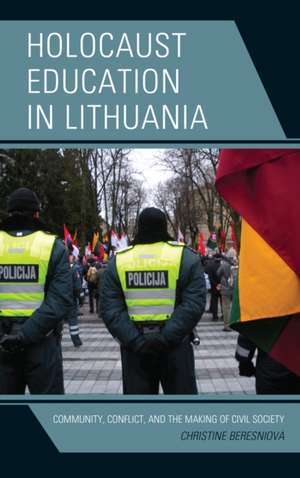
Holocaust Education in Lithuania: Community, Conflict, and the Making of Civil Society: Lexington Books
Autor Christine Beresniovaen Limba Engleză Hardback – 8 mar 2017
Din seria Lexington Books
- 19%
 Preț: 426.72 lei
 - 32%
 Preț: 712.23 lei
 - 59%
 Preț: 427.24 lei
 - 23%
 Preț: 318.57 lei
 - 25%
 Preț: 362.03 lei
 - 23%
 Preț: 322.75 lei
 - 27%
 Preț: 355.41 lei
 - 29%
 Preț: 345.71 lei
 - 25%
 Preț: 306.14 lei
 - 33%
 Preț: 710.24 lei
 - 31%
 Preț: 437.25 lei
 - 29%
 Preț: 342.12 lei
 - 25%
 Preț: 361.02 lei
 - 29%
 Preț: 344.18 lei
 - 28%
 Preț: 347.76 lei
 - 28%
 Preț: 346.74 lei
 - 23%
 Preț: 318.96 lei
 - 37%
 Preț: 660.07 lei
 - 24%
 Preț: 309.62 lei
 - 29%
 Preț: 599.98 lei
 - 24%
 Preț: 369.89 lei
 - 36%
 Preț: 730.77 lei
 - 33%
 Preț: 642.37 lei
 - 29%
 Preț: 345.71 lei
 - 27%
 Preț: 354.68 lei
 - 29%
 Preț: 342.63 lei
 - 28%
 Preț: 252.34 lei
 - 27%
 Preț: 354.28 lei
 - 22%
 Preț: 332.36 lei
 - 22%
 Preț: 338.89 lei
 - 23%
 Preț: 321.63 lei
 - 23%
 Preț: 319.79 lei
 - 28%
 Preț: 346.74 lei
 - 23%
 Preț: 321.53 lei
 - 35%
 Preț: 560.77 lei
 - 24%
 Preț: 308.07 lei
 - 23%
 Preț: 321.63 lei
 - 27%
 Preț: 263.04 lei
 - 23%
 Preț: 333.36 lei
 - 34%
 Preț: 630.22 lei
 - 22%
 Preț: 341.76 lei
 - 33%
 Preț: 358.06 lei
 - 34%
 Preț: 418.63 lei
 - 34%
 Preț: 601.39 lei
 - 35%
 Preț: 593.04 lei
 - 25%
 Preț: 884.44 lei
 - 33%
 Preț: 640.95 lei
Preț: 581.93 lei
Preț vechi: 863.17 lei
-33%
Puncte Express: 873
Carte tipărită la comandă
Livrare economică 17 noiembrie-01 decembrie
Livrare prin curier în România Termenul estimat este afișat lângă disponibilitate.
Transport gratuit pentru acest produs Plată online sau ramburs, în funcție de opțiunile comenzii.
Retur gratuit în 14 zile Comandă securizată și suport în română.
Specificații
ISBN-13: 9781498537445
ISBN-10: 1498537448
Pagini: 218
Dimensiuni: 154 x 230 x 20 mm
Greutate: 0.45 kg
Editura: Bloomsbury Publishing
Colecția Lexington Books
Seria Lexington Books
Locul publicării:New York, United States
ISBN-10: 1498537448
Pagini: 218
Dimensiuni: 154 x 230 x 20 mm
Greutate: 0.45 kg
Editura: Bloomsbury Publishing
Colecția Lexington Books
Seria Lexington Books
Locul publicării:New York, United States
V-ar putea interesa
-
 Designs on FilmCathy Whitlock-8%Preț: 397.40 lei431.96 lei
 -
 Theatre and TherapyFintan Walsh-23%Preț: 54.37 lei70.35 lei
 -
 Preț: 304.84 lei
 -
 Preț: 388.27 lei
 -
 By Design: Interviews with Film Production DesignersVincent LoBrutto-21%Preț: 258.60 lei327.14 lei
 -
 The Theatre of the Holocaust, Volume 1: Four PlaysRobert SklootPreț: 179.38 lei
 -
 The Theatre of the Holocaust, Volume 2: Six PlaysRobert SklootPreț: 149.06 lei
 -
 -51%Preț: 336.19 lei692.28 lei
 -
 The History of the Holocaust in RomaniaJean AncelPreț: 311.49 lei
 -
 The Holocaust in American FilmJudith DonesonPreț: 151.36 lei
 -
 -11%Preț: 500.57 lei562.44 lei
 -
 -30%Preț: 474.44 lei675.52 lei
 -
 Theatre History and HistoriographyClaire Cochrane-18%Preț: 805.27 lei982.04 lei
 -
 The Ethics of Teaching at Sites of Violence and TraumaNatalie BormannPreț: 418.48 lei
 -
 Preț: 454.28 lei
 -
 Staging Holocaust ResistanceGene A. PlunkaPreț: 308.69 lei
 -
 Beckett's Creatures: Art of Failure after the HolocaustJoseph Anderton-25%Preț: 255.74 lei340.61 lei
 -
 Applied Theatre: AestheticsGareth White-16%Preț: 197.62 lei235.79 lei
 -
 Anatomy of the Moving Body, Second EditionTheodore Dimon-19%Preț: 133.19 lei164.29 lei
 -
 -15%Preț: 143.23 lei168.03 lei
 -
 The Feldenkrais MethodYochanan RywerantPreț: 110.93 lei
 -
 The Post-traumatic Theatre of Grotowski and KantorMagda RomanskaPreț: 282.88 lei
 -
 Designing for ScreenGeorgina ShorterPreț: 131.85 lei
 -
 Holocaust Education in Primary Schools in the Twenty-First CenturyClaus-Christian W. Szejnmann-18%Preț: 740.39 lei902.92 lei
 -
 -8%Preț: 432.00 lei469.56 lei
 -
 Romania and the Holocaust: Events – Contexts – AftermathSimon Geissbühler-14%Preț: 221.76 lei258.64 lei
 -
 -23%Preț: 173.90 lei225.23 lei
 -
 Preț: 350.09 lei
 -
 Holocaust Education and the Student PerspectiveEvette MelizaPreț: 312.15 lei
Cuprins
Introduction "Again with the Jews?": The Politics of the Holocaust in Post-Soviet Lithuania
Chapter 1"Nazi = Soviet": The Debate the Defines a Generation
Chapter 2 "The Ambassador is doing the Devil's Work": International Dimensions of Holocaust Education in Lithuania
Chapter 3 "Tribal Thinking": Chronopolitics, Elite Culture, and the Making of Policy Subjects
Chapter 4 "It all Depends on the Teacher": Teacher Motivations, Administrative Hierarchy, and the Visibility of Western Power
Chapter 5 "It's Just Holocaust, Holocaust, Holocaust": The Missing Jews in Lithuanian
Chapter 6 "Right-Wing Mad Generals": Discourses and Counter-Discourses about the Nation in Lithuania Chapter 7 "One Man Alone in a Field is Not a Soldier": Community, Society, and Battle in
Conclusions "All of Us Think We Are Special": History, Magic, and Battlegrounds as Opportunities
Chapter 1"Nazi = Soviet": The Debate the Defines a Generation
Chapter 2 "The Ambassador is doing the Devil's Work": International Dimensions of Holocaust Education in Lithuania
Chapter 3 "Tribal Thinking": Chronopolitics, Elite Culture, and the Making of Policy Subjects
Chapter 4 "It all Depends on the Teacher": Teacher Motivations, Administrative Hierarchy, and the Visibility of Western Power
Chapter 5 "It's Just Holocaust, Holocaust, Holocaust": The Missing Jews in Lithuanian
Chapter 6 "Right-Wing Mad Generals": Discourses and Counter-Discourses about the Nation in Lithuania Chapter 7 "One Man Alone in a Field is Not a Soldier": Community, Society, and Battle in
Conclusions "All of Us Think We Are Special": History, Magic, and Battlegrounds as Opportunities
Recenzii
The book analyzes not only the motivation of teachers working with Holocaust programs, but also many other contexts which influence the success or failure of these programs. . . . Beresniova's book can serve the interests of other researchers who analyze similar problems in other countries. The book will be truly useful to everyone working in the field of education who is able to critically reflect on their activities.
In Holocaust Education in Lithuania: Community, Conflict, and the Making of Civil Society, Beresniova deftly uncovers the contested divergence of memory and history while cogently attending to transnational epistemological entrepreneurship. Informed by rich theoretical depth, Beresniova's position provides a unique and insightful perspective into a complex site of multiple and overlapping cultural, ethnic, political, and historical legacies. With an ultimate focus on the transformative role of teacher agency and the importance of community for opening controversial and closed areas, Beresniova's work provides generative pathways for understanding how educational innovations can help bring about more just societies.
This book provides a fascinating account of one of the most important conversations to be had in today's democratic Lithuania: how to deal with the history and legacy of mass atrocities and local collaboration during the Holocaust. By focusing on Holocaust education in a context of ongoing research into the actual historical events and fierce public battles over how to remember both Stalinist and Nazi crimes, Beresniova manages to combine scrutiny of memory politics (not least of all the US) and a scrupulous interrogation of local education practices with much empathy for diverse positions and concerns on the ground. This is a must-read for anyone interested in contemporary Lithuania and in national and transnational politics of history and memory.
Christine Beresniova provides deep insight into the cultural struggles over history and memory that are occurring within and between European states in this beautifully written and sensitively rendered study. Beresniova explores the shifting meanings of the Holocaust in Lithuania as educators navigate the local and international politics surrounding memory. This sympathetic but critical analysis captures local perspectives and, crucially, shows how foreigner advocates often fail to understand local history, culture and language, which undermines dialogue and progress for all involved. The vivid vignettes effectively illuminate the broader policy and cultural currents, providing readers an understanding of the interaction between global and local dynamics. This volume will be of high interest to any reader of European politics, memory and education.
In Holocaust Education in Lithuania: Community, Conflict, and the Making of Civil Society, Beresniova deftly uncovers the contested divergence of memory and history while cogently attending to transnational epistemological entrepreneurship. Informed by rich theoretical depth, Beresniova's position provides a unique and insightful perspective into a complex site of multiple and overlapping cultural, ethnic, political, and historical legacies. With an ultimate focus on the transformative role of teacher agency and the importance of community for opening controversial and closed areas, Beresniova's work provides generative pathways for understanding how educational innovations can help bring about more just societies.
This book provides a fascinating account of one of the most important conversations to be had in today's democratic Lithuania: how to deal with the history and legacy of mass atrocities and local collaboration during the Holocaust. By focusing on Holocaust education in a context of ongoing research into the actual historical events and fierce public battles over how to remember both Stalinist and Nazi crimes, Beresniova manages to combine scrutiny of memory politics (not least of all the US) and a scrupulous interrogation of local education practices with much empathy for diverse positions and concerns on the ground. This is a must-read for anyone interested in contemporary Lithuania and in national and transnational politics of history and memory.
Christine Beresniova provides deep insight into the cultural struggles over history and memory that are occurring within and between European states in this beautifully written and sensitively rendered study. Beresniova explores the shifting meanings of the Holocaust in Lithuania as educators navigate the local and international politics surrounding memory. This sympathetic but critical analysis captures local perspectives and, crucially, shows how foreigner advocates often fail to understand local history, culture and language, which undermines dialogue and progress for all involved. The vivid vignettes effectively illuminate the broader policy and cultural currents, providing readers an understanding of the interaction between global and local dynamics. This volume will be of high interest to any reader of European politics, memory and education.