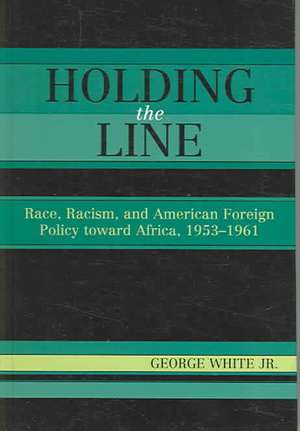
Holding the Line: Race, Racism, and American Foreign Policy Toward Africa, 1953-1961
Autor George White Jr.en Limba Engleză Hardback – 10 noi 2005
Preț: 674.42 lei
Preț vechi: 972.54 lei
-31%
Puncte Express: 1012
Carte tipărită la comandă
Livrare economică 25 noiembrie-09 decembrie
Livrare prin curier în România Termenul estimat este afișat lângă disponibilitate.
Transport gratuit pentru acest produs Plată online sau ramburs, în funcție de opțiunile comenzii.
Retur gratuit în 14 zile Comandă securizată și suport în română.
Specificații
ISBN-13: 9780742533820
ISBN-10: 0742533824
Pagini: 236
Dimensiuni: 176 x 234 x 20 mm
Greutate: 0.43 kg
Editura: Bloomsbury Publishing
Colecția Rowman & Littlefield
Locul publicării:New York, United States
ISBN-10: 0742533824
Pagini: 236
Dimensiuni: 176 x 234 x 20 mm
Greutate: 0.43 kg
Editura: Bloomsbury Publishing
Colecția Rowman & Littlefield
Locul publicării:New York, United States
Cuprins
Chapter 1 The Ghosts in the Shell
Chapter 2 As the Snake Sheds its Skin: Eisenhower Diplomacy, African Decolonization and Nationalism
Chapter 3 The Negus and I: American Foreign Policy Toward Ethiopia
Chapter 4 Less than Strangers: Ghana and the United States
Chapter 5 Diplomacy with the Not-So-Distant CousinL: The United States of America and The Union of South Africa
Chapter 6 Stabilizing the Happy Colony: The United States and The Belgian Congo
Chapter 7 Conclusion: Overrunning the Best Interests of those Concerned
Chapter 2 As the Snake Sheds its Skin: Eisenhower Diplomacy, African Decolonization and Nationalism
Chapter 3 The Negus and I: American Foreign Policy Toward Ethiopia
Chapter 4 Less than Strangers: Ghana and the United States
Chapter 5 Diplomacy with the Not-So-Distant CousinL: The United States of America and The Union of South Africa
Chapter 6 Stabilizing the Happy Colony: The United States and The Belgian Congo
Chapter 7 Conclusion: Overrunning the Best Interests of those Concerned
Recenzii
An interesting and engaging exploration of the malleability of race in American culture and foreign policy during the Eisenhower administration. George White, Jr. has helped to illuminate the pathology of the 'American Dilemma' as it confronted the disintegration of both colonial rule in Africa and the Jim Crow regime in American life.
George White has delivered a crisp, historical analysis of the rules of 'whiteness' and how those rules undercut the promise of racial equality in the United States and the fight for political and economic independence in Africa. Holding the Line simply deepens our understanding of how far we have not come and why.
Recommended.
In his Holding the Line, George White makes an outstanding contribution to the historiography. His writing is clear, concise, and convincing, and based on thorough research. His critical analysis of the policies toward Africa of the Eisenhower administration joins the excellent work of other scholars such as Thomas Borstelmann regarding the relationship between race and foreign policy. In the tradition of William Appleman Williams, White spells out another aspect of the tragedy of American diplomacy-specifically how American attempts to preserve white supremacy contributed to economic instability and undermined democracy in Africa. His discussion of the harmful effects of these policies on African women is particularly enlightening. This is a must-read for anyone interested in the Cold War, relations with Africa, or the significance of race in U.S. history.
George White has delivered a crisp, historical analysis of the rules of 'whiteness' and how those rules undercut the promise of racial equality in the United States and the fight for political and economic independence in Africa. Holding the Line simply deepens our understanding of how far we have not come and why.
Recommended.
In his Holding the Line, George White makes an outstanding contribution to the historiography. His writing is clear, concise, and convincing, and based on thorough research. His critical analysis of the policies toward Africa of the Eisenhower administration joins the excellent work of other scholars such as Thomas Borstelmann regarding the relationship between race and foreign policy. In the tradition of William Appleman Williams, White spells out another aspect of the tragedy of American diplomacy-specifically how American attempts to preserve white supremacy contributed to economic instability and undermined democracy in Africa. His discussion of the harmful effects of these policies on African women is particularly enlightening. This is a must-read for anyone interested in the Cold War, relations with Africa, or the significance of race in U.S. history.