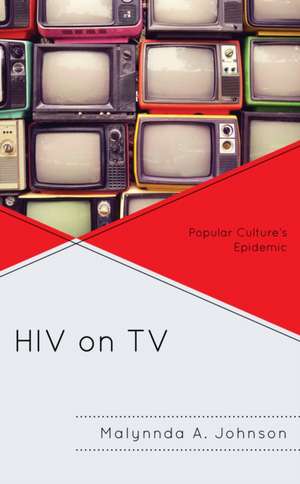
HIV on TV: Popular Culture's Epidemic
Autor Malynnda A. Johnsonen Limba Engleză Hardback – 15 sep 2018
Anatomy and How to Get Away with Murder. 35 years since HIV hit prime time it
remains a hot topic for TV producers to include in storylines. While the motivation
behind creating an HIV narrative is sometimes the disseminate facts about HIV and STIs, far
more often it is the sexy ratings a show can receive by including a "taboo" or controversial topic. As a result, while some education is provided to audiences, far more shows are found only perpetuating misinformation and stereotypes. As a result viewers, young populations especially,
continue to believe they are not at risk.
HIV on TV: Popular Culture's Epidemic offers a discussion of how HIV has
permeated popular culture. News broadcasts, movies, television shows, even music
lyrics have imbedded messages about HIV. Examining over 35-years of the
HIV evolution on television this book offers a critical lens for examining how medial topics, specifically HIV, are covered in the media. Cutting across three common genres (news, drama, and comedy), characterizations, contexts, and themes are critically analyzed to uncover what each genre has contributed to audience's understanding of risk, and what it is like to live with HIV. In total, the book offers three perspectives of the lessons presented about HIV. First, is the view from the screen; asking what the characters themselves say to the viewer. Second the book shares results from interviews with viewers themselves who have recalled seeing the shows mentioned. Finally, the book offers thoughts and reflections from writers, producers, and actors involved in the narratives. Providing the greatest insight, an interview with Daniel Franzese (Mean Girls, Road to Recovery, Looking) offers his experience in playing multiple roles as someone living with HIV and a challenge to media writers to be cautious in how they choose to write HIV into a storyline.
Preț: 524.89 lei
Preț vechi: 791.25 lei
-34%
Puncte Express: 787
Preț estimativ în valută:
92.79€ • 107.52$ • 80.24£
92.79€ • 107.52$ • 80.24£
Carte tipărită la comandă
Livrare economică 07-21 mai
Specificații
ISBN-13: 9781498547260
ISBN-10: 1498547265
Pagini: 184
Ilustrații: 2 b/w photos; 1 tables;
Dimensiuni: 158 x 232 x 17 mm
Greutate: 0.5 kg
Editura: Bloomsbury Publishing
Colecția Lexington Books
Locul publicării:New York, United States
ISBN-10: 1498547265
Pagini: 184
Ilustrații: 2 b/w photos; 1 tables;
Dimensiuni: 158 x 232 x 17 mm
Greutate: 0.5 kg
Editura: Bloomsbury Publishing
Colecția Lexington Books
Locul publicării:New York, United States
V-ar putea interesa
-
 Your BreastBob HurwitzPreț: 53.26 lei
 -
 A Brain Wider Than the SkyAndrew LevyPreț: 109.18 lei
 -
 Rsd in Me!Barby InglePreț: 97.04 lei
 -
 Common Chronic Illnesses and Their TreatmentsJames M. LowrancePreț: 39.25 lei
 -
 Stiff Person SyndromeJohn Hewitt M. a.Preț: 118.98 lei
 -
 No More Secs!Ann PietrangeloPreț: 100.63 lei
 -
 The Best Darn Hypothyroidism Book!James M. LowrancePreț: 40.59 lei
 -
 What Is a Pacemaker?Jeffrey L. WilliamsPreț: 77.56 lei
 -
 I Have Ibs...Now What?!!!Ashkan FarhadiPreț: 96.65 lei
 -
 Parkinson's Treatment Portuguese EditionMichael Scott OkunPreț: 85.03 lei
 -
 Preț: 70.73 lei
 -
 Sexually Transmitted Disease Surveillance 2012U. S. Department of Heal Human ServicesPreț: 142.92 lei
 -
 Eczema No MoreJason S. BradfordPreț: 62.67 lei
 -
 Behavior BasicsMartha Gabler MaPreț: 38.67 lei
 -
 Chronic Fatigue SyndromeKara AimerPreț: 48.48 lei
 -
 Gastrointestinal Reflux Disease GerdGavin SkyPreț: 61.29 lei
 -
 Treatments for TremorsRobert Rodgers PhdPreț: 86.88 lei
 -
 Endocrine DisruptedDarlene M. Rose HhpPreț: 63.85 lei
 -
 Preț: 127.54 lei
 -
 Preț: 127.16 lei
Cuprins
Introduction
Part One - Teaching HIV
Chapter One: Television as Teacher
Chapter Two: Conceptualizing HIV in the Media
Part Two - Previously On.. HIV on Television
Chapter Three: This Just In, HIV in the News
Chapter Four: Oh the Drama! The Many Sides of HIV in Dramatic Shows
Chapter Five: HIV as a Punchline: Comedic Narratives on Stage and Screen
Chapter Six: Didactic Dichotomy of HIV Narratives
Part Three - AIDS: The Body, The People, The Perceptions
Chapter Seven: Characters and the "AIDS Body"
Chapter Eight: Negative in Life, Positive on Screen
Chapter Nine: "Those People Are at Risk"
Part Four - Stay Tuned for Clips of Next Season
Chapter Ten: Overcoming the Barriers and Moving Forward
Appendix 1: Show Listing
Part One - Teaching HIV
Chapter One: Television as Teacher
Chapter Two: Conceptualizing HIV in the Media
Part Two - Previously On.. HIV on Television
Chapter Three: This Just In, HIV in the News
Chapter Four: Oh the Drama! The Many Sides of HIV in Dramatic Shows
Chapter Five: HIV as a Punchline: Comedic Narratives on Stage and Screen
Chapter Six: Didactic Dichotomy of HIV Narratives
Part Three - AIDS: The Body, The People, The Perceptions
Chapter Seven: Characters and the "AIDS Body"
Chapter Eight: Negative in Life, Positive on Screen
Chapter Nine: "Those People Are at Risk"
Part Four - Stay Tuned for Clips of Next Season
Chapter Ten: Overcoming the Barriers and Moving Forward
Appendix 1: Show Listing
Recenzii
The author of this volume provides a deeply engaging and enriching account of HIV/AIDS (mis)representations and (mis)constructions in the popular media. Well-researched and beautifully written, this book provides a robust framework-theoretical and methodological-for understanding how our notions of illness and disease are socially constructed and influenced by the media.
The arguments and insights in this manuscript are both new and important. A researcher in AIDS representation myself, I have been shocked and disappointed by the lack of information and-crucially-cultural analysis of the AIDS epidemic. This work offers an important contribution to a conversation in which there are relatively few participants.
HIV on TV: Popular Culture's Epidemic demands that readers take popular culture representations of HIV and AIDS seriously. In addition to providing a rich history of how HIV has been portrayed in television and film, Johnson offers her candid assessments about how media creators must repair the problems that continue to persist in popular culture depictions of HIV. The book offers the opportunity for scholars who study media, health, rhetoric, popular culture, sexuality, and/or journalism to combine various threads of thought and enhance how they envision popular culture as a form of education.
The arguments and insights in this manuscript are both new and important. A researcher in AIDS representation myself, I have been shocked and disappointed by the lack of information and-crucially-cultural analysis of the AIDS epidemic. This work offers an important contribution to a conversation in which there are relatively few participants.
HIV on TV: Popular Culture's Epidemic demands that readers take popular culture representations of HIV and AIDS seriously. In addition to providing a rich history of how HIV has been portrayed in television and film, Johnson offers her candid assessments about how media creators must repair the problems that continue to persist in popular culture depictions of HIV. The book offers the opportunity for scholars who study media, health, rhetoric, popular culture, sexuality, and/or journalism to combine various threads of thought and enhance how they envision popular culture as a form of education.