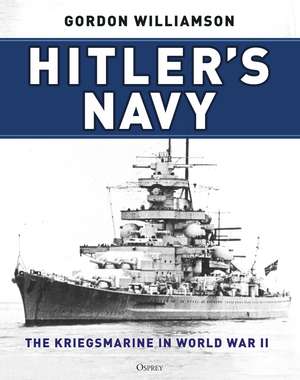
Hitler's Navy
Autor Gordon Williamsonen Limba Engleză Hardback – 3 feb 2022
Găsim în Hitler's Navy o abordare interdisciplinară care îmbină istoria politică, strategia militară și ingineria navală pentru a oferi o imagine completă a marinei germane în Al Doilea Război Mondial. Putem afirma că lucrarea semnată de Gordon Williamson reușește să explice modul în care limitările stricte impuse prin Tratatul de la Versailles au forțat, paradoxal, o inovație tehnologică accelerată în anii '30, transformând o flotă constrânsă într-o forță capabilă să amenințe rutele comerciale globale. Reținem organizarea riguroasă a volumului, care permite o navigare facilă între contextul istoric și datele tehnice. Prima parte oferă o privire de ansamblu operațională, de la campania din Polonia și invazia Norvegiei până la scufundarea cuirasatului Tirpitz în 1944. Ulterior, capitolele dedicate navelor propriu-zise clasifică arsenalul german pe categorii: nave de linie, crucișătoare, distrugătoare și submarine. Această structură completează perspectiva oferită de The German Navy 1935–45 de Nigel Thomas; în timp ce Thomas se concentrează pe uniformologie și echipamentul personalului, Williamson prioritizează platformele de luptă și dinamica lor în teatrele de operațiuni. În contextul operei autorului, acest titlu reprezintă o sinteză a cercetărilor sale anterioare, precum German Pocket Battleships 1939-45 sau German Light Cruisers 1939–45. Dacă lucrările menționate se concentrau pe nișe specifice, Hitler's Navy integrează aceste elemente într-un tablou vast, susținut de o iconografie bogată ce include fotografii de epocă și ilustrații color detaliate. Este un instrument de referință care documentează ascensiunea și declinul unei forțe navale ce a operat din Atlantic până în Oceanul Indian.
Preț: 177.30 lei
Preț vechi: 233.47 lei
-24%
Carte disponibilă
Livrare economică 20 octombrie-03 noiembrie
Livrare express 03-09 octombrie pentru 120.09 lei
Specificații
ISBN-10: 147284792X
Pagini: 256
Ilustrații: Illustrated throughout with black and white and colour photography and colour artwork.
Dimensiuni: 196 x 244 x 24 mm
Greutate: 1.1 kg
Editura: Bloomsbury Publishing
Locul publicării:London, United Kingdom
De ce să citești această carte
Recomandăm această carte cercetătorilor și pasionaților de istorie navală care caută o resursă factologică precisă despre Kriegsmarine. Cititorul câștigă o înțelegere clară a modului în care designul navelor a influențat doctrina de război germană. Este un volum esențial pentru bibliografia oricărui student la istorie militară, oferind date tehnice și operaționale într-un format vizual de excepție, util inclusiv pentru modelism istoric.
Despre autor
Gordon Williamson este un istoric militar britanic născut în 1951, specializat în forțele armate germane din perioada celui de-al Doilea Război Mondial. Cu o experiență de șapte ani în cadrul Poliției Militare Regale (TA), Williamson a transpus rigoarea documentării în peste 60 de volume publicate, multe dintre ele sub egida editurii Osprey. Printre lucrările sale de referință se numără The SS: Hitler's Instrument of Terror și The Iron Cross: An Illustrated History 1813-1945. Expertiza sa acoperă atât aspectele tehnice ale armamentului naval, în special submarinele U-boat, cât și structurile organizaționale ale forțelor de poliție militară, reflectată în lucrarea Kettenhund!.
Descriere
Hamstrung at first by the terms of the Treaty of Versailles, during the 1930s, the German Navy underwent a programme of rearmament in defiance of the restrictions, building modern warships under limitations which forced technological innovation. Submarines were strictly prohibited by the treaty, and yet, following years of covert development, they became one of the Kriegsmarine's most deadly weapons.
Blooded in the Spanish Civil War, the surface ships of the Kriegsmarine went on to play a crucial role in the opening salvoes of World War II during the invasions of Poland and Norway, although serious losses here set back plans for the invasion of Britain, and by the end of the war, only a handful of surface vessels remained to be divided up among the Allies. From the beginning of the war, but especially after the fall of France, the dreaded and extraordinarily successful U-boats stalked the Atlantic, threatening vital British shipping convoys and choking off the lifeline of munitions and supply from the US. Once Italy and Japan entered the war, German naval operations expanded to the Mediterranean and the Indian Ocean.
This highly illustrated volume is a comprehensive study of the German Navy throughout the war, from pocket battleships to torpedo boats.
Cuprins
Strategy and Doctrine
CHAPTER ONE: OPERATIONAL OVERVIEW
1939
The Polish Campaign
Commerce Raiding
1940
Denmark and Norway
Commerce Raiding
1941
Battle of the Denmark Strait
The Sinking of the Bismarck
E-boats and U-boats
1942
The Channel Dash
Operation Rösselsprung
Battle of the Barents Sea
1943
Battle of the North Cape
The Last Capital Ship: Tirpitz
1944-45
The Sinking of Tirpitz
CHAPTER TWO: HITLER'S SHIPS
Capital Ships
Pre-Dreadnoughts
The Scharnhorst Class
The Bismarck Class
Cruisers
The Deutschland Class
The Admiral Hipper Class
Light Cruisers
Auxiliary Cruisers
Destroyers
Aircraft Carriers
U-Boats
CHAPTER THREE: COASTAL AND MISCELLANEOUS VESSELS
E-boats
The Security Branch (Sicherungsverbände)
Minesweepers (Minensuchboote)
Outpost or Patrol Boats (Vorpostenboote)
Sub-Chasers (U-Jagd Boote)
General-Purpose Boats (Mehrzweckboote)
Barrier-Breakers (Sperrbrecher)
Escort Boats (Geleitboote)
Torpedo Boats
Fleet Auxiliary Supply Ships (Tross-Schiffe)
Tenders/Escorts
Miscellaneous Vessels
Accommodation Ships (Wohnschiffe)
Miscellaneous Vessels
Kleinkampfverbände der Kriegsmarine
CHAPTER FOUR: SERVICE IN HITLER'S NAVY
Seamen, NCOs and Officers
Other Service Roles
CONCLUSION
FURTHER READING
GERMAN NAVAL RANKS AND EQUIVALENTS
INDEX
Recenzii
With superb production standards and plenty of contemporary photos, this is an excellent guide to the Kriegsmarine in WWII.