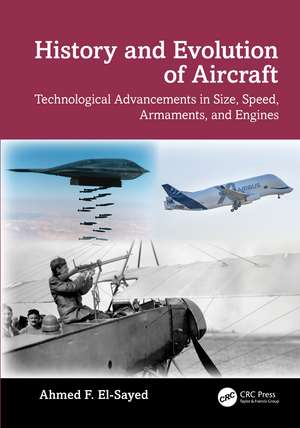
History and Evolution of Aircraft: Technological Advancements in Size, Speed, Armaments, and Engines
Autor Ahmed F. El-Sayeden Limba Engleză Hardback – 31 iul 2024
Covering current and developing applications of unmanned aerial vehicles (UAVs), the book highlights the prospects of future flying vehicles including automotives and jetpacks. It follows the transition from piston to jet engines that include shaft-based engines (turboprop, turboshaft, and propfan), turbine-based engines (turbojet and turbofan), and athodyd engines (ramjet, turbo-ramjet, and scramjet). The book explores flight vehicles’ technological advancements and evolution, including their geometrical features and performance parameters. It will also include nine appendices resembling databases for all types of aircraft.
The book will be a useful reference for academic researchers and aviation, aerospace, and mechanical engineering students taking aerodynamics, aircraft structures, aircraft engines, and propulsion courses. Aviation history enthusiasts will be interested in the scope of the content as well.
Instructors can utilize a Solutions Manual for their course.
Preț: 1280.72 lei
Preț vechi: 1561.85 lei
-18%
Puncte Express: 1921
Carte tipărită la comandă
Livrare economică 08-22 iunie
Specificații
ISBN-13: 9781032584485
ISBN-10: 1032584483
Pagini: 686
Ilustrații: 884
Dimensiuni: 178 x 254 mm
Greutate: 1.4 kg
Ediția:1
Editura: CRC Press
Colecția CRC Press
Locul publicării:Boca Raton, United States
ISBN-10: 1032584483
Pagini: 686
Ilustrații: 884
Dimensiuni: 178 x 254 mm
Greutate: 1.4 kg
Ediția:1
Editura: CRC Press
Colecția CRC Press
Locul publicării:Boca Raton, United States
V-ar putea interesa
-
 Preț: 194.24 leiRecomandat
 -
 Preț: 146.00 leiRecomandat
 -
 Flight: The Complete History of AviationR. G. Grant-16%Preț: 217.98 lei258.37 lei
 -
 Aircraft FlightR.H. BARNARD-15%Preț: 636.51 lei748.83 lei
 -
 Preț: 186.40 lei
 -
 From Wax Wings to Flying DronesNorman FergusonPreț: 90.13 lei
 -
 Fighter Aircraft, The World Encyclopedia ofFrancis CrosbyPreț: 114.31 lei
 -
 The Complete Book of SpacecraftMichael H. Gorn-21%Preț: 172.07 lei216.88 lei
 -
 Introduction to Uav SystemsPaul G Fahlstrom-18%Preț: 902.75 lei1100.92 lei
 -
 Preț: 229.28 lei
 -
 Powering the World's AirlinersReiner DecherPreț: 187.90 lei
 -
 Taking FlightLev ParikianPreț: 75.76 lei
 -
 Military Aircraft Markings 2024Stuart SchofieldPreț: 89.40 lei
 -
 Preț: 93.53 lei
 -
 AviationMatt Ralphs-17%Preț: 100.34 lei120.92 lei
 -
 The Changing Face of Aerial WarfareAnthony Tucker-JonesPreț: 103.41 lei
 -
 Military Jet AircraftRobert Jackson-21%Preț: 150.35 lei191.51 lei
 -
 Encyclopedia of Military AircraftChris McNab-15%Preț: 265.19 lei313.80 lei
 -
 Modern Military AircraftBing ChandlerPreț: 191.50 lei
 -
 Wings of ArgentinaSantiago RivasPreț: 276.36 lei
Public țintă
Academic, Postgraduate, and Undergraduate AdvancedCuprins
PART I History and Classifications of Aircraft 1. Flight Dream and Ancient History. 2. Pioneers of Man-Powered Flight Vehicles. 3. History and Classification of Civil Aircraft. 4. History and Classification of Military Aircraft. 5. History and Classification of Helicopters. 6. History and Classification of Balloons, Airships, and Flying Cars. 7. History and Classification of UAV. 8. History and Classification of Aircraft Engines. PART II Evolution of Aircraft 9. Evolution of Civil Aircraft. 10. Evolution of Military Aircraft. 11. Evolution of Helicopters. 12. Evolution of UAVs (Drones). 13. Evolution of Aircraft Engines. Appendix 1. Timeline 9000 BC–1950s AD. Appendix 2. List of Pioneer Aircraft. Appendix 3. List of Civil Aircraft. Appendix 4. List of Military Fighters. Appendix 5. List of Military Bombers. Appendix 6. List of Military Transports. Appendix 7. List of Turbofan Engines. Appendix 8. List of Helicopters. Appendix 9. List of UAV (Drones).
Notă biografică
Dr. Ahmed F. El-Sayed has been a Professor of aerospace and mechanical power engineering at Zagazig University, Egypt, since 1983. He was a Senior Engineer with the Egyptian airline EgyptAir for 10 years, working in maintenance, technical inspection, and R&D departments. He has worked as a Researcher on corporate projects with Westinghouse, USA; Rolls Royce, UK; and Wind Energy Projects at VUB, Belgium. He is a member of ten international societies and institutions and the New York Academy of Science. He is listed in Marquis Who’s Who in America, Who’s Who in Science and Engineering, and Who’s Who in Education.
Dr. El-Sayed has authored 14 textbooks, over 100 technical papers, and reports in international journals and conferences. He was a Founder and Chairman of the Aeronautical and Spacecrafts Department at Zagazig University (2015–2017) and Chairman of the Mechanical Power Engineering Department at Zagazig University (1999–2005). He was awarded the Distinguished Professor Award from Zagazig University in 2009. He was awarded the Medal of Long-Life Engineering Distinction, Egyptian Engineering Syndicate, 2017. He was also awarded the Distinction medals from the USAF Academy, USA, in 2013; MIPT, Russia, in 2015; EgyptAir Co. in 2019; Zewail City for Science and Art, Egypt, in 2020; the Chinese-Egyptian University in 2022, and the Institute of Aviation Engineering and Technology, IAET, Egypt, in 2023.
Dr. El-Sayed has authored 14 textbooks, over 100 technical papers, and reports in international journals and conferences. He was a Founder and Chairman of the Aeronautical and Spacecrafts Department at Zagazig University (2015–2017) and Chairman of the Mechanical Power Engineering Department at Zagazig University (1999–2005). He was awarded the Distinguished Professor Award from Zagazig University in 2009. He was awarded the Medal of Long-Life Engineering Distinction, Egyptian Engineering Syndicate, 2017. He was also awarded the Distinction medals from the USAF Academy, USA, in 2013; MIPT, Russia, in 2015; EgyptAir Co. in 2019; Zewail City for Science and Art, Egypt, in 2020; the Chinese-Egyptian University in 2022, and the Institute of Aviation Engineering and Technology, IAET, Egypt, in 2023.
Recenzii
Dr. Ahmed F. El-Sayed’s History and Evolution of Aircraft is a valuable and timely contribution to the field of aviation and more. From the title, I was under the impression that the is a documentary for the evolution of aircraft and its industries. Once I started, I found that the book serves equally well three different purposes:
i. A comprehensive reference for aviation historians documenting both the technology and operations of aircrafts over the years.
ii. A well-written textbook for engineering students with problems and questions after each chapter. I also like the feature on digital questions embeded in the electronic version of the book.
iii. A research report developed with many years of dedicated research and teaching of Dr. El-Sayed. The very large number of charts and tables provides a great benefit for researches in the filed of aviation.
Rather than offering a simple catalog of aircraft types and technologies, this book provides a well-rounded account of how aviation has developed over time—technically, historically, and culturally.
Beginning with early ideas of flight and moving through key innovations in the 19th and 20th centuries, the book leads readers all the way to the present era of advanced propulsion and aerospace systems. The detailed discussion of aircraft engines—from early turbofans, turboprop and turbo-ramjet, …engines to ramjets, and scramjets—is especially strong, making the book a useful technical resource for engineers as well as a compelling study for anyone interested in the evolution of modern flight.
One of the book’s strengths is its ability to place aviation within a larger context. Dr. El-Sayed shows how war, commerce, exploration, and scientific progress have all shaped aircraft development. His treatment of topics such as unmanned aerial vehicles and rotary-wing aircraft adds further depth. The appendices—which include performance data, historical timelines, and system classifications—make this an indispensable tool for both educators and researchers.
Dr. El-Sayed’s writing reflects not only technical command but also the kind of clarity and organization that comes from years of experience in both industry and academia. The book is well-suited for use in classrooms, libraries, research institutes, and professional settings.
Given the importance and richness of this work, I would also encourage Dr. El-Sayed to consider translating it into other major languages and adapting the content into audiovisual formats. Doing so would make the book more accessible to a wider international audience, including students, enthusiasts, and members of the general public who may not come from an engineering background but are eager to understand the story of flight.
This is a major achievement—scholarly, readable, and deeply informative—and I believe it will continue to serve as a foundational resource for years to come.
Mohamed El-Mehalawi, Professor of Supply Chain Management at Nile University, Giza, Egypt.
First, I would like to commend Professor El-Sayed on his effort in writing and introducing this valuable book to all who are in the industrial and academic fields.
The information in this book covers almost all what needed to understand the history of aviation for personnel involved. It explains in great and precise details that history and its components.
As an Aerospace Engineer and being involved in the industry for the last 30+ years, I recommend this book for all those future engineers and educators. The book is well written and structured to provide the necessary information in easy and affordable ways.
All the best to the educators and future and current engineers. This is their treasured information for success.
Malath Arar
Aerospace engineer & Adjunct Professor
i. A comprehensive reference for aviation historians documenting both the technology and operations of aircrafts over the years.
ii. A well-written textbook for engineering students with problems and questions after each chapter. I also like the feature on digital questions embeded in the electronic version of the book.
iii. A research report developed with many years of dedicated research and teaching of Dr. El-Sayed. The very large number of charts and tables provides a great benefit for researches in the filed of aviation.
Rather than offering a simple catalog of aircraft types and technologies, this book provides a well-rounded account of how aviation has developed over time—technically, historically, and culturally.
Beginning with early ideas of flight and moving through key innovations in the 19th and 20th centuries, the book leads readers all the way to the present era of advanced propulsion and aerospace systems. The detailed discussion of aircraft engines—from early turbofans, turboprop and turbo-ramjet, …engines to ramjets, and scramjets—is especially strong, making the book a useful technical resource for engineers as well as a compelling study for anyone interested in the evolution of modern flight.
One of the book’s strengths is its ability to place aviation within a larger context. Dr. El-Sayed shows how war, commerce, exploration, and scientific progress have all shaped aircraft development. His treatment of topics such as unmanned aerial vehicles and rotary-wing aircraft adds further depth. The appendices—which include performance data, historical timelines, and system classifications—make this an indispensable tool for both educators and researchers.
Dr. El-Sayed’s writing reflects not only technical command but also the kind of clarity and organization that comes from years of experience in both industry and academia. The book is well-suited for use in classrooms, libraries, research institutes, and professional settings.
Given the importance and richness of this work, I would also encourage Dr. El-Sayed to consider translating it into other major languages and adapting the content into audiovisual formats. Doing so would make the book more accessible to a wider international audience, including students, enthusiasts, and members of the general public who may not come from an engineering background but are eager to understand the story of flight.
This is a major achievement—scholarly, readable, and deeply informative—and I believe it will continue to serve as a foundational resource for years to come.
Mohamed El-Mehalawi, Professor of Supply Chain Management at Nile University, Giza, Egypt.
First, I would like to commend Professor El-Sayed on his effort in writing and introducing this valuable book to all who are in the industrial and academic fields.
The information in this book covers almost all what needed to understand the history of aviation for personnel involved. It explains in great and precise details that history and its components.
As an Aerospace Engineer and being involved in the industry for the last 30+ years, I recommend this book for all those future engineers and educators. The book is well written and structured to provide the necessary information in easy and affordable ways.
All the best to the educators and future and current engineers. This is their treasured information for success.
Malath Arar
Aerospace engineer & Adjunct Professor
Descriere
History and Evolution of Aircraft reviews the history of aviation from early history to present day, including milestones of civil and military airplanes, helicopters, drones, balloons, and airships. World conflicts are reviewed with a thorough description of the manned and unmanned aircraft used.